Forest Resource
Overview
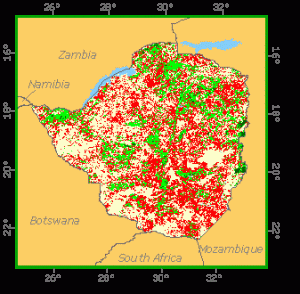
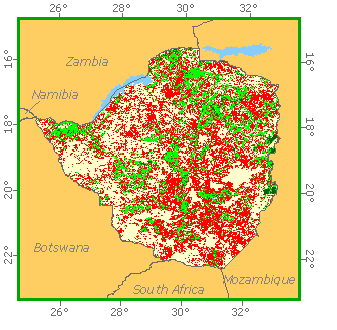
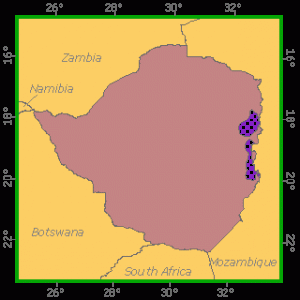
Zimbabwe is moderately forested with around 22 percent forest cover and an additional 44 percent of other wooded land. Areas of closed natural forest are rare, with the predominant vegetation being “miombo” woodland, an association of Brachystegia spiciformis and Julbernardia spp. Mopane (Colophospermum mopane) woodland occurs on the northern Zambezi depression and the Limpopo Valley on the southern border. Small remnants of subtropical high forest remain in the Eastern Highlands. Prominent species include red mahogany (Khaya nyasica) and ironwood (Androstachys johnsonii). Zimbabwe has established significant areas of plantation forests with the most common species being Pinus patula, Eucalyptus spp. and Acacia mearnsii. Zimbabwe has a well-established network of more than 40 protected areas, including the 1.5 million hectare Hwange National Park. Around 12 percent of Zimbabwe’s forest area is protected.
Forest Types

Geographic Description
The Republic of Zimbabwe, located in southern Africa, is bounded on the north by Zambia and Mozambique, on the east by Mozambique, on the south by South Africa and on the south-west and west by Botswana. The total area of the country is 390 759 km2.
Much of the country is a high, rolling plateau from 900 to 1 500 m in elevation, part of the great central and southern African plateau. A broad ridge, known as the High Veld, runs from south-west to north-east across the country. The land slopes downward to the north to the Zambezi River and to the south to the Limpopo River. These regions, with an elevation of about 1 000 m, are known as the Middle Veld. The Low Veld consists of sandy plains in the Zambezi, Limpopo, and Sabi river basins. The highest point in the country, Mount Inyangani (2 592 m), lies in the mountains along the eastern border.
Although Zimbabwe lies in the Tropics, its climate is moderated by its high elevation. The average temperature is 16° C in July (winter) and 21° C in January (summer). The average annual rainfall is about 890 mm in the High Veld and less than 610 mm in most parts of the Middle Veld. Most rainfall occurs during the summer from October to April.
Forest Industry