Forest Resource
Overview
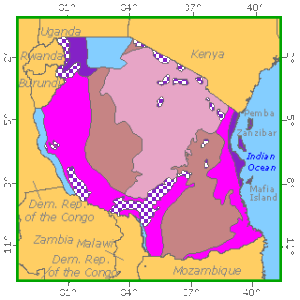
Tanzania is moderately forested with around 37 percent forest cover and an additional 39 percent other wooded land. Tanzania has relatively small areas of closed forest with the bulk of these being montane or submontane forests with dominant species being Ocotea usambarensis, Juniperus procera and Cassipourea malosana. Lowland closed forests are generally semi-deciduous secondary forest, bamboo or mangroves. Open forests are much more extensive with “miombo” woodland being the predominant type. Brachystegia spiciformis and Julbernardia spp. are the characteristic miombo species. The extensive Itigi thicket comprises a large area of shrubland on the central plateau. Tanzania has established significant areas of plantation forest with Pinus spp. and Cupressus lusitanica common. Tanzania has an extensive network of national parks, game reserves and game controlled areas. Around 15 percent of Tanzania’s forests are inside protected areas
Forest Types

Geographic Description
The United Republic of Tanzania is located on the east coast of Africa between parallels 1° S and 12° S and meridians 30° and 40° E, extending from Lake Tanganyika to the Indian Ocean. It is bounded on the north by Kenya and Uganda, on the east by the Indian Ocean, on the south by Mozambique, Malawi, and Zambia, and on the west by the Democratic Republic of the Congo (formerly Zaire), Burundi, and Rwanda. Tanzania has an area of 945 090 km2.
The land rises from the coastal strip to about 350 m and continues rising in rolling plains to the central plateau with an elevation of around 1 200 m. To the west this plateau drops sharply to Lake Tanganyika, formed by the western branch of the Great Rift Valley. The eastern branch dissects the elevated plains of central Tanzania from Lake Natron in the north to Mbeya in the south, where it joins with the western branch at the north end of Lake Nyasa. Volcanic mountains and steep hill ranges rise up from the central plateau. These uplands occur along a great figure G, beginning with a cluster composed of the Crater Highlands, various small volcanoes, Mt. Meru and Mt. Kilimanjaro (5 895 m) in the north-east. It continues via the Usambaras near the coast and curves inland along the Ngurus, Ulugurus and the Usagaras toward the southern Highlands and volcanic Rungwe. From here the mountain line bifurcates, one branch going southward into Malawi, the other curving north-westward to the Ufipa Highlands and ending at Kungwe east of Lake Tanganyika. In the north-west part of the country, a series of hills is contiguous to Rwanda and Burundi.
Mean annual rainfall varies from about 400 mm to 2 500 mm and over, but both extremes occur only in restricted areas. The dry season has a duration of 4 to 6 months. It is shorter and less severe in the north-east than in the south. . High temperatures along the coast average 29° C year around. The plateaus have average daytime highs of 29° C and cool nights.
The country has the following climatic zones:
- Lowland zone, with three subzones: Wet (1 800 mm rainfall and up to 500 m elevation), moist (1 000 to 1 800 mm rainfall and up to 1 000 m elevation) and dry (750 to 1 000 mm rainfall and up to 1 000 m elevation);
- Highland zone, with two subzones, the moist highlands (1 000 to 1 800 mm, occasionally up to 2 500 mm of rainfall and from 1 200 to 2 100 m elevation) found on the eastern and southern slopes of mountains and the dry highlands, with 625 to 1 000 mm of rain, from 1 500 to 2 100 m on the drier western mountain slopes;
- Plateau zone, with a moist subzone (1 000 to 2 000 mm of rain, and located from 900 to 1 500 m elevation) occurring around the Lake Victoria basin and a dry subzone (625 to 1 000 mm of rain, elevation from 900 to 1 500 m) covering a very large area in central and western Tanzania;
- Semi-desert zone, with less than 625 mm of rainfall. A great variation in rainfall intensity from one year to another is also characteristic.

Forest cover Vegetation
Introduction
A wide range of ecological conditions is responsible for an interesting pattern of vegetation from tropical forest to alpine moorland, though there is little of either extreme. Closed forests are scarce.
Forest Industry
Closed Forests
Broadleaved
Closed broadleaved forests can be divided into montane and submontane forests and lowland forests including “groundwater forest”. Nearly all the closed forests are confined to the uplands, with the most valuable parts occurring in two regions, the larger covering Mts. Meru and Kilimanjaro and the West Usambaras, the smaller the East Usambaras (Lined and Morrison, 1975).
The majority of the upland forests is in the form of isolated blocks and is of similar nature as those found elsewhere on the East African uplands, namely Ocotea forest, Juniperus forest, bamboo thicket and Cassipourea forest.
- The Ocotea-Podocarpus forests occur along the West Usambara Mountains and in a zone on Mt. Kilimanjaro (not on north slopes). The most important tree species are Ocotea usambarensis, Podocarpus usambarensis, Entandrophragma excelsum and Prunus africana. The forest structure consists of three layers with an understorey of shrubs (mainly Rubiaceae). Forests of similar composition, but without Ocotea, occur on Mt. Meru, on the Mbulu highlands, on the Ufiome-Mikiulu uplands and on the Ifiome and Hanang Mountains. A forest composed almost entirely of Ficalhoa laurifolia and Afrocrania volkensii covers large areas of the Mporoto and Rungwe Mountains.
- In Tanzania, Juniperus forest occurs on the drier north-west slopes of Mt. Kilimanjaro, Mt. Meru and the West Usambaras. Some authors believe that the Juniperus forest was in the past much more widespread but that competition from less light demanding species has restricted it to dryer sites. In most places Juniperus is accompanied by large trees of Olea africana (in the higher parts) and Olea welwitschii (on the lower parts) and by smaller trees of broadleaved species.
- Formations of mountain bamboo (Arundinaria alpina) are found in Tanzania on Mts. Meru and Rungwe, on the Ulugurus and the Livingstone Mountains (8 000 ha), and in the Iringa Highlands and the Mporotos. Small patches are noted in forest areas of southern Tanzania.
- Between 1 200 and 2 750 m a Cassipourea malosana forest occurs, accompanied by Albizia gummifera. Heights are up to 21 m. The most important area is found on Mt. Kilimanjaro. Other blocks of this forest have been reported at Mufundi, Ukwene, Myumbaniku, Uzungwa, Dabaga, and the west side of Rungwe and Umalita.
- The lowland forests in many cases consist of secondary semi-deciduous and low-growing stands, merging between 650 and 1 000 m on the eastern face of the mountains into evergreen rainforest and occupying only modest areas in the Usambara, Nguru, and Uluguru Mountains and parts of Zanzibar. The lowland bamboo (Oxytenanthera abyssinica) occurs from the south of Iringa to the Lini district up to 615 m altitude, and also in the form of widely spaced clumps in the miombo woodland. The so-called ground-water formations consist of gallery forest, often the only remnants of once extensive forests in the lower zones.
- Mangroves occur along the continental coast and on Zanzibar island.

Open forests
Broadleaved
The upper zone of the upland forest belt usually consists of low stature (12 to 18 m) woodland. On the southern slopes of Mt. Meru, Hagenia woodland can be found, often accompanied by Rapanea rhododendroides.
The so-called miombo woodlands, with generally small trees, occupy extensive areas. They extend from sea level up to 1 600 m, with an annual rainfall of 500 to 1 200 mm and one rainy season. They occupy the central plateau in the north and the south-east, separated by a “miombo-free” corridor about 500 km long and 60 to 120 km wide. The well-drained ridges bear miombo woodland on their upper and middle slopes; the valley bottoms are occupied by grasslands and, in between, bushland or wooded grassland with Combretum and other species. Stands of borassus palm occur where there is shallow ground water. The most important species is Brachystegia spiciformis, together with Julbernardia spp. Trees are normally deciduous. Other genera include Afzelia, Albizia, Burkea, Combretum, Dalbergia, Erythrophleum, Monotes, Ostryoderris, Pericopsis, Pterocarpus, Swartzia, Strychnos, Sterculia and Uapaca. The two most important characteristics of the miombo trees are their resistance to fire and the annual dieback of seedlings.
Green shallow valleys break the monotony of the miombo, part of extensive drainage systems locally known as “mbugas”. The mbugas have scattered termite mounds and a characteristic tree vegetation, including muninga (Pterocarpus angolensis) and African blackwood (mpingo or poyi) (Dalbergia melanoxylon).
Other trees common in the grasslands and sometimes in farming woodlands belong to the genus Acacia: A. xanthophloea (fever tree), A. tortilis, A. abyssinica, A. gerrardii and others.
In the flood plains of the Igombe and Ugala rivers, and in other riverine communities, palm grassland occurs with borassus and, sometimes, crooked palm trees of Hyphaene spp. (doum palm).
In the northern and central provinces of Tanzania and the central highlands, where upland forest has given way to grassland, a community is found called Protea-Dombeya highland grassland, with the tree species Brachystegia microphylla, Uapaca kirkiana, Aeschynomene burtii, Erythrina abyssinica, Dombeya quinquisete and Cussonia arborea.
Other wooded land
Shrubs
Near the eastern edge of the central plateau of Tanzania occurs the so-called Itigi thicket consisting of coppicing shrubs ranging from 2.5 to 5 m in height with occasionally a flat-topped tree up to 7.5 m projecting through its canopy.
References
Lined, E. M. and M. E. S. Morrison (1975). East African vegetation. Longman, London.