Forest Resource
Overview
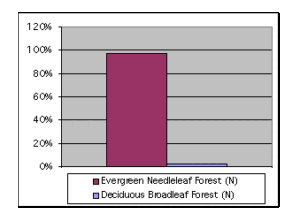
Sweden is situated in Scandinavia between Norway and Finland, with a long coastline on the Baltic Sea. Apart from mountains in the north west, the terrain is relatively flat. Climatic conditions range from temperate in the south to boreal in the north. Forest and other wooded land accounts for three quarters of the land area. More than three quarters of the forest is available for wood supply, the remainder is not available mainly for conservation and protection reasons. As much as one sixth of the forest is classed as undisturbed by man, most of the rest as semi-natural, with small areas of plantations. Many of the forests in south and central Sweden were restored since the mid-19th century on abandoned agricultural land. Coniferous species, of which the most important are Scots pine and Norway spruce, account for more than four fifths of the growing stock volume. Birch is the main broadleaved species, with some aspen, alder, oak, beech and ash. Net increment per hectare, at about the European average, is higher than fellings, resulting in a steady expansion in growing stock. Half the forest is owned by private individuals, a further two fifths by forest industries and most of the remainder by public institutions other than the State. Hunting, which is closely regulated, and nature conservation are major forest functions, as is the collection of non-wood forest products, but the supply of wood to the large wood-processing sector remains the most important individual function.
Forest Types
Geographic Description
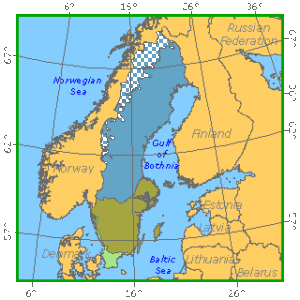
The Kingdom of Sweden is located on the Scandinavian Peninsula in northern Europe. It is bounded on the north and west by Norway, on the north-east by Finland, on the east by the Gulf of Bothnia and the Baltic Sea, and on the south-west by the Skagerrak, Kattegat and Öresund straits. Its area is 452 180 km2. Sweden includes numerous islands, the largest of which are Gotland and Öland in the Baltic Sea.
The Kolen Mountains lie in the north-west and form part of the boundary with Norway. The highest point in the range, and the highest point in Sweden, is atop Mount Kebnekaise (2 111 m). The land is completely treeless above about 500 m in the northernmost part of the mountains. Some birch trees grow on the warmer, lower slopes. Hundreds of small glaciers cover the higher slopes of the range. To the east of the mountains is a long plateau, which slopes east to a coastal plain bordering the Gulf of Bothnia. Many rivers, including the Ångermanälven, Dalälven, Trysilelva, Ume älv and Torne älv, flow south-east to the Gulf of Bothnia.
In south-central Sweden is a hilly lowland with many lakes, including the largest lakes in the country, Lake Vänern and Lake Vättern. Lake Vänern covers 5 584 km2 and is one of the largest lakes in Europe. An upland region, known as the Småland highlands, is located south of the lowland. The plains of Skåne occupy the south-eastern tip of the Scandinavian Peninsula.
The climate is moderated by oceanic influences and is comparatively mild, considering the northern latitude. The climate of northern Sweden is considerably more severe than that of the south both because it is farther to the north and because the mountains cut off the moderating marine influence. In the extreme south of Sweden, temperatures in January and February, the coldest months, average 0° C. In Kiruna, in the far north of the country, temperatures average about -12° C during these months. In July, Sweden’s warmest month, temperatures average from 15 to 17° C in the south, and 12 to 14° C in the north. In winter, eastern air masses may lower the temperature to -23° C in Stockholm, and to -43° C in the north.
Precipitation is relatively low throughout Sweden except for on the higher mountain slopes. In Stockholm the average annual precipitation is 550 mm; in Göteborg it is 670 mm. Rainfall is heaviest in the south-west and in the Kolen Mountains along the Norwegian border. Most rain falls in the late summer. Heavy snows are common in central and northern Sweden
Ecological Zones
Forest Industry
Management
The forest sector is an important part of Sweden´s economy, although agriculture, which once accounted for most of Sweden´s economy, now employs less than 3% of the labour force. About 80% of forest areas are available for wood supply. Some 20% of forest and other wooded lands are public and 80% are privately owned. Over the centuries, lands with rich soils, especially in southern regions and mid-Sweden, have been converted from forests to other land uses, mainly agriculture. The forest management has also changed the composition of the forests. The naturalness of Swedish forests is reported as 16% forest areas undisturbed by man, 82% semi-natural forests, and 2% plantations.