Forest Industry
Overview
Suriname is one of the world´s most extensively forested countries, with some 95 percent of the country´s land area covered by forests. The forests are predominantly dry highland tropical rainforest with areas of wet lowland forest in the coastal belt, and a belt of dryland savannah forest dividing the two. The main canopy species in the highland forests include Qualea spp., Protium spp., Eschweilera spp. and Licania spp.. Mangroves occupy a large proportion of Suriname´s coast and also grow along the major rivers. Almost all forest land in Suriname is state-owned. The vast majority of Suriname´s forest remains pristine although several significant new logging concessions have been recently granted. Suriname has a network of nature parks and reserves formally protecting around 7 percent of the country´s land area.
Forest Types

Geographic Description
The Republic of Suriname is situated on the north coast of South America. It is bounded on the north by the Atlantic Ocean, on the east by French Guiana, on the south by Brazil and on the west by Guyana. It covers an area of 163 270 km2.
The Courantyne River forms its western border with Guyana and the Marowyne River forms the boundary in the east with French Guiana. Apart from these, there are six major rivers, flowing generally from south to north, turning westwards in the coastal area.
The interior of the country consists of a dissected peneplain, sloping gently towards the low-lying coastal region between ranges of hills and low mountains (maximum elevation 1 280 m). Topography varies from undulating to steep and rugged.
A geographic division into four main natural regions is generally made that is also useful for soils and vegetation:
- The young coastal plain, increasing in width from 10 km in the east to 50 km in the west that can intrude deeply locally into the old coastal plain. It forms by far the most important agricultural zone of the country. Large areas of this region are at sea level or below;
- The old coastal plain does not form a continuous zone but consists of hundreds of undulating surfaces, separated by creek systems and swamps belonging to the young coastal plain. There is some farming and cattle;
- The “Zandery” landscape is a dissected plain, rising from 10 to 70 m. It consists of bleached white quartz sands and unbleached yellow or brown sands, forming a continuous belt across the country. Some shifting cultivation is practised;
- The old basement complex forms the remaining 80 percent of the country and consists of lowlands south of the coastal sedimentary basis. This zone corresponds with the “lowland region” and the “southern uplands” in Guyana. It forms part of the pre-Cambrian Guyana shield. However, sandstone mountains exist only in a few places in the central ranges of the country, in contrast with Guyana where the Roraima and Pakaraima mountains extend over a large area.
The climate is tropical. Average temperature is around 27° C all year round. Mean annual rainfall ranges from 2 000 to 2 500 mm, with the driest month (October) generally receiving over 60 mm. Locally, rainfall may be higher (in the central mountain ranges) or lower (in a narrow coastal strip and in the south-western part of the country) than the indicated range. The main rainfall occurs from April to July or August, with another ill-defined wet season in December-January.
Ecological Zones
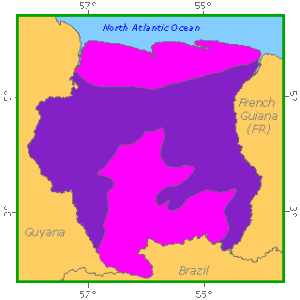

Resources Forest cover Vegetation
Natural Woody Vegetation Description
Introduction
The following vegetation classification was adapted in conjunction with the classification used for Guyana and based on (Lindeman and Moolenaar, 1955) and (Vink, 1970).
Closed Forest
Broadleaved
Rainforest (called in Lindeman and Moolenaar (1955) “hoog drooglandbos”, “high dryland forest”), in its most abundant form, has three or four storeys with emergents up to 45 m. The lower storey reaches 25 to 30 m. Underneath is undergrowth consisting of small trees and poles. In the north-western part of Suriname the emergents are not so conspicuous, the forest is less dense and generally the number of storeys is limited to two or three. Palms are common, including paramaka (Astrocaryum paramacca) and boegroemaka (A. sciophyllum), and Attaleasp. in the undergrowth and koeboe (Oenocarpus bacaba) in the canopy. Lianas are fairly uncommon. The total number of species over 25 cm diameter is around 140 with about 50 different ones per hectare. The forest is evergreen. Very often only a few species are dominant to a high degree. Among these are Qualeasp., Protium sp., manbarklak (Eschweilera sp.), wallaba (Eperua falcata), Micropholissp., foengae (Licania sp.), Pouteria surinamensis, Piptadenia suaveolens, Vouacapoua americana, Tetragastrissp., Inga sp. Dicorynia guianensis. Underneath Vochysiasp., Lecythis sp. and Couratari sp., among others, occur. Goupia glabra, Cecropia sp. and Jacaranda copaia occupy natural clearings.
A somewhat poorer form of rainforest called “ritsbos” consists of two storeys up to 30 m. Palms form the undergrowth. In the upper storey Hymenea courbaril, Cedrela odorata, Simaruba amara and Licania sp. occur. The latter become dominant in the east of the country.
On shallow soils patches of “climber forest” without storeys may appear. Trees are widely spaced and openings are filled with lianas and climbers.
Dry evergreen forest (“Hoog savannebos”, “high savanna forest”) is two-storeyed, with a closed upper canopy reaching 25 to 30 m in height. Big trees are scarce. Palms are few and small. Dominant species are the same as in the rainforest. It occurs on deep white sands. When one (or more) species is particularly dominant the following types are distinguished:
- The wallaba forest with Eperua falcata occurring in all sizes;
- The dakama forest with Dimorphandra conjugata. In this forest a very thick organic layer is formed on the mineral soil causing a fire hazard. Herbs are absent;
- The dakama-wallaba forest;
- The dakama-savanneyzerhartbos with Swartzia bannia.
In the other mixed types of dry evergreen forest species of the genera Protium, Bombax, Ocotea, Nectandra, Licaria, Eschweilera and Licania are present.
Xeromorphic woodlands (“laag savannebos”, low savanna forest) do not show any storeys. Height varies from 10 to 20 m. This type of forest is very dense and closed and more homogeneous than the previous ones. Important species are Clusia fockaena, Licania incana, Bombax flaviflorum, Swartzia bannia, Ocoteasp. and Protium sp.
The “bergsavannebos” or mountain savanna forest, corresponds to the xeromorphic rainforest in Guyana, and occurs on bauxite hills with laterisation or in the mountains of the interior where soils are thin and shallow. Predominant families are Myrtaceae and Bromeliaceae. It has no pronounced storeying and is rather low. The floristic composition is different from the previous type.
Marsh forests are characterised by insufficient drainage, causing seasonal fluctuation in moisture conditions from very wet to very dry. The upper canopy is somewhat irregular, with the height between 15 and 20 m and a very dense understorey 5 to 15 m high. This forest is quite rich in species, the most important ones being krapa (Carapa guianensis), nekoehoedoe (Clathrotropis brachypetala), hoepelhout (Copaifera guianensis), manbarklak, nickerie basralocus (Lonchocarpus hedyosmus), possum (Hura crepitans), kankantri (Ceiba pentandra), soemaroeba (Simaruba amaro), goebaja (Psidium spp.), groenhart (Tabebuia serratifolia), foengoe, mora (Mora excelsa) and morototo (Schefflera paraensis). In the lower storey occur Rinorea sp., Gustavia sp., and Jacaranda rhombifolia. There is a well- developed herb layer. Epiphytes are very common. Palms are well represented, including maripa (Maximiliana maripa), pina (Euterpe oleracea), koemba, maurisie (Mauritia flexuosa) in the upper storey, and in the under storey kiskismaka (Bactris sp.), tas (Geonoma sp.), paramaka and boegroemaka. In the western part concentrations of troeli (Manicaria saccifera) can be found


Marsh forests show a considerable diversity according to local conditions. Three types are mentioned in Lindeman and Moolenaar (1955):
- Riparian forest (oeverbos) along the rivers, with such typical species as kroebara (Pentaclethra macroloba), moeserki (Zygia sp.), rode locus (Hymenaea courbaril) and oeverwallaba (Eperua sp.). Locally, palms are very dominant;
- The mora forest is considered a special case of riparian forest in which Mora excelsa is dominant in all layers. It occurs in the western part of Suriname along seasonally inundated river plains. Its eastern limit lies more or less along the Saramaca river. The canopy reaches a height of 35 to 40 m;
- Creek forest occurs in the hill country and is strongly influenced by the surrounding rain forest. Wallaba is well represented in most cases;
- The possum forest occurs locally in the coastal area, where possum (Hura crepitans) is dominant. It is one of the trees attaining the largest diameter in Suriname (up to 250 cm);
- The krapa forest in which Carapa guianensis is dominant, especially in western Suriname along the Corentyne river.
- Swamp forests (zwampbos) are marked by very wet conditions all year round. However, the shorter the time of inundation, the more it resembles rain forest.
- High swamp forest is at least 20 m high, with two or more storeys. The canopy is fairly closed and consists of small crowns between 18 and 30 m high. Characteristic species are baboen (Virola surinamensis), mataki (Symphonia globulifera), mierenhout (Triplaris surinamensis), watrabébé (Pterocarpus officinalis), zwamppanta (Tabebuia insignis) and kanamboelie (Simaba multiflora). In the understorey typical species are Diospyros sp. and Bactris sp. Many trees have spreading horizontal branches. The herb layer is present but its characteristics vary. The palm, pina (Euterpe oleracea), occurs abundantly. The following types are distinguished according to location:
– High swamp forest on recent formations of the young coastal plain and along the rivers. It is characterised by an abundance of mierenhout and consists of only a few species;
– High swamp forest on the other formations of the young coastal plain characterised by baboen and mataki. There is accumulation of peat (pegasse), sometimes several meters deep;
– High swamp forest on the lower parts of the old coastal plains, the low sites behind the riverbanks and on creek grounds. This is a richer forest and no species are very dominant. Peat is present only intermittently.
- Low swamp forest varies from an open scrub to a low closed forest with one storey from 10 to 15 m high. Palms and epiphytes are rare. The water is brackish or fresh. Soils are heavy clay. The forest has no large trees and is not rich in species. Watrabébé, zwamppanta, mierenhout, zwampzuurzak (Annona glabra), taproepa (Genipa americana), kanamboeli, pruim (Chrysobalanus icaco) and Ficus sp. are prevalent.
This category also includes a forest type with a totally different physiognomy, where the palm Mauritia flexuosa forms a 20-m-high canopy with smaller trees of pruim and Clusia nemorosa.
- Mangrove forests are one storeyed and closed, 10 to 25 m high. The undergrowth is restricted to ferns (Acrostichum sp.). Two types are distinguished:
- The parwa forest, along the coast with Avicennia nitida, and
- The mangro forest, along the major rivers, with Rhizorphora mangle and patches of low trees of Laguncularia racemosa.
In the major river mouths a mixed type of mangrove occurs with species such as Carapa guianensis and Pterocarpus officinalis.
Other wooded land
Shrubs
Towards the open savanna the xeromorphic woodlands change into a scrub (called “struiksavanne”) with the same floristic composition. Only Bombax flaviflorum appears as a small tree.
References
Lindeman, J. C. and S. P. Moolenaar (1955). Voorlopig overzicht van de bostypen in het nordelijk deel van Suriname. Paramaribo.
Vink, A. T. (1970). Forestry in Surinam. Paramaribo.
Forest Industry
Resources Forest cover Vegetation
Natural Woody Vegetation Description
Introduction
The following vegetation classification was adapted in conjunction with the classification used for Guyana and based on (Lindeman and Moolenaar, 1955) and (Vink, 1970).
Closed Forest
Broadleaved
Rainforest (called in Lindeman and Moolenaar (1955) “hoog drooglandbos”, “high dryland forest”), in its most abundant form, has three or four storeys with emergents up to 45 m. The lower storey reaches 25 to 30 m. Underneath is undergrowth consisting of small trees and poles. In the north-western part of Suriname the emergents are not so conspicuous, the forest is less dense and generally the number of storeys is limited to two or three. Palms are common, including paramaka (Astrocaryum paramacca) and boegroemaka (A. sciophyllum), and Attaleasp. in the undergrowth and koeboe (Oenocarpus bacaba) in the canopy. Lianas are fairly uncommon. The total number of species over 25 cm diameter is around 140 with about 50 different ones per hectare. The forest is evergreen. Very often only a few species are dominant to a high degree. Among these are Qualeasp., Protium sp., manbarklak (Eschweilera sp.), wallaba (Eperua falcata), Micropholissp., foengae (Licania sp.), Pouteria surinamensis, Piptadenia suaveolens, Vouacapoua americana, Tetragastrissp., Inga sp. Dicorynia guianensis. Underneath Vochysiasp., Lecythis sp. and Couratari sp., among others, occur. Goupia glabra, Cecropia sp. and Jacaranda copaia occupy natural clearings.
<