
Forest Resource
Overview
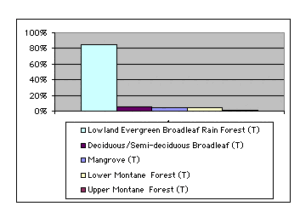
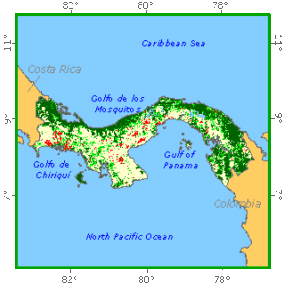
Panama is moderately forested with around 40 percent forest cover. The most prevalent vegetation type is semi-deciduous tropical moist forest, with forest types divided into lowland, sub-montane and montane forest. The forests can be further differentiated according to the presence or absence of cuipo (Cavallinesia platanifolia). The most important timber species is Cativo (Prioria copaifera) mainly from Darien province. At higher altitudes oak forests (primarily Quercus roblito and Q. mameicillo) are common. Significant areas of mangroves are present, particularly in the Gulf of San Miguel on the Pacific coast. Panama has a modest area under plantation forest, comprised mainly of pine species. Panama has a large network of protected areas. Almost a quarter of Panama´s land area is protected in the country´s 50 parks and reserves.
Forest Types
Geographic Description
The Republic of Panama is the most southerly country in Central America. It is bounded on the north by the Caribbean Sea, on the east by Colombia, on the south by the Pacific Ocean and on the west by Costa Rica. It covers an area of 75 520 km2.
There is a spine running down the whole of the Panama isthmus in the form of a central mountain range, starting in the west in Costa Rica, reaching heights of about 3 000 m (Mounts Picacho and Santiago) and decreasing to low mountains at the Panama Canal. On the other side of the canal, the ground rises again, forming the Portobello and San Blas mountains, but elevations do not exceed 1 000 m.
The Baru volcano at 3 475 m, Panama’s highest point, is found near the border with Costa Rica on the western Pacific coast. The Azuero chain and the Palmas mountains do not rise above 1 600 m. The Darien hills (800 m) lie east of the canal, stretching to the Pacific coast, while the San Blas mountains continue as far as Colombia in the border mountains, forming an arc.
Most of Panama has a hot, humid tropical climate, with cooler temperatures at higher elevations. Prevailing winds carry moisture from the Caribbean Sea to the northern coast, making it wetter than the Pacific side. The northern slopes of the mountains receive an average of 2 970 mm of rain a year, mostly during the wet season from May to December. Pacific winds bring drier air to the southern coast, which receives up to 1 650 mm a year. The average temperatures in coastal areas are 23° to 27° C; at higher elevations they average about 19° C.
Forest Industry
Resources Forest cover Vegetation
Natural Woody Vegetation Description
Closed Forests
Broadleaved
Heterogeneous forests
- Heterogeneous forests with Cavallinesia platanifolia. These are found in Holdridge’s “tropical moist forest”, “tropical wet forest” and “premontane wet forest” life zones, and are typical of the lowlying and medium-altitude parts of Darien (in the east of the country), where they cover considerable area. These stands are heterogeneous, always dominated by Cavallinesia platanifolia, in some cases more closed than others and with average heights of over 25 m.
The very closed stands usually have three storeys. Cavallinesia platanifolia is often found in combination with Anacardium excelsum in the dominant storey. The lower storey contains various species of palm. There is a sparse undergrowth.
More open Cavallinesia platanifolia stands differ from the closed ones in terms of the density of the dominant and dominated storeys, with the co-dominant species becoming more scarce, while Cavallinesia appears as abundantly as in the more closed forests. The greater openness of the dominant storey means that palms are much more common in the understorey and lower storey. The undergrowth is thick and sometimes contains thorn bushes, becoming almost impenetrable.
- Heterogeneous forests without Cavallinesia. These are the most extensive forests in the country, differing in appearance and composition depending on location, terrain and environmental conditions.
Tropical moist forest” and “premontane wet forest” reach heights of over 25 m in Darien, although not as tall as Cavallinesia forest. This type has three storeys, with Anacardium excelsum always present in the dominant storey, associated mainly with Carapa guianensis, Dipterix oleifera, Virola sp. and Dialyanthera sp.. The second storey is made up of more poorly formed trees with smaller diameters, while the third storey is very sparse for lack of light. The undergrowth is relatively open.
The fairly open forests of Darien differ from the previous type in terms of the greater openness of the dominant storey and the proliferation of understoreys and undergrowth. Anacardium excelsum is less common here, while Apeiba aspera and Pithecolobium angense are more common. The understorey is very profuse and contains many palms, while the undergrowth is very thick.
Tropical wet forest.” Forests with and without Cavallinesia platanifolia make up a mosaic in the west Pacific coastal region, resembling the best stands of “tropical moist forest”. Carapa guianensis and Dipterix oleifera are clearly dominant in these stands. The undergrowth is marked by the presence of palms (Oenocarpus panamensis and Astrocaryum standleyanium) but is not as thick as in tropical moist forests.
Pure stands
- Quercus forests are found in the highest areas. They are sometimes very closed, with a dominant storey representing a cover of 70 to 80%, 18 to 25 m high. They are made up of two species of Quercus and a few other species. They become degraded at higher altitudes and where slopes are steeper.
- Prioria copaifera forests are found alongside mixed forest stands, always in the proximity of rivers on flat ground with surface water in the eastern region. Their average height is 20 to 25 m. The predominant species is Prioria copaifera in association with other good-quality species. Practically pure stands are found in the very closed forests.
- Mangrove forests are located along the Pacific coast and are dominated by three species – red mangrove (Rhizophora mangle), Pelliciera rhizophorae and Mora oleifera, the first apparently being the most widespread. Their average height is sometimes over 25 m and three storeys can be distinguished. The dominant storey is always monopolized by red mangrove, while the undergrowth is scant or non-existent.
- Campnosperma panamensis forests are found on poorly drained ground in the west Atlantic coastal region and may be pure or mixed with mixed-forest species. In areas with surface water, there are pure, tall, closed stands with a single storey and without any undergrowth. Where drainage is better, Campnosperma is found in association with other species and sometimes also with species of mangrove (Rhizophora mangle and Pelliciera rhizophorae). Where the dominant storey is very sparse, the understorey contains many palms.
Forest Map
Mixed
Forests in the flat low-lying areas of the west Atlantic region have a structure similar to the tropical moist forest and the promontane wet forest, but differ in composition. The dominant storey contains no Carapa guianensis, but rather Lecythis ampla, Apeiba aspera, Cetharexylum macrodermium , etc. Palms and shrubs are found in the understorey, while the undergrowth is fairly sparse.
In mountainous areas, forests are generally lower and more open, especially when the terrain is particularly rough. The trees are ill-formed, often with low branches and open crowns. The division between storeys is not clear. Near the border with Colombia, the density of the dominant and dominated storeys rarely exceeds 60%. The dominant storey includes Brosimum sp., Terminalia lucida, Sapium sp. , Vitex cooperi and Carapa guianensis. Very scattered exemplars of Carapa guianensis are also found. The dominated storey is generally thicker, with small-diameter trees. The understorey is very thick and includes palms, while the undergrowth is impenetrable.
– In the mountainous areas of the west Atlantic region, the forests are very rarely divided into storeys. On the other hand, in the east Atlantic coastal region, between the canal and the San Blas region, which is also very rugged terrain, the forests are very much thicker and sometimes have a very tall average height, with clearly distinguished storeys. Brosimum sp. holds an important place in the dominant storey, followed by Carapa guianensis, Pouteria sp., Sacaglottis sp. Virola koschnyi and Calicophylum candidissimum. The division between the dominated storey and the understorey is less clear, and the trees are less well-formed. The understorey and undergrowth are thick.
Premontane rainforest” is generally found at higher altitudes than the previous types and the mixed forests are affected by the terrain. In valleys and on gentle slopes they are closed, but on steeper slopes the dominant storey is much more open and not as tall, with poorly formed trees and thick undergrowth. The storeys are not clearly differentiated. The dominant storey contains miguelario Apeiba aspera, Brosimum sp. , etc.
- Low montane rainforest” is similar to the previous types, but more open, with the cover often broken by large spaces. There is no clear division between storeys. The major dominant species are Clusia sp., Sapium sp., Cetharexylum macrodermium and Virola koschnyi. The understorey, which is mixed with the dominated storey, contains palms. The undergrowth is very abundant and almost impenetrable.
- Protection forests” are found on the steepest slopes of the western region and belong to the “tropical wet forest”, “premontane wet forest” and “low montane rainforest” life zones. They resemble degraded forms of mixed forest where the dominant storey has completely vanished and the dominated storey is now very thick, with small-diameter trees about 15 m tall. In good edaphic conditions, they are particularly closed, with clean, straight trunks. There is a single storey of trees. The undergrowth is generally sparse, and the composition resembles that of the dominated storeys of neighbouring mixed forests. There are many palms.
- Small-crowned forests and forest renewal” are generally degraded or reconstituting forms of mixed forest in the “tropical moist forest”, “tropical wet forest”, “premontane rainforest” and “low montane rainforest with agricultural influence” life zones, and are found around the edges of the previously described forests
Open forests
Mixed
The mixed forests of the west Atlantic region are very similar to the above forests in appearance, the only difference being the absence of cashew and the rarity of Dipterix oleifera, while Virola sp, Dialyanthera sp. sandbox tree (Hura crepitans), Manilkara achras and Symphonia globulifera are much more in evidence. There are fewer palms in the understorey. The more rugged nature of the terrain means that the stands are generally lower and more open.
References
Donaldson, P. Q. et al (1963). Forests of the Republic of Panama: Resource development, industrial development, product potential. Greenacres, Inc.; Seattle.