Forest Resource
Overview
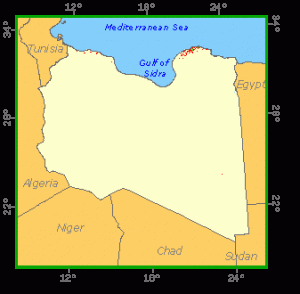
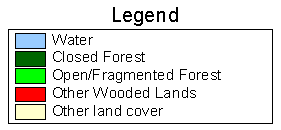
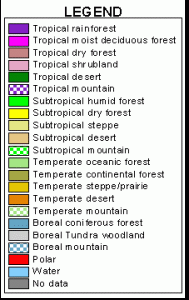
Libya is very lightly forested with less than 1 percent forest and woodland cover. The majority of the country is desert or semi-desert with only the Mediterranean coast having extensive areas of vegetation. The only areas of natural forest are in the Jabal al-Akhdar mountains, east of Benghazi, where the forests are characterised by juniper (Juniperus spp.) and mastic (Pistacia spp.) species. Shrublands occur on the Jabal Nafusah plateau with predominant species being non-woody shrubs such as asphodel (Asphodeline spp.). Inland, vegetation is mainly confined to oases, where date palms predominate. Acacia species are sparsely scattered in desert regions. Libya has larger areas of plantation forest than natural forest. Much of this has been planted in sand dune stabilisation projects, particularly in the Gefara plain and Jebal Nefusah plateau, or as windbreaks. Principal species include Acacia cyanophylla, A. saligna, Eucalyptus camaldulensis, E. gomphocephala, and Pinus halepensis. Libya has several forest and nature reserves designated as protected areas.
Forest Types
Geographic Description
Socialist People’s Libyan Arab Jamahiriyah, located in northern Africa, is bounded on the north by the Mediterranean Sea, on the east by Egypt, on the southeast by the Republic of Sudan, on the south by Chad and Niger, on the west by Algeria, and on the northwest by Tunisia. One of the largest countries in Africa, its area is 1 757 000 km2.
About 90 percent of Libya is made up of the barren, rock-strewn plains and sand dunes of the Sahara desert, with two small areas of hills rising to about 900 m in the northwest and northeast. In the south the land rises to the Tibesti massif along the Chad border. Libya’s highest point, Bette Peak, rises to 2 286 meters in the south-east.
The climate is extremely hot and dry with little precipitation in the desert areas. Daytime temperatures in the desert reach an average high of 38° C but nights are cool, averaging 10° C. The Mediterranean Sea strongly influences the climate of the coastal region. The coast has warm summers and mild winters. January temperatures in Tripoli average 11° C and July temperatures average 27° C. The coast receives about 400 mm of annual precipitation.
Ecological Zones
Forest Industry