Scientific Name
Planchonella euphlebia
Trade Name
Planchonella
Family Name
Common Names
Ereru, Hickory boxwood, Kete, Mumu, Northern yellow boxwood, Nyatoh, Planchonella, Red planchonella, Sarosaro, Tadiri, Tala, White planchonella
Regions of Distribution
Oceania and S.E. Asia
Countries of Distribution [VIEW MAP]
Australia, Fiji, Malaysia, Solomon Islands
Common Uses
Boat building, Boxes and crates, Carvings, Dowell pins, Dowells, Furniture , Furniture components, Furniture squares or stock, Interior construction, Interior trim, Moldings, Sporting Goods, Veneer
Environmental Profile
| Environmental status not officially assessed |
Distribution Overview
Various species in the genus Planchonella are reported to occur in Southeast Asia, and are found in Malaysia, the Solomon Islands, Fiji, and Australia.
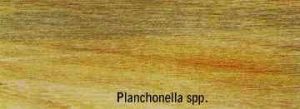
Heartwood Color
| Brown | ||||||||||||
| Red | ||||||||||||
| Red and White | ||||||||||||
| Pinkish to pinkish-brown with dark line markings | ||||||||||||
| Fine pale brown lines |
Tyloses in the wood cause glistening on longitudinal surfaces, particularly in the Red variety.
Sapwood Color
| White | ||||||||||||
| Very little color difference from heartwood |
Grain
| Even | ||||||||||||
| Closed |
| Straight, sometimes wavy |
Texture
| Fine | ||||||||||||
| Medium | ||||||||||||
| Resinous and oily | ||||||||||||
| Moderately fine | ||||||||||||
| Even textured |
Luster
| Medium | ||||||||||||
| High | ||||||||||||
| Slightly lustrous |
Natural Durability
| Very durable |
Odor
| No specific smell or taste |
Silica Content
| Some Planchonella timbers are siliceous |
Drying Defects
| Checking | ||||||||||||
| Distortion |
Ease of Drying
| Slowly | ||||||||||||
| Reconditioning Treatement | ||||||||||||
| Moderately Difficult to Difficult | ||||||||||||
| Dries at a moderate rate with little degrade. | ||||||||||||
| Conditions should be controlled to prevent sap stain |
Tree Size
| Bole length is 10-20 m | ||||||||||||
| Tree height is 20-30 m | ||||||||||||
| Trunk diameter is 100-150 cm |
Product Sources
Comments
Color grouping counteracts some differences
Vary significantly in physical and mechanical properties
Boring
| Fair to good results | ||||||||||||
| Fairly easy to very easy |
Carving
| Fair to Good Results | ||||||||||||
| Fairly Easy to Very Easy |
Cutting Resistance
| Easy to saw | ||||||||||||
| Some species are slightly siliceous and thus do not interfere with conversion operations | ||||||||||||
| Saws well | ||||||||||||
| Convert easily |
Gluing
| Glues well |
Mortising
| Fair to Good Results | ||||||||||||
| Fairly Easy to Very Easy |
Moulding
| Fair to Good Results | ||||||||||||
| Fairly Easy to Very Easy |
Nailing
| Good nailing characteristics |
Planing
| Fair to Good Results | ||||||||||||
| Fairly Easy to Very Easy |
Resistance to Impregnation
| Permeable sapwood | ||||||||||||
| Resistant heartwood | ||||||||||||
| Resistant sapwood |
Response to Hand Tools
| Responds Readily | ||||||||||||
| Yields a smooth, clean finish | ||||||||||||
| Works easily with ordinary machine tools |
Routing & Recessing
| Fair to Good Results | ||||||||||||
| Fairly Easy to Very Easy |
Sanding
| Fair to Good Results | ||||||||||||
| Fairly Easy to Very Easy |
Screwing
| Screws without splitting |
Turning
| Fair to Good Results | ||||||||||||
| Fairly Easy to Very Easy | ||||||||||||
| Very Good to Excellent Results |
Veneering Qualities
| Suitable for veneer manufacturing |
Planchonella timbers are reported to have freedom from felling shakes, ability to peel smoothly, little or no checking, and good drying and gluing properties
Polishing
| Very Good to Excellent Results | ||||||||||||
| Fairly Easy to Very Easy | ||||||||||||
| Material takes a high polish |
Strength Properties
| Very hard | ||||||||||||
| High in density | ||||||||||||
| Compression strength (parallel to grain) = high |
May require special tools to process.
The species has exceptionally high bending strength properties in the air-dry condition (about 12 percent moisture content). It is far stronger, for example, than Hard maple, White oak, or Teak.
Numerical Data
| Item | Green | Dry | English |
| Bending Strength | 13524 | 25774 | psi |
| Crushing Strength | 1715 | psi | |
| Density | 65 | lbs/ft3 | |
| Hardness | 3224 | lbs | |
| Maximum Crushing Strength | 6125 | 12348 | psi |
| Shearing Strength | 3170 | psi | |
| Static Bending | 6076 | 13230 | psi |
| Stiffness | 2381 | 3489 | 1000 psi |
| Toughness | 190 | inch-lbs | |
| Specific Gravity | 0.89 | ||
| Item | Green | Dry | Metric |
| Bending Strength | 950 | 1812 | kg/cm2 |
| Crushing Strength | 120 | kg/cm2 | |
| Density | 1041 | kg/m3 | |
| Hardness | 1462 | kg | |
| Maximum Crushing Strength | 430 | 868 | kg/cm2 |
| Shearing Strength | 222 | kg/cm2 | |
| Static Bending | 427 | 930 | kg/cm2 |
| Stiffness | 167 | 245 | 1000 kg/cm2 |
| Toughness | 218 | cm-kg |
References
Bolza, E. and N.H. Kloot. 1963. The Mechanical Properties of 174 Australian Timbers. Division of Forest Products Technological Paper No. 25. Commonwealth Scientific and Industrial Research Organization, Melbourne, Australia.
Eddowes, P. J. 1961. Commercial Timbers of Papua New Guinea – Their Properties and Uses. Office of Forests, Department of Primary Industry, Forest Products Research Center, Papua New Guinea
Kloot, N.H. and E. Bolza. 1961. Properties of Timbers Imported into Australia. Division of Forest Products Technological Paper No. 12. Commonwealth scientific and Industrial Research Organization, Melbourne, Australia