Forest Resource
Overview
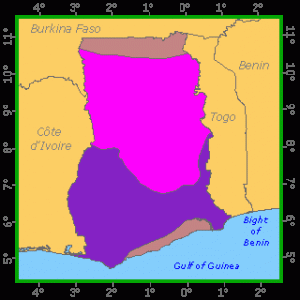
The Republic of Ghana is well-forested with around 39 percent of forest cover, and a further 37 percent of woodland. Ghana can be divided into two broad ecological zones. Tropical high forest covers much of the southern third of the country, with areas of scrub and grassland near the coast and around the Volta river, and mangrove vegetation around lagoons. A savannah zone blankets the inland two-thirds of the country. The high forest can be separated into rainforest in the most southwestern part of the country, characterised by a Cynometra-Lophira-Tarretia spp. association; and moist semi-deciduous forests containing Triplochiton scleroxylon and Celtis spp.. Ghana has a modest area of mainly Teak (Tectona grandis) plantations. Ghana´s network of protected areas encompasses around 2 percent of the forest area. The premier forest reserve is Kakum National Park, a 360 square kilometre rainforest park.
Forest Types
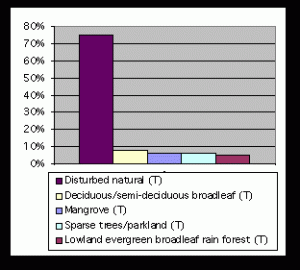
Geographic Description
The Republic of Ghana lies almost in the centre of those countries whose shores front along the Gulf of Guinea on the west coast of Africa. The coastline stretches over 565 km. The country reaches some 675 km from south to north and 540 km from east to west and has a total area of 238 538 km2. Extreme longitudes are 3°07’W and 1°14’E and extreme latitudes 4°45’N and 11°11’N.
The country is generally undulating but the Akwapim, Kwahu, Mampong, Ejura and Gambaga scarps are prominent, although of no great height, seldom exceeding 600 meters. The greatest altitude, 880 meters, is in the Volta region where a series of hill ranges runs in a north-east to south-west direction. These ranges continue north-eastward into the Republic of Togo.
The Volta is the most important river and others like the Pra, Ankobra and Tano run southerly to the sea and are navigable for about 80 km. The drainage is dominated by this system, which includes a vast artificial lake of over 770 000 ha. Soils are variable and in general moderately fertile and capable of supporting good growth unless they remain bare for some years.
The climate of Ghana is tropical, with some variation due to season and elevation. In the southern part of the country there are two rainy seasons (April to July and September to November). Rainfall is highest in the south-west, ranging from 1 250 to 2 150 mm.
The south-east has also two rainy seasons but a lower annual rainfall (750 mm). In the northern part, rainfall ranges between 1 100 and 1 250 mm and occurs in a single season (April to September) followed by a long dry season. The mean annual temperature in Ghana averages between 26 and 29°C. The climate is also influenced by the “harmattan,” a dry desert wind that blows south from the Sahara between December and February and produces a significant drop in humidity.
Ecological Zones
Forest cover Vegetation
Introduction
The natural vegetation is tropical high forest in the south-west and savanna woodland north of this zone, where the climate is drier, petering out to savanna grasslands in the northern third as well as in the east. Near the coast are areas of scrub and grassland with mangrove vegetation around the lagoons.
Closed Forests
Broadleaved
The closed high forest lies within the “two-peak” rainfall belt (May to June and September to October). It has a multi-storeyed structure. The ground flora is usually sparse and the shrub layer is not dense. Grasses are mostly absent. There is a closed lower canopy in which the trees have heavy crowns and low branches. They do not reach a height much greater than 18 m. The upper canopy is closed, about 40 m high and is made up of trees with tall straight stems, many with a small crown. Lastly, there are the emergents, which may reach up to 60 m in height and do not form a closed canopy. Entwined through the entire system are lianas, some of which go right up into the crowns of the highest trees. The high forest can be divided into two types, the rainforest and the moist semi-deciduous forest. From a purely physiognomic point of view the two types are rather similar and they differ mostly in their floristic composition.
Within both types, the freshwater swamp communities are mostly found along the streams and contain a special flora. They are not rich in tree species or in total number of trees. The main tree species are Alstonia boonei, Berlinia spp., Carapa procera, Mitragyna cìliata, Macrolobium spp. and Uapaca spp. Raphia palms and the climbing palms Ancistrophyllum and Calamus are very characteristic.
The rainforest is situated in the southwestern part of the country where rainfall is highest, between 1 800 and 3 000 mm annually, and relative humidity is very high, close to the saturation point. The harmattan has no real effect here and there is rain every month of the year. The country is generally low-lying, but contains numerous small steep hills with freshwater swamps in the valleys. The rainforest is characterised by the Cynometra ananta–Lophira procera–Tarrietia utilis association, and by the complete absence of Celtis spp. and Triplochiton scleroxylon. The three characteristic species are not deciduous, nor are the species of the lower canopy, such as Cola chlamydantha, Diospyros spp. Pentadesma butyracea, Protomegabaria stapfiana and Strombosia pustulata. Typical shrubs are Bertiera racemosa, Conopharyngia chippii and Randia hispida. Devastation of the forest has been caused by the gold and manganese mines through repeated cutting for timber, poles and firewood. Large areas around the mines now support a scrub vegetation where Alchornea cordifolia, Athocleista spp. and Harungana spp. predominate, and trees of any great size can hardly be found. The soil fertility in these areas has deteriorated considerably. Cocoa plantations are very few in this part of the country.
The region covered by moist semi-deciduous forest is generally at elevations higher than 150 m above sea level. The Kwahu, Mampong and Ejura Scarps, and the hills of Western Ashanti are prominent topographic features. The annual rainfall varies between 1 250 and 1 750 mm, although the upper limit may be exceeded in some of the higher altitude areas. Many of the species in the upper and emergent canopies are deciduous for variable periods between October and April. The characteristic species of the lower canopy are evergreen and mixed with the young trees of most of the species belonging to the dominant storeys. Under this canopy high humidity prevails although other conditions exist along the northern limits of the type during the short harmattan period. This type of forest is actually more luxuriant than the rainforest and contains more useful timber species. Three associations are recognised:
Forest Industry
- The Lophira procera–Triplochiton scleroxylon association occurs to the immediate north and east of the rainforest and is really a transition zone between the rainforest and the moist semi-deciduous type. Celtis spp. and Triplochiton scleroxylon are found in mixture with Cynometra ananta and Lophira procera. Just as the former species decrease toward the south, so do Cynometra and Lophira become scarce towards the north. Meliaceae such as Entandrophragma angolense, E. cylindricum, Guarea cedrata, Khaya ivorensis and Lovoa klaineana and Leguminosae like Daniellia similis, Distemonanthus benthamianus, Parkia bicolor and Piptadeniastrum africanum are also well represented. Among the Sterculiaceae, Tarrietia utilis is rare, but Cola cordifolia, Pterygota macrocarpa and Sterculia rhinopetala begin to appear. The understorey species are those of the rainforest, except that Diospyros spp. becomes scarce. Where farming has taken place on the margins of this forest, the resulting secondary forest evolves towards the type described hereafter by the disappearance of Cynometra, Lophira and Tarrieta.
- The Celtis spp.-Triplochiton scleroxylon association occupies the remainder of the tropical high forest area south of the line of the Kwahu and Mampong Scarps and its continuation to the north-west, except for a strip on the south-east. Celtis adolfi-frederici, C. seyauxii, C. zenkeri, Triplochiton scleroxylon, Cylicodiscus gabunensis, Piptadeniastrum africanum, Cola cordifolia, Pterygota macrocarpa, Sterculia elegantiflora, S. rhinopetala and S. tragacantha are common, while Lovoa klaineana and Parkia bicolor become scarce. Entandrophragma utile, Khaya anthotheca, Cistanthera papaverifera and Mansonia altissima make their appearance, particularly towards the north. Common understorey species are: Corynanthe pachyceras, Lecaniodiscus cupanioides, Monodora myristica and Myrianthus spp. Among the shrubs, Mussaenda erythrophylla replaces M. chipii. Large areas have been and are being farmed for cocoa and foodcrops. Where a secondary forest has grown up, the light-demanding species Albizia gummifera, A. zygia, Funtumia elastica, Pyonanthus anglensis, Terminalia ivorensis, T. superba and Triplochiton scleroxylon are present as well as those species usually not felled by the farmers, such as Amphimas pterocarpoides, Bombax buonopozense, Ceiba pentandra, Chlorophora excelsa and Piptadenia africana. Near the towns and villages repeated farming has reduced the vegetation to shrub, with an occasional big tree as a relic of the former forest. Many of the cocoa farms maintain a skeleton structure of the forest to preserve the type of environment required by the cocoa crop.
- The Antiaris africana – Chlorophora excelsa association occupies the northern limit of the tropical high forest, a strip on the south-east adjoining the coastal scrub and grassland, and an area east of Lake Volta and continuing into Togo. The question of water availability becomes important here, as this vegetation type is more exposed to the drying effects of the harmattan than the forests to the south. Celtis and Triplochiton are still common, but to a lesser degree than in the former association. Antiaris africana, Chlorophora excelsa, Morus mesozygia, Nesogordonia papaverifera, Cola cordifolia, Mansonia altissima, Pterygota macrocarpa and Sterculia spp. are well represented, as are Aningueria spp. and Chrysophyllum spp. Khaya grandifolia, and, to a lesser extent, K. anthotheca, replace K. ivorensis. In addition to the understorey species found in the Celtis–Triplochiton association, Chidlowia sanguinea and Talbotiella gentii are found in the north. This forest is slightly different in structure from the other types as there is no significant differentiation between the emergent and upper canopies. The upper storey is uneven and broken. On account of fires set for hunting and farming the “derived woodland savanna” has encroached a great deal into this association.
In the southern part, riverain forest is found. A similar type exists as outliers, usually on higher ground with good drainage. In the upper canopy are Afzelia africana, Albizia gummifera, Antiaris africana, Bombax buonopoense, Ceiba pentandra, Chlorophora excelsa, Cola cordifolia, Erythrophleum guineense, Terminalia superba and Triplochiton scleroxylon. The lower canopy contains Caloncoba dusenii, Celtis scotellioides, Monodora myristica, Napoleana parviflora, Teclea grandifoliola and Trichilia prieuriana. Mallotus oppositifolius and Mussaenda elegans occur among the shrubs.
The strand and mangrove zone covers a narrow strip along the coast, tidal river estuaries and lagoons and is broken in places by the topography. The mangrove swamps are very restricted in area and distribution and rarely develop beyond a thicket stage. Laguncularia racemosa and Rhizophora racemosa are found on the seaward side of lagoons in saline conditions. Avicennia nitida occurs on the landward side of the swamps. The latter is exploited for its bark, which is used for tanning fishing nets, and firewood for local use
- The Lophira procera–Triplochiton scleroxylon association occurs to the immediate north and east of the rainforest and is really a transition zone between the rainforest and the moist semi-deciduous type. Celtis spp. and Triplochiton scleroxylon are found in mixture with Cynometra ananta and Lophira procera. Just as the former species decrease toward the south, so do Cynometra and Lophira become scarce towards the north. Meliaceae such as Entandrophragma angolense, E. cylindricum, Guarea cedrata, Khaya ivorensis and Lovoa klaineana and Leguminosae like Daniellia similis, Distemonanthus benthamianus, Parkia bicolor and Piptadeniastrum africanum are also well represented. Among the Sterculiaceae, Tarrietia utilis is rare, but Cola cordifolia, Pterygota macrocarpa and Sterculia rhinopetala begin to appear. The understorey species are those of the rainforest, except that Diospyros spp. becomes scarce. Where farming has taken place on the margins of this forest, the resulting secondary forest evolves towards the type described hereafter by the disappearance of Cynometra, Lophira and Tarrieta.
- The