Forest Resource
Overview
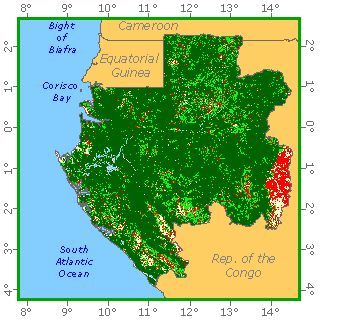
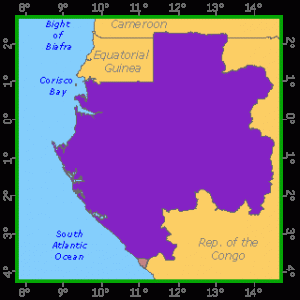
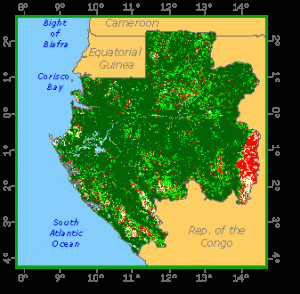
The Republic of Gabon is heavily forested with around 70 percent forest cover. The forests of eastern and central Gabon are mainly lowland moist evergreen rainforests comprising an enormous diversity of species including commercial timbers such as okoume (Aucoumea klaineana) and ozouga (Sacoglottis gabonensis). Okoume is Gabon’s most important commercial species and it has been selectively logged in a significant proportion of the country’s forests. The forests of the northeast highlands comprise semi-deciduous “elfin woodland”, unique to Gabon. Savannah forests occupy the southern corners of the country, while large areas of mangroves extend inland from the coast, along waterways. Gabon has a modest network of protected areas including 3 national parks. Around 4 percent of Gabon’s forests are inside protected areas.
Forest Types
Geographic Description
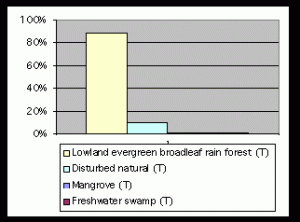
The Gabonese Republic, located in west central Africa, lies across the equator between latitudes 3° S and 2° N and longitudes 9° and 14° E and has an area of 267 670 km2. It is bounded on the north-west by Equatorial Guinea, on the north by Cameroon, on the east and south by the Republic of the Congo, and on the west by the Atlantic Ocean.
Gabon has three main geomorphological regions:
- The sedimentary basin in the west is made up of secondary formations (basically marl, limestone and sandstone) and the ground is slightly rolling. Forest completely covers the basin, except for some coastal bars and very sandy islands (in the bays region) occupied by savannah;
- The old Precambrian base occupies the eastern half of Gabon and is made up of plateaux with a medium altitude (about 600 m). In the north and north-east, rivers with shallow beds and flat, marshy valleys have worn only slightly into these plateaux, but in the south, the Ogooué and its tributaries have gouged out deep valleys intersected by rapids. An area of sandstone interspersed with schist extends over the south-eastern part of the area, where the terrain is uneven. Lastly, along the frontier with the Congo the table of the Batéké tertiary plateaux of sandstone and continental sand rises up, dominating the base by 100 to 200 m. The forest that covers almost all the base stops abruptly at the Batéké plateaux, which are totally covered by savannah. On the geological strata of the Franceville region, forest and savannah overlap in a complicated mosaic, while equatorial savannah penetrates the forest in the mid-Ogooué region;
- The northern rim of the base is formed by the Cristal Mountains, with peaks between 800 and 900 m, carved out of granite and extending south with the N’Djolé Mountains of similar heights, carved out of metamorphic rock. In the south, the granite massifs of Mayombe and Chaillu enclose a vast synclinorium of schisto-sandstone and schisto-calcareous sediment. The Mayombe in the west forms a long north-south ridge often exceeding 800 m and traversed by the Nyanga River, while the Chaillu in the east is over 1 000 m and rivers have etched out deep valleys in it. Forest covers the whole mountainous rim of the base except for a deep corridor of savannah with two branches at the end that exactly follow the tongue of schisto-calcareous sediment.
The climate is described as transitional equatorial and varies markedly from one end of the country to the other. Rainfall in particular ranges from 4 000 mm at Cocobeach on the coast at the country’s north-western point to 1 500 mm at Tchibanga in the south-west, decreasing steadily away from the coast. The year has four seasons: a short dry season from January to February, often marked only by an easing of the rains; a rainy season from March to May; a long dry season from June to October; and a long rainy season from October to December. North of a line between Okondja and Oyem, the summer dry season is less pronounced, but the winter easing of the rains becomes a proper dry season. In the south-west, however, the long dry season is longer, reaching six months at Mayumba. Such a long dry season is very exceptional in terms of the whole part of equatorial Africa covered by closed rainforest. No other tropical rainforest experiences as long a dry season as that suffered by most of the Gabonese forest. This is also true of the severity of the dry season, for three-quarters of Gabon receives less than 25 mm of rain per month during these three or more months.
There are two other major climatic features: high atmospheric humidity throughout the year, and heavy cloud cover throughout the dry season due to the permanent presence of a ceiling of stratus clouds, thus reducing the amount of exposure to the sun, the total quantity of light radiation (which allows photosynthesis in plants) and evaporation. This explains how the trees can withstand a dry season lasting three or more months.
Ecological Zones
Forest cover Vegetation
Introduction
August Chevalier was the first to write about the Gabonese forest in 1936, followed by Heitz (1943), Aubréville (1948) and Saint Aubin (1963). Since then, knowledge has been considerably extended thanks to the various inventories made by the Forestry Research Service prior to 1965 and then by the CTFT and FAO. In 1977, Nicholas collated the information contained both in phytogeographic studies and in various forest inventory reports. The following descriptions of the different types of vegetation have been drawn from all these works.
Most of Gabon belongs to the closed rainforest zone. Savannah, either grass, scrub or, more rarely, tree, occupies only a small part of the country and is determined by climatic, soil-related and/or human factors.
Closed Forests
Broadleaved
1. The central Gabonese forest
The central Gabonese forest is essentially very similar to the closed evergreen rainforest found in other countries from Liberia to the Congo basin. Its appearance is identical (particularly on photographs) and its botanical composition is very similar:
- The presence of major “pan-African” species, occurring to varying degrees from Sierra Leone to Uganda: dabéma (Piptadeniastrum africanum), aiélé (Canarium schweinfurthii), movingui (Disthemonanthus benthamianus), ilomba (Pycnanthus angolensis), eveuss (Klainedoxa gabonensis), ehoumeu (Coula edulis), tali (Erythrophleum micranthum), azobé (Lophira alata), abalé (Petersia africana), andok (Irvingia gabonensis), Khaya and Entandrophragma spp., douka (Tieghemella africana) and silk-cotton (Ceiba pentandra).
- The presence of vicarious species, replacing those found in other countries but very close botanically. Thus Gabon has distinct Gilbertiodendron and Dacryodes species that are close to those found in Côte d’Ivoire, and this is true of many other botanical species. The special feature of the Gabonese central forest in comparison with other evergreen forests seems to be the presence of its two most frequent species, okoumé (Aucoumea klaineana) and sorro (Scyphocephalium ochocoa).
The Gabonese central forest covers most of the country (except for mangroves, swamp forests, the north-eastern forest and the okoumé and ozouga forest growing on the sandy soil of the lower Ogooué). It has species that are absent from the north-eastern and coastal forests, and this is especially true of the following, listed here in order of abundance: miama (Calpocalyx heitzii), beli (Paraberlinia bifoliata), ovang-kol (Guibourtia ehie), gheombi (Sindoropsis le-Testui), ngaba (Librevillea klainei) and andoung nzobeu (Brachystegia laurentii). These species are all Leguminosae, and five of them are Caesalpiniaceae.
Three types of forest can be distinguished:
1. Forests in the sedimentary basin:
- The intermediate forest between the coastal forest and the central forest (Saint Aubin’s type III). This marks the transition from the coastal forest of ozouga to the forest in the sedimentary basin. species from the coastal forest are still abundant here (Sacoglottis, Aucoumea, Erismadelphus and Guibourtia tessmannii), but species from the sedimentary basin are already well represented, notably the Irvingiaceae.
- Forest on sand and forest on clay. There is a strip of sandstone and sand in the heart of the sedimentary basin on which coarse, well-drained soils have developed, and here the forest has the appearance of an “old forest”, with very open undergrowth and some very large trees (Entandrophragma, Lophira, Daniellia, Parkia and Cylicodiscus spp.) dominating a forest of second- and third-sized trees. Certain species are more or less exclusive to the area: anzilim (Eurypetalum batesii), sipo (Entandrophragma utile), meudou (Brachystegia laurentii) and allen-ocpo (Dracaena fragrans). In addition, some species such as ekat (Hymenostegia stephanii), azobé (Lophira alata), niové (Staudtia stipitata), ngaba (Librevillea klainei) and ehoumeu (Coula edulis) are much more abundant here than elsewhere.
- Forest of the lake region (Centre Technique Forestier Tropical, 1970). The continual high water table causes the proliferation of certain species such as Calpocalyx heitzii, Guibourtia tessmannii, Berlinia confusa, B. bracteosa, Tieghemella africana, Afzelia pachyloba, Khaya ivorensis and Mitragyna ciliata;
- Forest in the south of the sedimentary basin. This forest differs from those above in the abundance of Aucoumea klaineana, Staudtia stipitata, Dacryodes normandii, Tetraberlinia bifoliata, Newtonia leucacarpa and Daniella soyauxii. Apart from these species, Klainedoxa spp., Monopetalanthus longiracemosus and Brachystegia mildbraedii are found in the Tandon Mountains. In the Mayombe Mountains there is also an abundance of Calpocalyx heitzii, Dacryodes heterotricha and D. pubescens and a fairly large number of Meliaceae. Lastly, stands of limba (Terminalia superba) and iroko (Chlorophora excelsa) appear south of the N’Dende-Tchibanga line.
Forest Industry
2. The forest of the Cristal and Chaillu Mountain rim. The features that distinguish the central forest from the coastal and northern forests are more pronounced here than in the sedimentary basin, that is: floristic wealth (a large number of endemic species, such as Monopetalanthus durandii), an abundance of hardwood species, in particular Caesalpiniaceae (Monopetalanthus heitzii, M. coriaceus, M. durandii, Sindoropsis le-Testui, Guibourtia demeusei, Calpocalyx heitzii, Paraberlinia bifoliata, Didelotia brevipaniculatum and Distemonanthus benthamianus), and the gregarious behaviour of species. The floristic composition is otherwise very similar to that of the sedimentary basin: an abundance of Burseraceae (especially Dacryodes büttneri), but also of okoumé (although to a lesser extent here), Myristicaceae and Irvingiaceae;
3. The intermediate forest between the forest of the mountainous rim and the north-eastern forest. This forest, which has become better known since the inventories carried out by the FAO/CTFT Gabonese Forestry Development Project (Gloriod, 1974), crosses the country diagonally in a 200-km-wide swathe from Mitzic to Lastourville. It contains an abundance of okoumé, sorro and red awougha (Aphanocalyx marginiervatus). Gilbertiodendron dewevrei (which flourishes on cool soils) and several Meliaceae also occur in this forest.
The north-eastern forest
This forest is apparently not semi-deciduous in type as was believed before the Gabonese Forestry Development Project inventory. It does in fact have the aspect of an evergreen forest, although the underwood contains fewer young trees and more lianas, while carpets of Marantaceae, though often sparse, are frequent, even under thick cover. Some semi-deciduous forest species occur, such as limba (Terminalia superba) and samba (Triplochiton scleroxylon) that invade clearings and seem to be moving southward; also Celtis midbraedii, C. zenkeri and Gambeya subnuda that occur increasingly often toward the north-east, Sterculia subviolacea which flourishes in humid zones as it does in the Congo and Cameroon, nka (Pteleopsis hylodendron) and wenge (Millettia laurentii). On the other hand, okoumé and sorro abruptly disappear as do alep (Desbordesia glaucescens) and miama (Calpocalyx heitzii).
Coastal forest (or okoumé and ozouga forest – Saint Aubin (1963) type II)
This forest is more open than the central forest (which is why it is called a “cathedral forest”), meaning that there are fewer trees per hectare and a smaller basal area. Distribution according to diameter further emphasises the particular aspect of okoumé and ozouga forest: trees of medium diameter (40-80 cm) are less frequent than in the central forest. On the other hand, in addition to ozouga (Sacoglottis gabonensis) and okoumé (Aucoumea klaineana), there are angoa (Erismadelphus exsul), niom (Pachypodanthium staudtii), kevazingo (Guibourtia tessmannii and G. pellegriana), ebam (Picralima nitida), akak-milong (Pinacopodium congolense), onzan (Odyendyea gabonensis) and angueuk (Ongokea gore. While Annonaceae are abundant, there are few Irvingiaceae, Myristicaceae or even Leguminosae. This forest is floristically fairly poor, with only 24 species covering 95% of the area.
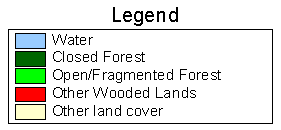
Forest Map
Forests on moist soil (Nicolas, 1977)
- Mangroves, particularly of Rhizophora racemosa, are found in some areas subject to tidal action.
- Swamp forests of bahia and raffia. A cover of trees and raffia palms is found on soil covered by a layer of water that is seldom deeper than 50 cm and gives way to mud in the dry season. The trees belong to a small number of species, the most common being bahia (Mitragyna ciliata), which grows very large, plus assongho (Anthostema aubryanum), while ekouk (Alstonia congensis) is found in drier areas. There are also varyingly pure scattered stands of Leguminosae (Gilbertiodendron spp.) or Sapotaceae of the Manilkara and Glumea genera.
Swamp forests in the west of Gabon usually have dense stands of tall trees with a volume of stem wood of over 300 m3 per ha, while palms are not so abundant. In the east, on the other hand, the trees are more widely spaced and smaller, with palms and other monocotyledons predominating.
Near the coast and on the lower reaches of the rivers, swamp forests sometimes cover vast areas. In the north of Woleu N’Tem they lie along rivers in strips broader than a kilometre. Moreover, over the country as a whole swamp forests cover a very intricate network of narrow but flat bottomlands, comprising an area very difficult to assess.
Gallery forests
In the south and especially the south-east of Gabon, the rivers crossing the savannah are lined with gallery forests that can sometimes be several kilometres wide. These stands often have an interesting composition, being rich in okoumé, ilomba, sorro and ekoune (Coelocaryon preussii).
Open forests
Broadleaved
Mixed stands of trees and grasses are virtually absent from Gabon. However, a few isolated clumps of Milletia laurentii do occur in the shrub savannah of the Franceville region.
Other wooded land
Shrubs
These occur in two relatively small areas. In the south of Gabon (the Tchibanga and Mouila region), along the upper reaches of the Nyanga and Ngounié Rivers, there are two strips of schisto-calcareous soil almost completely covered by sparse shrub savannah, cut up by gallery forests. The shrubs and bushes are mainly Hymenocardia acida, Sarocephalus esculentus, Annona arenaria and Bridelia ferruginea. In the east (the Franceville region) there are large stretches of savannah, within which scraps of forest of varying size are found. The woody species are the same, but Hymenocardia acida predominates here.
References
Aubréville, A. 1948. Etude sur les forêts de l’A.E.F. et du Cameroun. Paris.
Centre Technique Forestier Tropical. 1970. Inventaire forestier dans la région de Lambaréné. Nogent-sur-Marne, France.
Chevalier, A. 1936. La forêt et les bois du Gabon. Paris.
De Saint-Aubin, G. 1963. La forêt du Gabon. Centre Technique Forestier Tropical, Nogent-sur-Marne, France.
Gloriod, G. 1974. Les forêts de l’est du Gabon. In: Bois et Forêts des Tropiques No. 155, Nogent-sur-Marne, France.
Heitz, H. 1943. La forêt du Gabon. Paris.
Nicolas, P. 1977. Contribution à l’étude phytogéographique de la forêt du Gabon. Centre National de la Recherche Scientifique, Paris.