Forest Resource
Overview
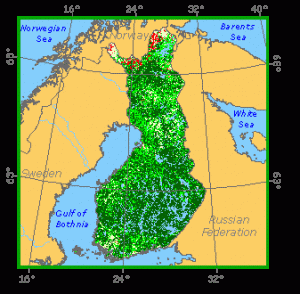
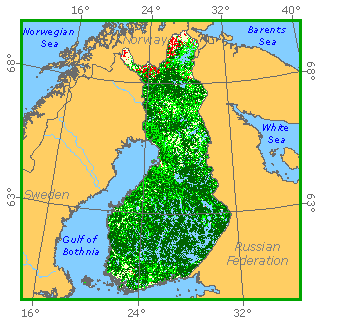
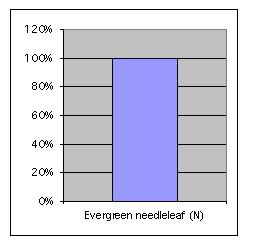
Finland, a mostly low-lying country of forests and lakes, stretches from the Baltic Sea beyond the Arctic Circle. Forest and other wooded land accounts for over three quarters of the land area, putting Finland among the countries with the highest forest cover in the world. The area of forest land per head of population is also very high, allowing the country to have become a leading producer and exporter of wood products. Forests are largely of the boreal type: coniferous species make up over four fifths of the volume of growing stock, with Scots pine and Norway spruce predominating. Birch is the main broadleaved species, with alder also common. Most of the forest is available for wood supply, but a substantial area is not available for conservation and protection reasons. There is a relatively small but important area of forest undisturbed by man, the remainder being classed as semi-natural. The volume of growing stock, but not the area of forest, has been rising steadily in recent decades, as fellings have remained below net annual increment. Seven tenths of the forest and other wooded land is in private hands, mainly individuals but also forest industries, the remainder mostly owned by the State. Hunting, reindeer husbandry and the gathering of non-wood products are important to local populations
Forest Types
Geographic Description
The Republic of Finland is located in northern Europe, extending above the Arctic Circle. Sweden lies to the west of Finland, northern Norway to the north, and Russia to the east. The Gulf of Finland and the Gulf of Bothnia, extensions of the Baltic Sea, border Finland on the south and south-west. The area of Finland is 338 145 km2, including 33 551 km2of inland water.
Finland is largely tableland broken by small hills and valleys. The land rises gradually from south to north, but the average altitude is only 120 to 180 m. Mount Haltia, the country’s highest point at1 324 meters is located in the far north-west. About 60 000 lakes are scattered throughout the country, the largest of which are Saimaa, Inarijärvi, and Päijänne. Thousands of islands dot the Gulf of Bothnia and Gulf of Finland.
Because of the moderating influence of the surrounding water bodies, the climate of Finland is more moderate than would be expected. The average July temperature along the southern coast is 15.6° C; in February the average is about -8.9° C. However, in northern Finland, winter temperatures sometimes drop as low as -30° C. Precipitation averages about 410 mm in the north and 690 mm in the south. Light snow covers the ground from December to April in the south and from about October to April in the north
Ecological Zones
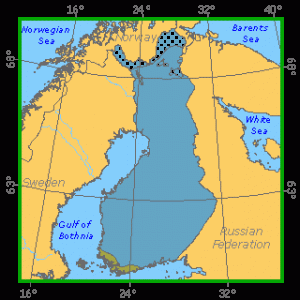
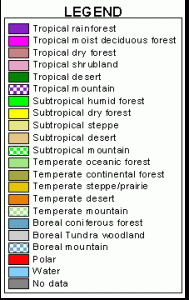
Forest Industry
Management
The forest sector is an important part of Finland´s economy. As in the majority of other European countries, Finnish forest resources have been increasing steadily for the last 2-3 decades as annual growth exceeds felling and natural losses. Almost two-thirds of the forest area belongs to small-scale private owners, mainly farmers. There are many absentee owners who live in the cities or towns for most of the year.
Forest Map