Forest Resource
Overview
Cuba is moderately forested with around 15 percent forest cover. Prior to Spanish settlement, in the early 16th century, more than 90 percent of Cuba was covered with forest. Much of the forest was cleared for cattle raising and sugar cane production. Around 75 percent of the land is now savannah or plains. The majority of the remaining forest and woodland is coastal swamp and mangrove forest (especially in the northern cays) or upland and montane forest. The remnant rainforest is largely confined to mountainous areas, for example in the Sierra Maestra and Sierra di Nipe at the eastern end of the island. Principal timber species in these forests are mahogany (Swietenia mahogany), cedar (Cedrela mexicana) and ebony (Albizia lebbeck). These mountain areas are also home to significant pine forest areas, mainly Pinus occidentalis and Pinus cubensis. There are over 7,000 plant species in Cuba, of which around 3,000 are endemic. Cuba has established a significant plantation estate based on pines, eucalypts, casuarina and gmelina. Protected areas cover 30 percent of Cuba including its marine platform. There are around 20 national parks and biosphere reserves.
Forest Types

+20,501 ac Upper Montane (T)
+22,724 ac Sclerophyllous Dry (T)
Geographic Description
Cuba is the largest island in the Caribbean. Its territory covers 110 860 km2. It forms, with numerous adjacent islands, the Republic of Cuba.
Approximately two-thirds of Cuba consists of plains or rolling lands with low elevation. The rest of the territory is formed by three groups of mountains, where most of the remaining natural forests occur:
- In the west, in Pinar del Rio province, lie the Organos range and the Rosario mountains, with fairly even terrain and a maximum altitude of 728 m;
- In the centre, in the south of Las Villas province, the Trinidad mountains reach an altitude of 1 156 m, while the Sancti Spiritus mountains are somewhat lower;
- In the east, in Oriente province, lies the Sierra Maestra, mountains of volcanic origin which reach an altitude of 2 000 m (Mount Turquino). The Moa, Cristal and Nipe Mountains and others are found in the far east of the country, with altitudes of between 900 and 1 200 m. The mountains in this region are the most rugged and isolated in the country.
Cuba lies within the northern tropics and has a semitropical climate. The trade winds moderate the climate throughout the year. Average daily temperatures range from about 21° C in winter to about 27° C in summer but the interior has a greater temperature range than the coastal regions. Temperatures on the island rarely fall below 4° C or rise above 38° C, although frosts sometimes occur in the mountains.
Cuba has a dry season from November through April and a rainy season from May through October. Average annual rainfall is about 1 300 mm, with local variations depending on location (the northern slopes of the Sierra Maestra, for example, have over 3 000 mm), since the trade winds blow from the north or east. Thunderstorms occur almost daily during the rainy season and the island is subject to hurricanes during the period June to November, but most commonly from August through October
Forest Industry
Resources Forest cover Vegetation
Natural Woody Vegetation Description
Closed Forests
Broadleaved
In the Sierra Maestra in Oriente province, there are, firstly, forests on calcareous soils referred to as “hound´s teeth”(dientes de perro). These forests are found in the west of the province and are comprised of such species as Cuban or West Indian mahogany (Swietenia mahogany), Spanish or red cedar (Cedrela mexicana), cabbage tree (Andira inermis), Cordia gerascanthoides and sabicu (Lysiloma latisiliqua), with considerable human influence in the form of exploitation for firewood and charcoal, as well as clearing for agriculture. Then there are forests on volcanic terrain, which can be divided as follows, depending on altitude and exposure:
- Up to 150 m: Deciduous or xerophytic forests with Cuban mahogany, Spanish cedar, Guazuma ulmifolia, Jamaica birch (Bursera simaruba), sabicu and lignum vitae (Guaiacum officinale). Gallery forests are found along rivers. “Fresh forests” (bosques frescos) are relatively closed and tall, while “rough forests” (bosques bravos) are a type of low forest confined to higher altitudes.
- Between 150 and 900 m: “Fresh forests” are found in the valleys and contain, Calycophyllum candidissimum, Cordia gerascanthoides and sabicu, with “rough forests” on higher slopes;
- Between 50 and 900 m with a northerly exposure: A very moist zone (annual rainfall of over 3 000 mm), with secondary scrub and some patches of the original forest.
In the other eastern zone, north and north-east of a line from Santiago de Cuba to Guantanamo but still within Oriente province,with mountainous terrain, calcareous and volcanic soils are again distinguishing.
In the south, on calcareous soils between Guantanamo and Maise Point, there is a xerophytic forest (annual rainfall of 1 000 mm and a very short rainy season), which is very sparse and yields only firewood.
In the west of Pinar del Rio province, between Cape Francés and Guanahacabibes Point, a Spanish cedar(Guazuma ulmifolia) and Cordia gerascanthoides forest covers a large calcareous area containing “hound´s teeth”. In the north and north-west of Pinar del Rio province, a very degraded broadleaved forest is found on rough terrain that rises abruptly from the plains.
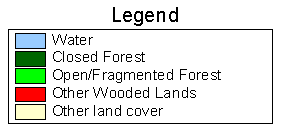
Forest Map
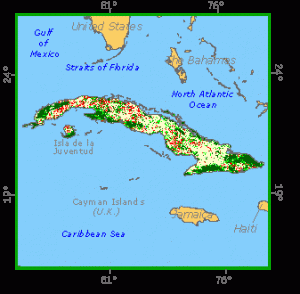
n the Escambray mountains (in the south of Las Villas province) some islands, generally of secondary forest, are still found up to 1 000 m; Cuban mahogany is found here, but in a stunted form useful only as a source of shade for livestock.
Mangrove forests are found in lagoons near the sea, made up of all four species found in the Caribbean: red mangrove (Rhizophora mangle), white mangrove (Avicennia germinans), white button wood (Laguncularia racemosa) and Conocarpus erecta.
Coniferous
On calcareous soil between 900 and 1 500 m with northerly and southerly exposures in the Sierra Maestra, islands of Pinus occidentalis forest are found within the “fresh forest” stands, with Protium cubense and trumpet wood (Cecropia peltata). Above 1 500 m, the only vegetation is low scrub suited to the moist environment.
Forests in the volcanic areas of the Nipe and Cristal mountains consist of degraded stands of Pinus cubensis. Broadleaved forests are also found in this region, are made up of “fresh forest” and “rough forest” stands. Species such as cabbage tree, pícaro, Calophyllum brasiliense, Hibiscus tiliaceus, sabicu and Carapa guianensis are found here.
On lateritic soils in volcanic parts of Pinar del Rio province, there are scattered patches of Pinus caribaea forest. On schistous and sandy soils in the same area, there are very degraded Pinus tropicalis stands on the most impoverished and eroded soils, and P. caribaea stands on slightly deeper soils. In the valleys, a few broadleaved stands with Quercus virginiana are also found.
Other wooded land
Shrubs
Cailliea glomerata is a shrubby member of the Leguminosae family, perhaps introduced from Africa, which invades relatively fertile but abandoned land. There are also very limited areas covered by special types of scrub formation, such as uveral and manigua costera along the coasts, encinar (found on the same soils as pine forests), cuabal and charrascal (INDAF, 1976).
References
INDAF (1976). Panorama de la silvicultura en Cuba. Editorial ORBE, Havana