Forest Resource
Overview
The Republic of Comoros is lightly forested with around 4 percent forest cover and an additional 13 percent of other wooded land cover. The islands were originally heavily forested but most of the lowland forest has been cleared for agriculture. The upland forests on Mohéli have been least degraded, with remnant tropical forests on upland slopes and cloud forest above 600 metres. Gran Comore is more degraded, with eruptions from the Kartala volcano also affecting vegetation. Anjouan has remnant rainforest in Foret de Moya. All three islands have areas of mangroves, and beach-strand vegetation. Comoros does not currently have any formally protected areas.
Forest Types
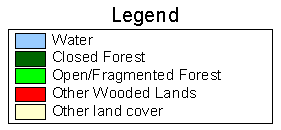
No map available.
Geographic Description
The Islamic Federal Republic of the Comoros occupies an archipelago in the Indian Ocean between the mainland of Africa and the island country of Madagascar. It consists of three of the four main islands-Anjouan (Nzwani), Grande Comore (Njazidja) and Moheli (Mwali). The fourth major island, Mayotte, is a dependency of France, although the Comoros claims sovereignty. . The three islands of the Comoros (excluding Mayotte) cover 1862 km2.
The islands are of volcanic origin and are mountainous. The highest mountain is Mont Karthala, which rises to 2361 m and is an active volcano, with major eruptions in 1965 and 1977. Plateaus and valleys lie below the peaks. The island shores are rocky with few sandy beaches.
The climate is tropical, oceanic, and subject to monsoons with a cool, dry season between April and October. The islands experience their warmest weather and heaviest rainfall between November and March and are also subject to cyclones. Daily temperatures seldom rise above 30° C. Up to 5 000 mm of rain per year fall on the upper slopes of Karthala, decreasing at lower elevations.
Forest cover Vegetation
Introduction
The archipelago of the Islamic Federal Republic of the Comoros consists of three volcanic (basaltic) islands in the southwest Indian Ocean – Njazidja or Grand Comoro, Nzwani or Anjouan, and Mwali or Mohéli – plus a number of small islands closely grouped around the main three.
Njazidja has an uneven relief, dominated by two volcanic cones, Karthala in the south and Grille in the north, reaching 2 361 and 1 087 m respectively; the rest of the island consists of the small plains of interior basins and the coastal plains. Mwali is the smallest of the three main islands, with a mountainous ridge reaching 790 m at its highest point; the eastern part of the island has a gentler landscape, not exceeding 300 m. The highest summit on the third island, Nzwani, is Pic Tingui, at 1 580 m.
The climate depends basically on the wind, and the archipelago is influenced by the Indian monsoon (northeasterly) during the hot wet season and the trade winds (southerly and southeasterly) during the cool dry season.
The soils on this archipelago of volcanic origin have evolved little, and they have only a secondary effect on the distribution of different types of vegetation. Rainfall, fog, altitude and human pressure are the main elements determining the structure and floristic composition of plant formations. Comorian flora includes 935 vascular plants, over half of which are indigenous and 136 endemic.
Njazidja contains the widest range of forest formations: closed moist forest, woody montane vegetation, fairly open transitional forest, xerophilous thickets and bush savannah. The floristic composition of these formations changes as altitude increases, and they become lower and more open. However, shrub formations cover the largest areas.
Mwali is the most sparsely populated and best preserved of the three islands, and has the highest percentage of forested areas. The natural forest forms an unbroken cover, continuing over the crest of Mount Mledjele (765 m).
The largest forests on Nzwani are those of N´Tingui and Moya, although only remnants exist today, as a result of heavy human pressure. Nzwani is thus the least forested of all the islands in the archipelago, and its woody cover is mostly shrub fallow. Apart from the very steep southern slopes of the N´Tingui mountain massif, the remainder of the island´s forests are severely degraded as a result of agricultural encroachment.
Forest Industry
Closed Forests
Broadleaved
Closed moist forests are found mostly on Njazidja (on Mounts Karthala and Grille) and Mwali (on Mount Mledjele).
The Karthala forest on Njazidja is found on the western and southern slopes of the mountain massif of the same name, on rich soils between 800 and 1 800 m in areas with the highest annual rainfall (3 000-5 000 mm). Atmospheric humidity is very high at these altitudes, due to the almost permanent presence of clouds.
This forest is floristically very rich, and includes such species as camphor (Ocotea comorensis), Comorian mahogany (Khaya comorensis), Nuxia pseudodentata, Trema spp., Macaranga bailloniana and Chrysophyllum boivimanum. It is a multi-storeyed forest with a dominant storey between 20 and 30 m high, a middle storey composed of the same species as the dominant storey, and a sparse undergrowth containing shade-loving species. This understorey is very moist, favouring tree ferns, epiphytes, lichens, mosses, orchids, etc.
At lower altitudes, this forest is very degraded as a result of the activities of local villages, and is replaced by fallow with the appearance of shrubland composed of tree ferns, palms and pandanus. At higher altitudes, it becomes thinner until it disappears completely at about 1 800 m, giving way to heath-like formations (see below).
Forests on the Grille mountain massif in the north of Njazidja are less extensive than the previous type and are found between 800 and 900 m. Annual rainfall in this zone exceeds 2 000 mm.
On the richest and deepest soils, these forests appear as high forest (20 m high) with trees covered in epiphytes (orchids, ferns, lycopods, etc). The undergrowth is on the whole fairly open. In zones with poorer soil, the formation becomes an impenetrable thicket 15 m high.
These forests are floristically very similar to the Karthala forest, although some species are absent here (such as Comorian mahogany). Fig (Ficus spp.), Anthocleiste, Eugenia spp., etc., are, however, found. There is almost no undergrowth because of agricultural cropping (banana and taro) under the forest cover. These stands have been much impoverished by grazing, logging and agriculture. The areas worst affected by cutting form coppices in which Aphloia mauritiana, Tambourissa spp. and Nuxia spp. are the predominant species.
The Mount Mledjele forest on Mwali is a moist evergreen forest rich in epiphytes. It is located at altitudes above 500 or 600 m, which is the upper limit for farming.
Soil conditions determine two different types of formation: a low uniform forest grows on crests and skeletal soils, while a high, multi-storeyed closed forest, dominated by tall trees (30-40 m), is found on colluvial soils on the slopes. The commonest species are Weinmannia comorensis, Ocotea spp., Tambourissa leptophylla and Macaranga spp. The undergrowth contains many herbaceous species, and the high atmospheric humidity encourages the growth of large numbers of epiphytes.
This forest is subject to extraction and also to clearing for agriculture. Most of the degraded sections are therefore found on gentler slopes.
Mangroves are found for the most part on Mwali, although they reach a height of only 6 m and form only small stands. There are several species, with Rhizophora mucronata being found in association with Avicennia marina, Bruguiera gymnorrhiza, etc.
Open forests
Broadleaved
Open forests are found on the northern and eastern slopes of Mount Karthala, at altitudes between 500 and 1 800 m, where the soil has evolved little and annual rainfall is less (2 500 mm) than on the other slopes. These are transitional forests, changing progressively from the closed moist forest of the western slopes to a more open, drier and floristically poorer forest. Various species of Nuxia are more abundant here than in closed moist forests. Nuxia pseudodentata, Weinmannia spp., Macaranga spp., Pygeum africanum, etc., occur in combination. Trees reach a maximum height of 15 m. The undergrowth consists of very scattered shrubs, while the herbaceous ground cover is thick and is composed mainly of Nepholepis.

Other wooded land
Shrubs
Shrub savannah and xerophilous thickets are found on the coast and on northern and eastern slopes on Njazidja up to 600 m, with a dry climate (annual rainfall between 1 000 and 1 500 mm).
The commonest species is Adansonia madagascariensis, which is found in association with Comorian ebony (Diospyros comorensis), Phyllanthus comorensis, etc. Thespesia populnea, Terminalia catappa and Cordia spp. occur in coastal formations.
This type of formation is particularly at risk from human activities, both the quest for new agricultural land and also the gathering of firewood.
Heath-like formations (Njazidja) occur in montane zones between altitudes of 1 700 and 1 900 m.
Up to 1 900 m, the transition zone between closed forest and heath-like formations is made up of isolated trees dominating a mixture of ferns, Graminaceae and Ericaceae.
Above 1 900 m, thicket-type formations cover the crests. The main species is Philippia comorensis, which can reach a height of 6 to 8 m. These formations become increasingly sparse and stunted as the altitude increases.
Forest fallow
The lower edges of the Karthala closed moist forest have been cleared for agriculture. Abandonment of this land leads to the establishment of fallow with the appearance of thick shrubland, invaded by tree ferns, palms and pandanus.
References
CTFT (1984). Etude des problèmes forestiers de l’archipel des Comores. Nogent sur Marne, France. 186 p.
Ducatillon C. et C. Loup (1985). Pratiques paysannes des Comores. L’arbre dans le paysage agricole. IRAM-GRET. Paris, France. 98 p.
Ledant J.P. (1993). Réserve marine et côtière de Nioumachoua. Comores. Conservation des écosystèmes forestiers. F.A.O., Rome, Italie. 87 p.
White F. (1983). The vegetation of Africa. Natural resources research XX. Unesco, Paris, France. 356 p.