Forest Resource
Overview
Canada has the world´s third largest forest resource after the Russian Federation and Brazil. Forest and other wooded land account for well over two-fifths of its land area; the area of forest and other wooded land per inhabitant is one of the highest in the world. There is a broad belt of coniferous forest, essentially boreal, across the country, with tundra to the north. To the south and east of this (Ontario, Quebec and the maritime provinces), forests have a larger broadleaved component. British Columbia has specific forest types determined by the montane and coastal nature of the province. . Coniferous species make up the major part of the growing stock, the main species being spruces, pines, firs and larches. Along the west coast of British Columbia other species, which grow to very large sizes, are Douglas fir, western hemlock and western red cedar. Broadleaved species, which predominate in the south-eastern parts of the country, include maples and oaks, while species of birch, alder and willow occur widely throughout the country. All in all, there are about 180 species of forest trees in Canada and a very wide range of forest types. Nearly two thirds of the forest and other wooded land is comprised of forest, of which one half is classified as available for wood supply. About one third of other wooded land, which is mostly in the harsher climatic conditions, is available for wood supply. Most of the forest not available for wood supply is classified as such because of its remoteness and the lack of infrastructure makes commercial harvesting economically non-viable. A large part of the forest and other wooded land is boreal in nature, about half of the forest and virtually all of the other wooded land is still undisturbed by man. More than nine tenths of forest and other wooded land is publicly owned, mostly by the provincial governments; private ownership is found mainly in the eastern provinces. There is a movement for the restitution of areas to indigenous peoples.
There are 417.6 million hectares of forests and other wooded lands in Canada. Some 37 percent of this area are open forests, comprising muskeg, rock, barrens and marshes, as well as slow-growing or sparse forests. Almost 56 percent are considered commercial forests capable of growing a merchantable crop of trees within a reasonable length of time. Forests themselves cover about 27 percent of the total land area. Approximately 119 million hectares of forests are currently managed for timber production. There are 180 native tree species in Canada. Sixty-three percent of the forest cover is composed of predominantly coniferous stands, 15 % predominantly broadleaved and 22 % are mixed forests. Among the main tree species are Abies spp., (e.g. Abies balsamea), Larix spp. (e.g. Larix laricina), Picea spp. e.g. black spruce (Picea mariana), Pinus spp. (e.g. Pinus banksiana), Acer spp. (e.g. Acer negundo), Betula spp. ( Betula papyrifera), Quercus spp., e.g. red oak (Quercus rubra), Salix spp. (e.g. Salix nigra), etc. All in all, including exotics used for plantations and landscaping, there are about 300 trees and shrubs species in Canada. Most of the forest stands are even-aged due to such cyclical and widespread disturbances as fire and insect infestations. An estimated 50 million hectares (12 %) are protected forest areas from harvesting by legislation or policy. Most Canadian forests are publicly owned (> 93 %); provincial governments are responsible for managing more than 70 percent of forests and other wooded land, and federal and territorial governments oversee 23 percent. Less then 7 percent are on private property, belonging to more than 425 000 private landowners. Forest management is a matter for provincial jurisdiction, policies and regulations. Two-thirds of Canada´s estimated wildlife species live in forests. Some 117 species are listed as threatened or endangered, including 41 forest-dwelling species.

Geographic Description
Canada is the second largest country in the world and extends across the continent of North America from Newfoundland on the Atlantic coast to British Columbia on the Pacific coast. Canada is slightly larger than the United States, its southern neighbour, but has only about a tenth as many people. Much of Canada is uninhabited or thinly populated due to rugged terrain and a severe climate.
Canada occupies nearly all of North America north of latitude 49° north and east of longitude 141° west. It has an area of 9 970 610 km2, of which 7.6 percent or 755 180 km2 is covered by fresh water such as rivers and lakes, including part of the Great Lakes. It is bounded on the north by the Arctic Ocean; on the north-east by Baffin Bay and Davis Strait, which separate it from Greenland; on the east by the Atlantic Ocean; on the south by the United States; and on the west by the Pacific Ocean and Alaska. It extends 4 600 km from its northernmost to its southernmost point and 5 500 km from east to west.
Canada has eight major land regions. They are (1) the Pacific Ranges and Lowlands, (2) the Rocky Mountains, (3) the Arctic Islands, (4) the Interior Plains, (5) the Canadian Shield, (6) the Hudson Bay Lowlands, (7) the St. Lawrence Lowlands, and (8) the Appalachian Region.
The Pacific Ranges and Lowlands make up most of British Columbia and the south-western part of the Yukon Territory, including the Queen Charlotte Islands and Vancouver Island. The Coastal Mountains rise along the coast of British Columbia. The glacier-covered St. Elias Mountains in the Yukon include Canada’s highest peak, Mount Logan, near the Alaskan border with an elevation of 5,951 m. The coast of British Columbia has many islands and fjords. Except for the valleys and the upper slopes of the mountains, much of this region is heavily forested. Inland from the coast is an area of plains, river valleys, and smaller mountains.
The Rocky Mountains are east of the Pacific Ranges and Lowlands. The Canadian Rockies vary in height from 2,100 to more than 3,660 m. The tallest peak, Mount Robson in eastern British Columbia, is 3,954 m high.
The Arctic Islands lie almost entirely within the Arctic Circle, north of Hudson Bay and between the Beaufort Sea and Davis Strait. They include about a dozen large islands and hundreds of smaller ones. All the islands are barren, and most remain unexplored. Two of the largest islands, Baffin Island and Ellesmere Island, have many glaciers, tall mountains, and deep fjords. Victoria Island and the other western islands are extremely flat. The seas surrounding the islands remain frozen most of the year. The subsoil of the islands is permanently frozen, and only a thin surface layer of soil thaws during the brief, cool summers.
The Interior Plains include the north-eastern corner of British Columbia, much of Alberta and Saskatchewan, and the south-western part of Manitoba. The region extends north through the Northwest Territories to the Arctic Ocean. About 1300 km wide at the U.S. border, it narrows to about one-quarter of that size west of Great Bear Lake and widens again to about 500 km at the mouth of the Mackenzie River on the Arctic Ocean coast. Grasslands form the natural cover of the vast prairies in the southern Interior Plains, although much of it is now farmed. Farther north, evergreen forests form part of the great northern forest that sweeps across Canada from Alaska to the coast of Labrador. Near the Arctic Ocean, the forests gradually give way to tundra that is frozen for more than half the year.
The Canadian Shield includes all of Labrador (the easternmost part of the mainland), most of Québec, northern Ontario, Manitoba, Nunavut Territory, and part of the Northwest Territories, with Hudson Bay in the centre. The Shield covers about half of Canada and is made up of extremely ancient granitic rock. Much of the region has an elevation between 180 and 366 m. The eastern part of the region is called the Laurentian Plateau. The Shield consists largely of low hills with thousands of lakes. It was highly eroded by continental glaciation and is covered only by sparse, rocky soil.
The Hudson Bay Lowlands form a flat, swampy region between the Canadian Shield and the south-western coast of Hudson Bay. They extend about 1,300 km from the Churchill River in Manitoba to the Nottaway River in Quebec. Poor-quality forests and huge deposits of decayed vegetable matter called peat cover much of the region.
Forest Industry
The St. Lawrence Lowlands make up the smallest Canadian land region, but about 55 per cent of the nation’s people live there. This region includes the flat-to-rolling countryside along the St. Lawrence River and the peninsula of southern Ontario.
The Appalachian Region includes south-eastern Quebec and the entire Atlantic Provinces region except Labrador. The region forms part of an ancient mountain chain that extends from the island of Newfoundland into the southern United States. The terrain of the Appalachian Region varies but is generally hilly. In most areas, the land rises gradually from the Atlantic Ocean, but parts of Newfoundland and Nova Scotia have steep, rocky coasts. The effects of glaciers and erosion have rounded the mountains. The Shickshock Mountains on the Gaspe Peninsula of Quebec have the region’s highest elevation, reaching just over 1,220 m.
Canada contains more lakes and inland waters than any other country in the world. In addition to the Great Lakes on the American border (all partly within Canada except Lake Michigan), the country has 31 lakes or reservoirs over 1 300 km2 in area. Canada’s two largest lakes are Lakes Superior and Huron. About one-third of Lake Superior is in Canada, and about three-fifths of Lake Huron. The largest lakes wholly within Canada are Great Bear and Great Slave, both in the Northwest Territories. Lake Winnipeg in Manitoba also compares in size with Lake Erie and is much larger than Lake Ontario. Other very large bodies of fresh water are Lake Athabaska and Reindeer Lake in Saskatchewan, Nettilling Lake on Baffin Island, Lakes Winnipegosis and Manitoba, Lake Nipigon and Lake of the Woods in Ontario, and Lake Melville in Newfoundland.
Canada’s two greatest rivers are the Saint Lawrence, draining the Great Lakes and emptying into the Gulf of Saint Lawrence, and the Mackenzie, which empties into the Arctic Ocean and drains a large part of north-western Canada. While the Saint Lawrence is the largest river in Canada in volume of water discharged at its mouth, the Mackenzie is the longest. Other large Canadian rivers in terms of both length and discharge are the Yukon, flowing from the Yukon Territory across Alaska into the Bering Sea; the Nelson-Saskatchewan system, flowing across the Interior Plains into Hudson Bay; the Churchill, also flowing into Hudson Bay; and the Fraser and the Columbia in British Columbia. Other significant regional rivers are the St. John, emptying into the Bay of Fundy between Nova Scotia and New Brunswick; the Churchill, in Newfoundland and the many rivers flowing into the Saint Lawrence from the Shield, including the Ottawa, the Saguenay, and the Saint-Maurice.
Because of its size, Canada has a great variety of climatic conditions. Part of the mainland and most of the Arctic Archipelago are within the arctic and the remainder of the country lies in the northern half of the north temperate zone. Average summer temperatures range from 8° C in the far north to more than 22° C in some parts of the far south. Average January temperatures range from -35° C in the far north to 3° C in south-western British Columbia. Similarly, precipitation ranges from near-desert conditions of less than 300 mm per year in the far north to very wet conditions of more than 2500 mm on parts of the west coast.
In the Atlantic provinces, the ocean lessens the extremes of winter cold and summer heat but also causes considerable fog and precipitation. The Pacific coast, which is influenced by warm ocean currents and moisture-laden winds, has mild summers and winters, high humidity, and abundant precipitation. In the interior mountains, the higher western receive sizeable amounts of rain and snow but the eastern slopes and the central plateau receive little precipitation. During the winter, westerly winds bring frigid Arctic air to much of the rest of Canada. The prairie provinces are marked by the most extreme ranges of summer heat and winter cold in Canada, but eastern Canada also has great variation in heat and cold, and is the snowiest lowland region in Canada. More than 2 500 mm of snow falls annually on large areas of New Brunswick, Newfoundland, Quebec, and Ontario.
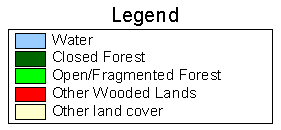
Forest Map

Management
Most of the forest stands are even-aged due to such cyclical and widespread disturbances as fire and insect infestations. An estimated 50 million hectares (12 %) are protected forest areas from harvesting bylegislation or policy. Most Canadian forests are publicly owned (> 93 %); provincial governments are responsible for managing more than 70 percent of forests and other wooded land, and federal and territorial governments oversee 23 percent. Less then 7 percent are on private property, belonging to more than 425 000 private landowners. Forest management is a matter for provincial jurisdiction, policies and regulations. Two-thirds of Canada´s estimated wildlife species live in forests. Some 117 species are listed as threatened or endangered, including 41 forest-dwelling species.