Forest Resource
Overview
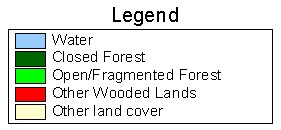
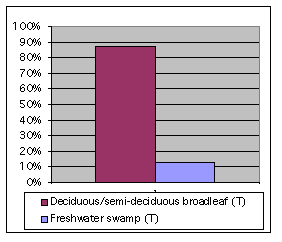
Botswana is moderately forested with around 25 percent forest cover and an additional 20 percent of its terrain classified as wooded land. Closed forests are rare in Botswana and occur only in riparian strips, particularly in the Okavango swamps. The most significant forest area is in and around the Chobe National Park where large areas of “Baikiaea woodland” occur. South of Chobe the tree canopy opens and Burkea africana becomes more prominent. Moving southward, this transitional zone turns into tree savannah, and eventually the Kalahari shrublands. Acacia species and thorn scrub are common in both savannah and shrubland. Botswana has a well-developed system of parks and reserves including Chobe National Park in the north and several large game reserves in the west, including the Central Kalahari Game Reserve, the largest protected area in Africa.
Forest Types
Geographic Description
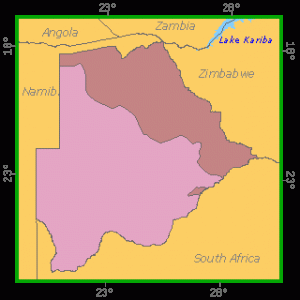
The Republic of Botswana is a land-locked country of some 581 730 km2, situated between latitudes 17° 45′ and 27° 45′ south and longitudes 20° and 29° 25′ east. It lies at the centre of the Southern African Plateau. The terrain is generally flat to slightly undulating, averaging 900 m above sea level with hilly and broken terrain on the eastern fringe.
The Kalahari Desert dominates southern and western Botswana and is without surface drainage. The rest of the country’s drainage is mostly to the interior and does not reach the sea. Extensive swamps are found in the north. The Okavango River coming from Angola feeds the large Okavango swamp. Soils everywhere are generally poor and sandy, and the associated natural vegetation varies from sparse thorn bush in the desert to dry woodland savanna in the north and east.
The climate is semi-arid to arid. There is a gradual increase in rainfall from the semi-desert conditions in the south-west, with an average annual precipitation around 225 mm, to the north (625 mm) and east (375 to 500 mm). Rainfall is concentrated in the summer months (December to April). Precipitation, however, is undependable, and the country is subject to drought.
Ecological Zones
Forest cover Vegetation |
Introduction
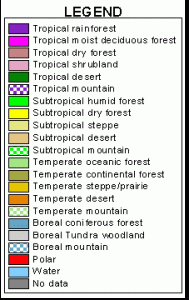
Much of the southern and western zones of the country is part of the Kalahari Desert that consists of undulating sandhills with stretches of grass shrub and wooded steppe. Only in the north-east and east, an open type of broadleaved forest occurs, while dense forests are extremely rare and found only along water courses.
Closed Forests
Broadleaved
Riparian or riverine forests are stands of deciduous and evergreen species over 15 m and up to 30 m high, fringing river banks and the outer zones of the bigger islands in the northern region, especially in the swamp areas. A grass stratum is usually absent or consists of a few shade-tolerant species. Prominent species in the dense canopy are Acacia nigresoans, A. albida, Lonchocarpus capassa, Diospyros mespiliformis, and Combretum imberbe, occasionally with Trichilia emetica (along the Chobe River), Ficus spp. and Acacia tortilis. The shrub layer, less than 4 m high, is often dense and includes shrub forms of the tree species already listed and others such as Grewia spp., Dichrostachys cinra, Rhus tenuinervis, Maytanus spp., etc. This type of forest only remains in the form of extremely narrow belts (e. g., less than 100 m along the Chobe River) and corresponds mostly to steep slopes hindering elephant browsing and concentrations of big game. Where the canopy is more open, there is dense undergrowth consisting largely of regeneration of Acacia spp. (Blair and McKay, 1968; FAO, 1972)
Open forests
Broadleaved
1. Woodlands
The woodland types consist of stands with two or three layers of trees and shrubs between 8 and 15 m in height. They have a rather open canopy of deciduous trees. The herbaceous cover is variable and contains forbs as well as grasses.
Baikiaea woodland occurs in pure stands in the Chobe District in the north-eastern part of the country. This species grows on deep sands, where it forms the climax vegetation. It may also be found in association with Burkea africana, Pterocarpus angolensis, Erythrophleum africanum, Ricinodendron rautanenii and Guibortia coleosprma. Sometimes these latter species form natural communities with Baikiaea plurijuga. These stands might be considered as a variant from which Baikiaea is sometimes absent because of previous extensive logging operations. The tree and shrub layers are often stratified, and the latter consists primarily of Baphia massaiensis, Bauhinia macrantha, Ochna pulchra and Commiphora mossambicensis, together with the regeneration of the canopy layer.
Baikiaea woodland lies between the 600 mm and the 700 mm isohyets, from the Chobe River in the north to the Ngwezumba River in the south. Areas outside the Chobe National Park where Baikiaea is dominant include the Kachikau enclave and the Kasane Forest Reserve. South of the Ngwezumba River and east of the Mababe depression, the tree canopy opens up and Burkea africana becomes more prominent. Fire, logging and a high concentration of elephants and buffalo on the northern limits of these woodlands have played an important role in their ecological evolution.
Nearly pure monotypic woodlands occur between the 550 mm and 600 mm isohyets on poorly drained soils, such as vertisols and soils of lacustrine origin. A narrow belt of this Colophospermum mopane woodland exists to the east of the Mababe depression and there are other small pockets of this type that is characterised by having bare or nearly bare ground beneath the trees. A poorly developed understorey of shrubs consists of the same species in shrubby form, of Ximenia americana, Grewia spp. and Combretum spp. Some stands are mixed, with isolated trees of Acacia spp., Combretum imberbe and Lonchocarpus capassa. Densities vary greatly over short distances and change to savanna woodland, tree savanna and shrub savanna very rapidly
Forest Industry
2. Savannas
Where edaphic or climatic conditions become unfavourable, the tree canopy opens up, grasses increase and shrubs and small trees become more abundant in the understorey.
Between the open areas of the south and the woodlands of the north there is a broad belt of mosaic-like vegetation consisting of units of tree savanna, of scattered patches of shrubland or grassland and small units of woodland. In many areas the tree savanna occurs on the ridges with the shrubland or grassland in the depressions. This pattern is characteristic of the transitional zone, although the juxtaposition of the units is more obvious in some areas than in others. Among the commonly occurring tree species are Baikiaea plurijuga, Burkea africana, Terminalia sericea, Ricinodendron rautanenii and Combretum spp. Locally common are Acacia spp., Boscia albitrunca and Lonchocarpus nelsii. Shrubs include Grewia spp., Dichrostachys cinerea, Bauhinia macrantha, Combretum spp., etc. The grass cover is variable, both in density and composition. On finer soils in certain depressions, there are pockets of Acacia woodland, the species being mainly A. giraffae, A. mellifera and A. erubescens.
Tree savanna, with a usually continuous and fairly well developed grass cover, occurs particularly in the east of the country, but also as a buffer zone between the Kalahari shrublands and denser woody vegetation types, such as transition savanna. Trees are scattered throughout the area and include mostly stunted forms of Kirkia acuminata, Acacia spp., Kigelia pinnata, Syzygium guineense, Garcinia livingstonei, Terminalia sericea, Colophospermum mopane (sometimes in open pure stands) and, in a dispersed way, many species that occur throughout the transition zone and in the woodlands. Terminalia prunioides and stunted shrub-like trees of Acacia tortilia are mainly found in scattered groups in heavily grazed grassland, especially north of Kanyu and sough of Gweta. The shrub layer includes species that form shrublands under the more arid conditions of the south (see also “shrubs”). On hilltops, particularly in the Goha, Gubatsa and Shinamba Hills, Albizia hanganyoensis, Steganotaenia araliacea and Adansonia digitata become characteristic.
Although the shrub-tree savanna is predominantly herbaceous, woody components are more frequent than in the shrubland. The greatest development of this type of vegetation occurs between the shrublands and grasslands of the south and the open savanna toward the north. In many areas, the growth of woody plants is greater on the sandy ridges. Among the shrubs Terminalia sericea is very common. Others include Grewia flavescens, Boscia spp., Rhus spp., Acacia spp., Colophospermum mopane and Zizyphus mucronata. Frequent trees, generally less than 12 m high, are Acacia giraffae, Croton gratissimus, Pterocarpus angolensis and Burkea africana. These species occur also in the shrub storey, often showing coppice development as the result of damage. This vegetation type extends into the Kalahari desert.
Forest Map

Other wooded land
Shrubs
Shrublands or woody steppes are said to cover about 35% of the total land area, especially in the south and the west of the country. They include the Kalahari savanna, the shrub savanna and the shrublands. The woody species may form thorny impenetrable thickets or open low savanna types, depending on site conditions and fire. In dune zones, shrubs are confined to the crests. The grass cover varies from extremely sparse under dense shrub growth to well developed in open bushland. Shrubs include tall-growing Acacia spp., Boscia albitrunca, Rhigozum brevispinosum and Terminalia sericea, sometimes with a lower storey of Grewia spp. and Ochna pulchra. The diversity and heterogeneity of this type is clearly demonstrated in its floristic composition. Only a few species have been mentioned, but many more occur in this vast area. Fire and overgrazing are locally common practices.
The vegetation of extreme south-west Botswana is sparse, being the result of low and very erratic rainfall. Typical species of this arid semi-desert vegetation are Rhigozum trichotomum, Acacia haematoxylon, and Monechma hereroense, all low shrubs, mostly found immediately below the dune crests, and the Gramineae Stipagrostis amabilis and Dantonia glauca. The grass cover is generally very poor.
References
Blair, R. A. and A. D. McKay (1968). The Northern State Lands, Botswana. Land Resource Study No. 5, Ministry of Overseas Development, Surbiton, U. K.
FAO (1976). The vegetation of the seasonal swamps. Based on the work of H. H. Heemstra, Technical Note No. 28, BOT/71/506. Maun, Botswana.