
Forest Resource
Overview
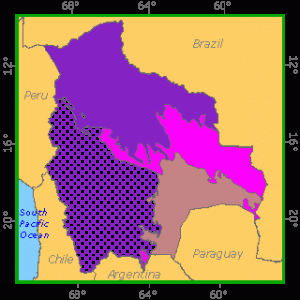
Bolivia is extensively forested with around 50 percent of the total land area covered by forests and woodlands. More than 2.700 tree and shrub species have been identified. The forests of Bolivia are mainly broadleaved tropical forests, although Bolivia´s climate, and hence forest types vary markedly with altitude. Dense lowland humid rainforests occupy much of the north-eastern third of the country. These forests are part of the Amazon basin system and species include mahogany (Swietenia macrophylla), Cinchona spp., Terminalia spp., and Calophyllum spp. The lowlands also have areas of dry tropical forest and savannah woodland. With altitude, the dominant species type gradually changes from laurel (Phoebe porphyria); to Eugenia spp.; Podocarpus spp.; and at the higher altitudes quenoa (Polylepis spp.). Much of the Bolivian forest comprises valuable commercial species, but is relatively inaccessible. Forest plantations cover around 40.000 ha. Bolivia has a substantial network of more than 50 protected forest areas covering more than 100 million hectare
Forest Types

Geographic Description
The Republic of Bolivia, located in central South America, is bounded on the north and east by Brazil, on the south-east by Paraguay, on the south by Argentina and on the west by Chile and Peru. Its total area is 1 098 581 km2.
As in other Andean countries, the extremes in latitude and elevation produce a diversity of ecological conditions. Some peaks in the highlands exceed 6 000 m, while Guayaramerín in the far north-east and Puerto Suárez in the south are respectively 170 and 145 m above sea level.
The most distinctive physical feature of the country is the Andes mountain range, which extends generally north to south across the western part of the country. The Andes form two ranges in Bolivia, the western range (Cordillera Occidental), which runs along the Chilean border, and the eastern range (Cordillera Oriental), the main range, which crosses the west central part of Bolivia. The Cordillera Oriental contains some of the highest Andean peaks, notably Ancohuma (6 388 m), Illampu (6 360 m), and Illimani (6 462 m).
Between the Cordillera Occidental and the Cordillera Oriental lies the Altiplano, a high plateau about 800 km long and about 130 km wide. Lake Titicaca, the highest navigable lake in the world, lies at the north end of the Altiplano at 3 812 m. The southern part of the plateau is arid and barren.
The Yungas, a series of well-watered valleys on the eastern mountain slopes, make up a small region north-east of the Andean Highlands. The region has steep hills covered with forests.
The Valles, a region of gently sloping hills and broad valleys, lie in the south-central part of the country.
Stretching east and north-east from the mountains is the Oriente, the great Amazonian plains containing large grassy tracts and, along the rivers, dense tropical forests. Much of this region becomes swampland during the wet season, from December through February. In the south-east, separated from the Amazonian plains by the Chiquitos highlands raising at 1 070 m, are the dry, semitropical plains of the Chaco.
Major river systems include the Beni River and its main tributary, the Madre de Dios River; the Guaporé River; the Mamoré River and the Pilcomayo River.
Although situated entirely within the tropics, Bolivia has a variety of climates. In the higher regions the climate is cold and dry. The temperature on the Altiplano averages 13° C in January and about 4° C in July, the winter season. Temperatures are even lower at higher elevations in the Andes.
The Yungas have a warm, humid climate, while that of the Valles is less humid. The temperature in these regions averages about 22° C in January and 11° C in July. Most of the Oriente has a hot, humid climate with an average temperature of 24° C the year around.
The rainy season in most parts of Bolivia lasts from December through February. The Oriente receives up to 2 000 mm of rain, while much less falls on the Altiplano and the desert areas in the south may only receive 50 mm.
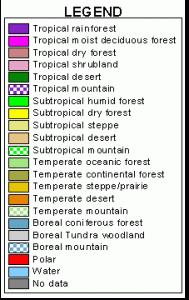
Ecological Zones
Forest Industry
Resources Forest cover Vegetation
Natural Woody Vegetation Description
Introduction
There are many vegetation layers and transitional types due to the great variety of ecological conditions (Arce, 1963).
Closed Forests
Broadleaved
Closed lowland rainforests
Called “moist forest” or “gallery forest” (Paardekooper, 1978), “moist alluvial” and “periodically flooded alluvial” forest on the Preliminary Forestry Map (Misión Forestal Alemana/Centro de Desarrollo Forestal, 1978), “tropical evergreen rainforest” by Hueck (1957) and “evergreen and semi-evergreen lowland forest” by Brockmann (1978), these forests are found in the northern half of the country, stretching from the foot of the Andean spurs to the tributary rivers on the Brazilian border (the Iteñez or Guaporé, Mamoré and Abuna Rivers). Due to the flat or only slightly rolling nature of the landscape and its almost imperceptible slope, there are vast expanses of temporarily or permanently flooded swampland in addition to many lakes and ponds. These wooded areas cover almost the whole of Pando department, as well as a large part of La Paz department, the northern strip of Cochabamba department, and the mid-western and north-western parts of Santa Cruz department. Large expanses of palm savanna occupy this zone together with the forested areas. A considerable portion – perhaps 20% -of the forests are found on permanently flooded ground or areas with little drainage and a high proportion of palms.
These forests areas have Peruvian mahogany, Swietenia macrophylla and to a lesser extent sandbox tree, Hura crepitans; Taralea oppositifolia; Cariniana sp.; Calophyllum sp.; Terminalia sp. and Ficus sp. In the periodically flooded areas Virola sp. is found. In Pando department and Vaca Diez Province (in the north of Beni department), two economically important trees are the rubber (Hevea brasiliensis) especially in low-lying areas, and the Bertholletia excelsa on higher solid ground.
The “Chiquitania”
This heading covers a combination of semi-deciduous and deciduous formations classified by Hueck (1957) as “partly evergreen deciduous mesophytic forest of the Chiquitos range” or “forests of the Velasco hills”. These formations stretch from north-west to south-east in the north of Santa Cruz department. These forests are of low to medium height (under 25 m) with very thick undergrowth. The dominant species include Astronium urundeuva, Piptadenia macrocarpa, Tabebuia sp. Tecoma sp., Machaerium sp. and Amburana cearensis.
In the north of the Chiquitania, there is a large area of Hylea amazonica vegetation containing such commercial species as mahogany and cedar, although they are not as abundant as in the closed forests of the Santa Cruz region. In terms of gross standing volume, these forests fall midway between the lowland rainforests and Chaco forest, which is made up of more open, shorter formations.
Forest Map


Sub-Andean and Andean forests
From the Argentinean border (Tarija department) to the Peruvian border, the slopes of the Andes are partially covered with forests from 400 m to 3 500 m. Using Hueck´s classification, the following basic formations can be distinguished:
- In the southern region, “evergreen Andean rainforest, lower level” and “evergreen and deciduous Andean forest, upper level” of the Tucuman-Bolivian region (Tarija and Chiquisaca departments and the south-west portion of Santa Cruz department):
– Laurel forests (Phoebe porphyria) between 500 and 900 m, from 25 to 30 m high, with other Lauraceae (Ocotea sp., Nectandra sp., cedars (Cedrela sp. and Myrtaceae such as Blepharocalyx gigantea;
– Myrtaceae cloud forests between about 800 and 1 200 m, with species of medium height and twisted trunks (Eugenia sp., etc.);
– “Walnut-pine forests” between 1 200 and over 1 700 m, made up of Juglans australis, and pine (Podocarpus sp.), often forming the edge of forests;
– Alder forests (Alnus jorullensis), forming pure stands between 1 400 and 2 700 m and reaching heights of up to 18 m, found mostly on the edge of forests;
– Queñoa forests (Polylepis sp.) at the high-altitude limit of woody vegetation (over 2 700 m).
- In the northern region (approximately north of latitude 19° S), in Cochabamba and La Paz departments, the same succession of woody formations is found, belonging to Hueck´s categories of “evergreen Andean rainforest, lower level” and “evergreen and deciduous Andean forest, upper level” of the “eastern slopes of the mid-Andes”, although there is a shift in altitude levels in comparison with the southern region:
– Up to 2 000 m, “lower Yungas forests” correspond to the laurel forests of the southern region, with a greater floristic variety;
– From 2 000 to 2 800 m, “upper or medium Yungas forests” correspond to the Myrtaceae cloud forests of the south; this level is favoured for coffee plantations;
– Above these and up to 3 400 m, “mountain-top forests”, either low or scrub in form, containing such species as Podocarpus sp. and Polylepis sp.; the latter grow taller in the drier interior valleys of the Andes.
Bamboo Palms
Palm savanna
The largest stretch of palm savanna occupies a vast area in Beni department and is marked on Hueck´s map as “palm savanna of Santa Cruz and Trinidad”. The two dominant palm species are Acrocomia totai and Attalea princeps. This savanna is mixed with gallery forests and patches of evergreen forest.
There are other smaller areas of palms within the Chiquitania (Orbignya phalerata) and also in the Bolivian part of the Pantanal swampland in the far east of the country.
Open forests
Broadleaved
Chaco forest
The south-western half of Santa Cruz department is covered mainly by Chaco-type forest, which stretches over vast areas in parts bordering Argentina and Paraguay. Called “dry alluvial” on the Preliminary Forest Map and “drought-deciduous lowland and submontane woodland” in the UNESCO (1973) classification, it has been classified as open because of an average crown cover less than that of closed forests as well as the presence of a grassy layer as in many open tropical formations. Forests described as “transitional to closed forest” can also be included in this category. The best-known species are red quebracho (Schinopsis sp..), white quebracho (Aspidosperma sp.), Piptadenia macrocarpa, Astronium urundeva, Calophyllum sp. and Tabebuia sp.
Chaco forest has various forms, including palm stands (Trithrinax campestris and Copernicia australis), gallery forests and gallery bush, secondary vegetation, and halophyte and cactus formations (Opuntia quimilo and Cereus coryne).
Coniferous
Species of the Podocarpus genus have been recorded in the wooded areas of the Andes. However, stands with a predominance of conifers do not seem to be extensive.
Other wooded land
Shrubs
In addition to degraded forms of Chaco forest there are large expanses of open scrubland on every level from the lowlands to the high plateau.
References
Arce, P. L. (1963). Explicación resumida del mapa de formaciones fitogeográficas de Bolivia. La Paz.
Brockmann, C. E. (1978). Mapa de cobertura y uso actual de la tierra: Bolivia. Memoria explicativa. Programa de Satélite Tecnológico de Recursos Naturales ERTS-Bolivia. Serie Sensores Remotos no. 2 GEOBOL, La Paz.
Hartschorn, G. (1978). Informe del consultor en dendrología. Proyecto Forestal FAO/CDF. FO:BOL/74/031. Información Técnica No. 1A, Santa Cruz.
Hueck, K. (1957). Las regiones forestales de Sudamérica. Boletin No. 2 del Instituto Forestal Latino Americano de Investigación y Capacitación, Mérida, Venezuela.
Misión Forestal Alemana/Centro de Desarrollo Forestal (1978). Diagnóstico del sector forestal. Tomo I Texto. Tomo II: Cuadros, tablas, anexos y mapas. Preparado por R. Stolz, Proyecto de Planificación Forestal, Documento de Trabajo. La Paz.
Paardekooper, E. C. (1978). Esquema de trabajo para aprovechar la goma en bosques y plantaciones de Bolivia. Proyecto Forestal FAO/CDF. FO:BOL/74/031. Documento de Trabajo No. 2, Santa Cruz.
UNECO (1973). Clasificación international y cartografía de las vegetación. Série: Ecologie et Conservation No. 6, Paris.