Forest Resource
Overview
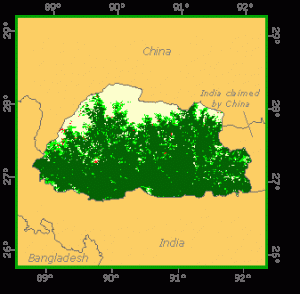
The Kingdom of Bhutan is a landlocked country in the eastern Himalayas, with some of the most rugged and mountainous terrain in the world. Bhutan is heavily forested, with a variety of forest types including fir forests, mixed coniferous, chir pine (Pinus roxburghii), and broadleaved forests. Bhutan has a negligible area under plantation forest. A relatively high proportion of forests are in protected areas and much of the forest that is legally available for wood supply is undisturbed by harvesting. Government policy specifies that 60 percent of the country´s land area should remain under forest.
Forest Types

+5,187 ac Deciduous/Semi-Deciduous Broadleaf (T)
+8,151 ac Deciduous Broadleaf (N)
Geographic Description
The Kingdom of Bhutan is a landlocked country falling between longitudes 88° 45´ and 92° 10´ E and latitudes 26° 45´ and 28° 30´ N.
Bhutan spans the foothills skirting the plains of India to the snow-clad eastern Himalayas. Tibet borders it to the north and India on the rest of the country: West Bengal and Assam to the south, Arunachal Pradesh to the east and Tibet, Sikkim and the Darjeeling district of west Bengal to the west. It has an area of approximately 47 000 km2, extending roughly 300 km from east to west and 150 km from north to south.
The country is covered with high mountains and valleys with the exception of the lowlands in the southern and south-eastern regions. The northern half of the country is formed by a series of valleys separated by mountain ranges that are accessible only through high passes. There are four main rivers: Torsa, Wong, Sankosh and Manas, that flow from the Himalayas to join the Brahamaputra River in India. Depending on altitude and location the country can broadly be divided into three zones:
- The northern zone is a belt 30 km in width running east to west with snowy tracts and extensive grasslands just below snowline between 4 300 to 4 600 m. The main backbone of mountains rises up to 7 320 m in the west and runs eastward into two prominent peaks about 6 400 m high;
- The central zone is a belt some 70 km wide running from east to west between 1 000 to 3 000 m at the foothills of the northern mountains with valleys at heights between 1 800 and 2 750 m. The most important mountain range separating the valleys reaches heights of 3 650 to 4 550 m. Punakha, Paro, Ha, Wanguphodrang and Thimpu valleys are part of this zone, which is also often described as the Inner or Higher Himalaya. The Manas is the most important river, other important ones being the Wong, Sankosh, Tongsa and Kuru. This zone contains the most valuable forests of the country;
- The southern zone is about 50 km wide, consisting of low foothills covered with dense tropical vegetation. All the rivers of the country flow down through this zone to meet the Brahamaputra River in India. The altitude ranges from about 900 m to 1 500 m.
The climate of Bhutan varies widely with the altitude, from tropical to temperate and alpine. Up to 1 500 m the climate is tropical/subtropical having monthly average temperatures varying from 4° C to 28° C. Between 1 500 and 4 000 m the annual rainfall is 1 000 mm and temperature varies from 0° C to 7° C. Above this altitude the climate is typically alpine. The snowline starts between 4 500 and 5 000 m.
Forest Industry
Resources Forest cover Vegetation
Natural Woody Vegetation Description
Introduction
Though lying entirely in the subtropical region, elevation and rainfall define a variety of vegetation types ranging from tropical to alpine.
Closed Forests
Broadleaved
Tropical semi-evergreen forests are found to a limited extent in the vicinity of the streams of foothills and the lower slopes of the hills (Champion and Seth, 1968). These are closed high forests, largely evergreen, and including a variable proportion of deciduous species. The middle storey is dense with varying undergrowth. The type is associated with heavy rainfall (up to 5 000 mm) but usually occurs on well-drained slopes from the foot of the range up to 760 m or more. Important species are Phoebe hainesiana, Beilschmiedia spp., Eugenia spp., Castanopsis spp., Michelia, Elaeocarpus, Tetrameles nudiflora, Ailanthus grandis, Cinnamomum, Altingia, Quercus, Schima wallichii, etc.
Sal forests occur through the sub-Himalayan zone including the lower slopes of the Himalayas. Rainfall is typically high, from 2 000 mm up to about 5 000 mm. Sal (Shorea robusta) is predominant with a canopy 25 to 40 m high. Due to its fire-hardy nature and ability to coppice, it is somewhat resistant to abiotic influences. Sal generally constitutes 50 percent or more of the canopy. Other associates are Schima wallichii, Lagerstroemia parviflora, Terminalia tomentosa, etc.
Lowland hardwood forests are found between 500 m and 650 m near riverbeds and occur extensively in lower areas. High rainfall (over 2 500 mm), a short dry season, well-drained porous soil and the absence of frost are characteristic. They are more or less closed high forests in which individual trees often reach large size. Species are usually well mixed. There is abundant undergrowth. Typical species are Lagerstroemia parviflora, Sterculia villosa, Bombax ceiba, Schima wallichii, Careya arborea, Amoora spp., etc. On the young alluvium of the large rivers an irregular forest occurs, usually dominated by more or less deciduous species such as Terminalia myriocarpa and Lagerstroemia speciosa and with a predominantly evergreen understorey. Other species are Pterospermum acerifolium, Duabanga spp., Ailanthus grandis, Chukrasia tabularis, etc. This type is viewed as the general seral type of the moist deciduous forest.
Subtropical wet hill forests are stands of good height and density, the dominant species being mostly evergreen, though some large, briefly deciduous trees occur, sometimes in pure consociations (e.g. Betula spp.). The trees are 20 to 35 m high but rarely stand close together. A middle storey is generally recognisable composed of a variety of medium-sized, mainly evergreen, trees. Shrubby undergrowth is always present. The type occupies slopes from about 1 000 to 2 000 m. Main species are Betula, Castanopsis, Cedrela, Albizia procera, Schima wallichii, Alnus nepalensis, Engelhardtia spicata, etc.
Upland hardwood forests occur beyond 2 000 m. Oaks (Quercus lamellosa, Q. pachyphylla) are found in patches of varying size between 2 000 and 3 000 m, often mixed with maple (Acer spp.), Magnolia campbellii, Betula alnoides, etc. Above 3 000 m these forests are found in larger patches of high density, usually free of grazing and fire. Typical species are Acer spp., Quercus spp., Machilus spp., Michelia spp., and Altingia spp.


Coniferous
Chir pine forests are generally found between 1 000 and 1 500 m, but occur to 500 m on cool aspects and may extend to 2 000 m depending upon locality. Most of the forests are of low to medium density with regeneration generally lacking as they are subjected to heavy grazing and frequent fires. Chir pine (Pinus roxburghii) usually occurs in pure form with almost no other tree reaching the canopy. There is no understorey and even undergrowth is rare. In eastern Bhutan a herbaceous layer of lemon grass is noticeable. Broadleaved species occur mixed with chir pine in hollows and depressions and along the streams. Main associates are Rhododendron spp., Quercus spp., Schima wallichii, Castanopsis spp., Kydia calycina, Phillanthus emblica, etc.
Blue pine forests generally stand between 2 500 and 3 500 m, although the range of occurrence extends down to 1 500 m on cooler aspects. Blue pine (Pinus wallichiana) normally occurs in pure patches in shady localities in the lower range of its area. In upper reaches it can be found on all aspects and is often found mixed with upland hardwoods and other conifers, particularly spruce (Picea spinulosa), Tsuga dumosa, maple (Acer spp.), oaks, birch etc. The forests are generally high, with a closed canopy, almost no understorey and low undergrowth. They are subjected to heavy biotic interference, grazing and fires. Despite this, regeneration is not a difficult problem.
High elevation coniferous forests are composed of various species among which fir (Abies densa) and spruce (Picea spinulosa) are predominant. Associates are junipers, hemlock (Tsuga dumosa), blue pine, larch (Larix griffithiana), maple, rhododendrons, etc. These forests are found in almost pure patches at elevations ranging from 3 000 to 4 000 meters. They are usually deficient in regeneration. These areas are grazing grounds for yak and other cattle during the summer months and are subject to fire.
Open forests
Broadleaved
Sub-alpine birch/fir forests grow in the eastern Himalayan region above 3 000 m. The forests consist of an irregular stand of birch (Betula bhojpatra) and Rhododendron spp. with an overstorey of Abiens densa. Rhododendron mostly occurs as undergrowth. Trees are widely spaced except in some sheltered pockets where the canopy may be closed. The forest usually occupies the ridges and slopes where snow slides are infrequent. Undergrowth may consist of Juniperus wallichiana, Pyrus aucuparia, etc. These forests have no commercial value, being inaccessible.
In addition, severely degraded forests of closed broadleaved types have acquired the character of open broadleaved forest except for floristic composition
Other wooded land
Shrubs
Alpine scrub forms a low, almost evergreen forest of Rhododendron spp mixed with some birch and other deciduous species at altitudes above 4 000 m. Trunks are small, short and branchy. The main characteristic is ample snowfall. Juniperus squamata is commonly found. In the inner valleys Myricaria spp. and Hippophae spp. also occur. In addition to these typical formations, there are various degradation stages of the climax high forests described earlier. Such formations are limited in extent and occur only on areas with difficult climatic and edaphic conditions.
References
Champion, H. D. and S. K. Seth (1968). A revised survey of the forest types of India. Publication Division, Government of India, Delhi.
Forest Industry
Resources Forest cover Vegetation
Natural Woody Vegetation Description
Introduction
Though lying entirely in the subtropical region, elevation and rainfall define a variety of vegetation types ranging from tropical to alpine.
Closed Forests
Broadleaved
Tropical semi-evergreen forests are found to a limited extent in the vicinity of the streams of foothills and the lower slopes of the hills (Champion and Seth, 1968). These are closed high forests, largely evergreen, and including a variable proportion of deciduous species. The middle storey is dense with varying undergrowth. The type is associated with heavy rainfall (up to 5 000 mm) but usually occurs on well-drained slopes from the foot of the range up to 760 m or more. Important species are Phoebe hainesiana, Beilschmiedia spp., Eugenia spp., Castanopsis spp., Michelia, Elaeocarpus, Tetrameles nudiflora, Ailanthus grandis, Cinnamomum, Altingia, Quercus, Schima wallichii, etc.
Sal forests occur through the sub-Himalayan zone including the lower slopes of the Himalayas. Rainfall is typically high, from 2 000 mm up to about 5 000 mm. Sal (Shorea robusta) is predominant with a canopy 25 to 40 m high. Due to its fire-hardy nature and ability to coppice, it is somewhat resistant to abiotic influences. Sal generally constitutes 50 percent or more of the canopy. Other associates are Schima wallichii, Lagerstroemia parviflora, Terminalia tomentosa, etc.
Lowland hardwood forests are found between 500 m and 650 m near riverbeds and occur extensively in lower areas. High rainfall (over 2 500 mm), a short dry season, well-drained porous soil and the absence of frost are characteristic. They are more or less closed high forests in which individual trees often reach large size. Species are usually well mixed. There is abundant undergrowth. Typical species are Lagerstroemia parviflora, Sterculia villosa, Bombax ceiba, Schima wallichii, Careya arborea, Amoora spp., etc. On the young alluvium of the large rivers an irregular forest occurs, usually dominated by more or less deciduous species such as Terminalia myriocarpa and Lagerstroemia speciosa and with a predominantly evergreen understorey. Other species are Pterospermum acerifolium, Duabanga spp., Ailanthus grandis, Chukrasia tabularis, etc. This type is viewed as the general seral type of the moist deciduous forest.
Subtropical wet hill forests are stands of good height and density, the dominant species being mostly evergreen, though some large, briefly deciduous trees occur, sometimes in pure consociations (e.g. Betula spp.). The trees are 20 to 35 m high but rarely stand close together. A middle storey is generally recognisable composed of a variety of medium-sized, mainly evergreen, trees. Shrubby undergrowth is always present. The type occupies slopes from about 1 000 to 2 000 m. Main species are Betula, Castanopsis, Cedrela, Albizia procera, Schima wallichii, Alnus nepalensis, Engelhardtia spicata, etc.
Upland hardwood forests occur beyond 2 000 m. Oaks (Quercus lamellosa, Q. pachyphylla) are found in patches of varying size between 2 000 and 3 000 m, often mixed with maple (Acer spp.), Magnolia campbellii, Betula alnoides, etc. Above 3 000 m these forests are found in larger patches of high density, usually free of grazing and fire. Typical species are Acer spp., Quercus spp., Machilus spp., Michelia spp., and Altingia spp.
Forest Map

Coniferous
Chir pine forests are generally found between 1 000 and 1 500 m, but occur to 500 m on cool aspects and may extend to 2 000 m depending upon locality. Most of the forests are of low to medium density with regeneration generally lacking as they are subjected to heavy grazing and frequent fires. Chir pine (Pinus roxburghii) usually occurs in pure form with almost no other tree reaching the canopy. There is no understorey and even undergrowth is rare. In eastern Bhutan a herbaceous layer of lemon grass is noticeable. Broadleaved species occur mixed with chir pine in hollows and depressions and along the streams. Main associates are Rhododendron spp., Quercus spp., Schima wallichii, Castanopsis spp., Kydia calycina, Phillanthus emblica, etc.
Blue pine forests generally stand between 2 500 and 3 500 m, although the range of occurrence extends down to 1 500 m on cooler aspects. Blue pine (Pinus wallichiana) normally occurs in pure patches in shady localities in the lower range of its area. In upper reaches it can be found on all aspects and is often found mixed with upland hardwoods and other conifers, particularly spruce (Picea spinulosa), Tsuga dumosa, maple (Acer spp.), oaks, birch etc. The forests are generally high, with a closed canopy, almost no understorey and low undergrowth. They are subjected to heavy biotic interference, grazing and fires. Despite this, regeneration is not a difficult problem.
High elevation coniferous forests are composed of various species among which fir (Abies densa) and spruce (Picea spinulosa) are predominant. Associates are junipers, hemlock (Tsuga dumosa), blue pine, larch (Larix griffithiana), maple, rhododendrons, etc. These forests are found in almost pure patches at elevations ranging from 3 000 to 4 000 meters. They are usually deficient in regeneration. These areas are grazing grounds for yak and other cattle during the summer months and are subject to fire.
Open forests
Broadleaved
Sub-alpine birch/fir forests grow in the eastern Himalayan region above 3 000 m. The forests consist of an irregular stand of birch (Betula bhojpatra) and Rhododendron spp. with an overstorey of Abiens densa. Rhododendron mostly occurs as undergrowth. Trees are widely spaced except in some sheltered pockets where the canopy may be closed. The forest usually occupies the ridges and slopes where snow slides are infrequent. Undergrowth may consist of Juniperus wallichiana, Pyrus aucuparia, etc. These forests have no commercial value, being inaccessible.
In addition, severely degraded forests of closed broadleaved types have acquired the character of open broadleaved forest except for floristic composition
Other wooded land
Shrubs
Alpine scrub forms a low, almost evergreen forest of Rhododendron spp mixed with some birch and other deciduous species at altitudes above 4 000 m. Trunks are small, short and branchy. The main characteristic is ample snowfall.