Forest Resource
Overview
Belize is heavily forested with around 90 percent of the total land area covered by moist sub-tropical forests and woodlands. Broadleaved rainforests predominate, with common species including sapote (Achras zapota); mahogany, Calophyllum brasiliense and Terminalia obovata. Many broadleaved forests have been “high-graded” for mahogany and cedar. Smaller areas of pine shrubland, mangrove forests and scrubland (from degraded closed forests) are also present. A substantial proportion of Belize´s forests are legally protected. More than 35 percent of the forest cover is in protected areas, and 18 percent is in formal forest reserves. Belize has small areas of gmelina and teak plantations.
Forest Types

Geographic Description
Belize covers an area of 22 965 km2 along the eastern coast of central America. It is bounded on the east by Guatemala and on the south by Mexico. The maximum altitude is about 1 100 m. A low coastal plain occupies the greater portion of the northern half and eastern fringe of the country.
The Maya Mountains, with an average altitude between 300 and 600 m (and a maximum elevation of 1120 m atop Victoria Peak), occupy the south-western half. The principal streams are the Belize River; the Río Azul, which forms much of the boundary with Mexico; and the Sarstún River, which forms the south-western boundary with Guatemala.
The climate of Belize is subtropical, moderated by sea breezes along the coast. The average annual temperature is about 26° C. The total annual rainfall increases from north to south and averages about 1800 mm. A rainy season extends from May to February.
Forest Industry
Resources Forest cover Vegetation
Natural Woody Vegetation Description
Closed Forests
Broadleaved
Broadleaved forests
Broadleaf forests, rich in “lime-loving” species, are part of a far more extensive forest, covering much of the Petén zone of Guatemala. The predominant tree is sapote (Achras zapota). The breadnut or ramon (Brosimum alicastrum) and mahogany (Swietenia macrophylla). The number of tree species is 300 to 400. The palm Crysophila argentea is well represented, as is cohune palm (Orbignya cohune). Annual rainfall varies from 1 300 to 1 500 mm in the north and from 1 500 to 2 300 mm in west of the country.
With increasing moisture chiquebul (Achras chicle) and bullhoof (Celtis hotteleyi) tend to replace sapote and ramon. Ironwood (Dialium guianensis) becomes a prominent tree on the deeper soils.
Broadleaf forests moderately rich in “lime-loving” species are evergreen and semi-evergreen seasonal forests, commonly developing along the riverbanks. Dominant trees are generally 30 to 35 m high. The canopy is very often broken and floods may periodically destroy part of the forest. Bamboo and cane then usually colonise the flooded areas. Quamwood (Schizolobium parahybum), Orbignya cohune, cotton tree (Ceiba pentandra), bribri (Inga edulis), Ficus sp. , santa maria (Calophyllum brasiliense), mahogany and sillon (Lucuma sp ) are among the more prominent trees.
Broadleaf forests with occasional “lime-loving” species are high forests (25 to 35 m) and have a similar composition as the previous ones but with an increased proportion of Sweetia panamensis, Acacia dolichostachya, banak (Virola koschnyi), Simaruba glauca, yemeri (Vochysia hondurensis), Vismia ferruginea and nargusta (Terminalia obovata).
Broadleaf forests with few or no “lime-loving species” are characterised as Calophyllum brasiliense – Terminalia obovata forests. Mahogany is still present but rarely denser than one tree per 20 ha. Vochysia hondurensis, Virola brachycarpa, Vismia ferruginea, negrito (Simaruba glauca), Guarea excelsa and Aspidosperma megalocarpa are slightly less abundant than in the previous type. On the slopes of the Maya mountains the average height of the trees drops slightly from over 30 m to around 20 m and Euterpe sp. palms and tree ferns (Alsophila sp.) become fairly common.
Transitional broadleaf forests show distinct signs of instability and there is a more marked tendency for segregation. Height is generally lower, the canopy is more level and there are few conspicuous emergent species. The soil profile indicates that there is a steadily increasing loss of fertility through leaching. Typical species include hogplum (Spondias mombin), sapote, santa maria, chiquebul, nargusta, Vismia ferruginea, Virola sp., yemeri, Simaruba glauca, Acacia costaricensis, Sweetia panamensis, Crysophylla argentea, Xylopia frutescens, and Dalbergia stevensonii. Miconia sp. becomes prominent in the shrub layer. Mahogany is present in varying density. However, it can often be very abundant, favoured by a more open canopy and soils rich in quartz pebbles and hence well drained.
Transitional low broadleaf forest is a type of low forest with an irregular canopy (“broken ridge”). Yemeri, Dalbergia stevensonii and Tabebuia pentaphylla are among the prominent trees. Common species in the shrub layer are Rinorea sp. and Miconia sp.
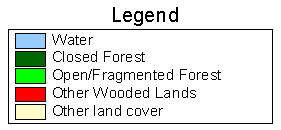
Forest Map

Marsh and swamp forests
Marshes have a perched water table 3 to 7 months of the year, while swamps have a high water table all year round. In the north, where most of the wet land associations are marsh communities, the most prominent tree is pucte (Bucida buceras), 15 to 25 m high. There is also a very conspicuous type of low marsh forest, dominated by chucum (Pithecolobium albicans), 4 to 6 m high and with a very level canopy. The high swamp forest is restricted to the southern part of the country. There are also palm swamps.
Mangroves
Mangrove swamps include Conocarpus erecta, Laguncularia racemosa, Rhizophora mangle and Avicennia nitida.
Littoral forests
Littoral forests cover a narrow coastal strip on recent dense sands.
Coniferous
Basically consist of Pinus caribaea
Bamboo Palms
Cohune palm forest is common throughout Belize.
Open forests
Coniferous
Shrubland with pine
These forests are known locally as “broken pine ridge” and consist of Pinus caribaea with Byrsonima crassifolia, Miconia sp. , Xylopia frutescens, Tabebuia pentaphylla, Dicranopteris ferus, Aspidosperma megalocarpon and cutting grass. Individual pines may rise to 15 to 20 m, 10 to 15 m above the level of the main plant cover.
Pine forest and orchard savanna
These open pine forests with grass layers also include broadleaved species such as Quercus olivifolia, Q. hondurensis, Q. sapotaefolia, Clusia sp., Tabebuia pentaphylla and palms.
Other wooded land
Shrubs
According to Wright (1959) scrub formations, originated mostly through degradation of closed forests.
References
Wright, A. C. S. et al (1959). Land in British Honduras. London Colonia Research Publications No. 24. London