Forest Resource
Overview
The principality of Andorra, among Europe´s smallest countries, is located in the Pyranees between France and Spain. Its mostly rugged, mountain terrain is covered by forests. Less than 4 percent of the land is arable. Tourism has replaced agriculture as the mainstay of the local economy. Verified data on the forest resources in Andorra is currently unavailable.
Forest Types
Geographic Description
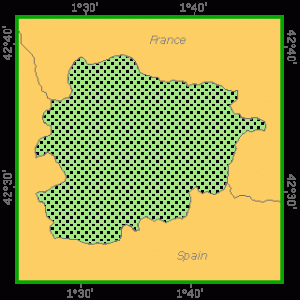
The Principality of Andorra, one of the smallest countries in the world (468 km2), lies high in the Pyrenees Mountains on the boarder between France and Spain. It is a country of narrow valleys and mountain peaks that reach heights of more than 2 700 m. The principal stream is the Valira River, which flows into Spain.
Andorra has a dry, sunny climate. Three or four heavy snows fall each year. Winter temperatures at Escaldes range between -7° C and -1° C. In the summer, the valleys are warm during the day and cool at night. Temperatures at Escaldes reach 21° C to 27° C.
Ecological Zones
Natural Woody Vegetation Description
Introduction
The Principality of Andorra is situated on the southern slopes of the Pyrenees and at 468 km2 is one of the smallest countries in Europe. It has a very uneven relief, being composed for the most part of gorges, deep valleys and mountains, culminating in Pic de Coma Pedrosa at 2 942 m. The country’s lowest altitude is at the confluence of the Rivers Runer and Valira at 840 m. Andorra’s valleys form a Y, through which three main rivers flow: Northern Valira, Eastern Valira and Great Valira. All its valleys are glacial, except in the Sant Julià region in the south where the landscape has been shaped by a river valley. The climate is Mediterranean in type, tending toward a more montane type at higher altitudes. Annual rainfall increases with altitude, averaging between 650 and 1 000 mm, and is greater on the mountain peaks.
Thirty-five percent of the country is covered by forest, mostly alpine and subalpine, although forests are also found around valleys, forming a green belt around the valley bottom and stretching up to over 2 000 m. There are four major types of forest:
- oak forests, typical of Mediterranean conditions, occur on the sunniest most southern-facing slopes. The dominant species, Quercus rotundifolia, is well-adapted to a dry climate and is mainly found on gentler slopes. This type of formation covers only small areas, due to long exploitation (for charcoal, firewood, etc.). It is still one of the most sought-after species in the country for construction timber;
- Quercus humilis, which prefers more sub-Mediterranean conditions, suffers extensively from human interference. These stands are found only in a residual form, mainly in the Andorra la Vella district. In degraded zones, the species is found together with Mediterranean trees and shrubs, sclerophyllous plants and a floristically rich herbaceous layer;
- deciduous forests contain different dominant species depending on geographical location: silver birch (Betula pendula), aspen poplar (Populus tremula), sessile oak (Quercus petraea) and hazel (Corylus avellana), as well as other secondary deciduous species. This type of forest covers large areas, mainly along water courses, and is found in the mid-montane regions, between 1 000 and 1 600 m, with an annual rainfall between 900 and 1 000 mm;
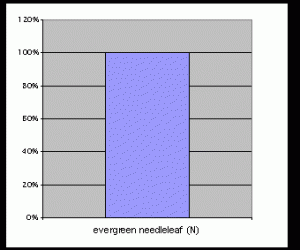
- at the other extreme in terms of Andorra’s forests are large subalpine forests suited to the climatic and edaphic rigours of the high mountains. Such stands, which account for the largest percentage of the country’s forests, are conifer forests composed mainly of Scots pine (Pinus sylvestris), silver fir (Abies alba) and black pine (Pinus uncinata). These species are found at various altitudes, depending on exposure, and form an unbroken cover on the slopes of the Pyrenees.
The dominant species in the high Pyrenean forests is the black pine which, followed by the Scots pine, is the commonest species in the country. These two species are also the most widely exploited because of the quality of their wood. There are also mixed forests, containing deciduous species (silver birch) and conifers (mainly black pine).
There are also unwooded areas and dry heaths of Cytisus purgans on sunny slopes of the subalpine zone, and moister heaths of Rhododendron ferrugineum, Gentiana lutea, G. burseri, Arnica montana, etc., on shady slopes. Above the tree-line there are alpine heaths of Festuca eskia.
Forest Industry
Closed Forests
Broadleaved
Predominantly Quercus rotundifolia forests occur at an average altitude of 1 400 m on sunny slopes. These trees never exceed 10 m in height. The understorey is made up mainly of box (Buxus sempervirens). This species of oak is ecologically very adaptable and will also grow on poor soils.
Predominantly Quercus humilis forests are typical of the sub-Mediterranean montane zone lying between 1 000 and 2 000 m with an annual rainfall of about 800 mm. They cover large areas, and the trees can reach 15 m in height. Quercus humilis is generally accompanied by Montpellier maple (Acer monspessulanum), Quercus rotundifolia, Acer opalus and Scots pine. The undergrowth is made up of box, Rosa sp., juneberry (Amelanchier ovalis), etc., but also contains such Mediterranean shrubs as common privet (Ligustrum vulgare) and Crataegus monogyna. The herbaceous layer contains Fragaria vesca and Anemone hepatica. These forests have suffered from extensive human pressure.
Deciduous forests have a variety of dominant species (sessile oak, silver birch, aspen poplar, etc.) depending on altitude and geographical location. These forests typically lie between 1 000 and 1 600 m on shady slopes, with the trees reaching 10 to 15 m in height. They are floristically rich and have a high tree cover.
Coniferous
Andorra’s conifer forests account for the major part of the country’s forested area and are made up of three main species: Scots pine, silver fir and black pine. Each species has its ecological preference: Scots pine is found between 1 200 and 1 800 m, silver fir between 1 500 and 2 000 m on shady slopes, and black pine above 1 900 m.
The dominant storey in conifer forests reaches a height of 20 m in optimum conditions, but tends to average about 15 m. The structure of these forests varies considerably, depending on exposure, human interference and altitude. Tree cover becomes lower with increasing altitude, because of the stronger winds and sunlight, poorer soil, etc., in subalpine zones. Pine and fir forests generally have two or three storeys.
Conifer forests are affected by two kinds of human pressure -alpine ski trails and motorways- both of which cause a fragmentation of forest habitats, thus leading to serious degradation of the forest environment.
Silver fir reaches a height of 30 m. Situated in the high montane zone at between 1 400 and 1 800 m, it is typically found on moist, cool, shady slopes, and needs a minimum annual rainfall of 800 mm. These stands cover only a small percentage of the country. Silver fir is dotted around the Soldeu, Ordino, Setúria and Madriu districts.
Scots pine, reaching heights of 25 or 30 m, is the commonest species in the country and is not fussy about the type of substratum. It forms large stands between 1 200 and 1 700 m with an annual rainfall of 600 to 900 mm. Thus it occupies medium-altitude mountains as well as the lower part of the subalpine level, and can be found up to 2 000 m on sunny slopes. Scots pine forests have in general replaced other plant communities (particularly Quercus humilis stands) after overexploitation. Box is the commonest shrub in their understorey.
Black pine is predominant in the subalpine zone at between 1 700 and 2 200 m and is the commonest species in Andorra after the Scots pine. It requires less moisture than the latter and is found with an annual rainfall of about 1 000 mm, where it can reach a maximum height of 25 m.
References
Dalmau I Ausàs J. et Mariné I Bellido R. (1997). Estudi de la diversitat ornitica dels boscos andorrans. Informe tècnic encarregat pel Ministeri de Medi Ambient I Turisme del M. I. Govern d’Andorra. 72 p.
Ministeri de Medi Ambient i Turisme, Departament de Medi Ambient. (1997). Mapa forestal del Principat d’Andorra. 53 p. + Mapa (Escala 1:25.000).