Forest Resource
Overview
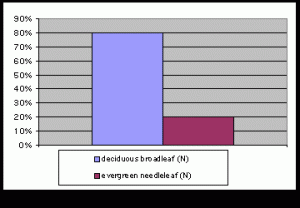
Forest covers less than two fifths of the land area of Albania, a small hilly country in southern Europe bordering the Adriatic Sea. Some areas of other wooded land are included with forest, half of which is classified as coppice and coppice with standards, the other half being high forest. Nearly four fifths of the growing stock consists of broadleaved species, predominantly species of deciduous and evergreen oak and of beech. The main coniferous species is Black Pine. Albania is one of the few European countries where there has been a decline in forest area in recent decades, due to clearance for agriculture, overgrazing and cutting for fuelwood. Fellings have exceeded net annual increment, resulting in a decrease in the growing stock; there has also been a decline in its quality as a result of illegal cutting. Most of the forest is available for wood supply; of the rest, the larger part is not available for economic reasons. More than four fifths of the forest is classified as semi-natural, with the remainder divided between forest undisturbed by man and plantations. There are efforts to increase the area of protection forest in order to preserve the rich biodiversity and the landscape. All forest is State owned.
Forest Types
Geographic Description
The Republic of Albania is bordered by the Adriatic Sea to the west, Greece to the south, the former Yugoslav Republic of Macedonia to the east, the Federal Republic of Yugoslavia to the north and north east, the Yugoslav republic of Montenegro to the north and the republic of Serbia to the north east. Its land area totals 28 750 km2. It is about 350 km north to south and 150 km east to west.
Albania is mountainous, with about 70 percent of the land above 300 m. The land rises steeply from the coastal plain to elevations of more than 2 400 m (2 764 m at the country’s highest point, Mount Korab). The most rugged mountains, the Dinaric Alps, are in the north. The mountains become gentler to the south, eventually merging with the Pindus Mountains of northern Greece.
Albania’s major rivers, the Bune, Drin, Shkumbin, and Vjose, all empty into the Adriatic Sea. It shares Lake Scutari (also called Lake Skhodra) with Yugoslavia, Lake Ohrid with Macedonia, and Lake Prespa with Macedonia and Greece.
The coastal lowlands have a Mediterranean climate with hot, arid, almost cloudless summers with mild, rainy winters. In the mountains, there is more summer rainfall and higher humidity, especially in the north. Temperatures in the mountains have much larger diurnal variation. The average temperatures in August, the hottest month, range from 170 C to 310 C. January, the coldest month, ranges from 20 C to 120 C. December, the wettest month, has an average rainfall of 211 mm while the driest months, July and August, receive only 32 mm. On the coast, annual rainfall averages 1 200 mm, but it may range up to 4 060 mm in the mountains, often occurring as snow.
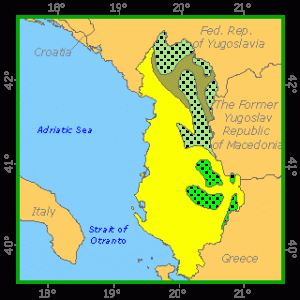
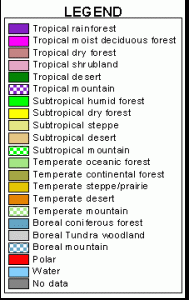
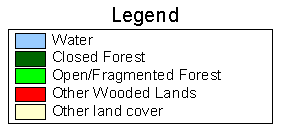
Forest cover Vegetation
Forest Industry
Closed Forests
Broadleaved
1. Oak forests
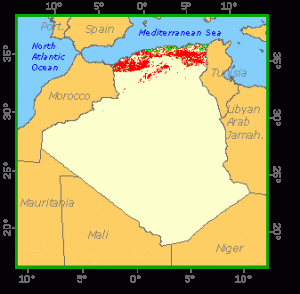
Predominantly cork oak forests (Quercus suber) are generally pure stands, mixed here and there with holm oak, and more often with zeen oak at higher altitudes and maritime pine in the northeast (the Kabylie region). Cork oak is the most common broadleaved species in Algeria, especially in the northeast.
Reaching heights of 6 to 12 m, cork oak has two different forms, depending on the bioclimatic zone in which these stands are found. In subhumid and humid zones, forests are very closed, with an extremely bushy undergrowth 2 to 4 m high, and the presence of many species (Quercus faginea, Q. afares, Prunus avium, Pistacia atlantica, Cistus spp., Cytisus spp., etc.). In semi-arid zones, on the other hand, forests are open, poor in woody undergrowth (Cytisus linifolius, Sarothamnus baeticus, Ulex spectabilis, etc.), and with a well-developed seasonal herbaceous layer.
Predominantly holm oak forests (Quercus ilex) are found in mountain zones (400-2 400 m) and in every type of bioclimate, although this species is particularly common in the northwest of the country. It is the second most widespread broadleaved species in Algeria and reaches its maximum height (about 15 m) in humid zones.
Holm oak forests have two forms, depending on climatic zone. In arid areas (Saharan Atlas and south of Oran), they form an open, low canopy with many species in the dominant storey (Juniperus phoenicea, Juniperus oxycedrus, Pistacia terebinthus, P. atlantica, etc.), while in subhumid and humid areas they form a high, very closed canopy, with such species as Pinus halepensis, Olea europea, Quercus faginea, Juniperus oxycedrus, Taxus baccata and Sorbus terminalis, and an undergrowth made up mainly of mastic (Pistacia lentiscus), Cistus sp. and Crataegus monogyna.
Forests with a predominance of other species of oak (zeen oak/Quercus faginea and afares oak/Quercus afares) are usually thick and closed, with a poorly developed undergrowth. They are found in the coolest parts of cork oak stands, and also at higher altitudes.
In the tree layer, zeen oak is often combined with other species such as Quercus suber, Quercus ilex, Sorbus terminalis and Acer campestre. Afares oak is closely related to zeen oak and is found only in Algeria, mainly on relatively dry mountain slopes. It forms a thick cover, and its undergrowth is made up of the same species as that in zeen oak forests.
Coniferous
Predominantly Aleppo pine forests (Pinus halepensis) occur at low altitudes, primarily on sedimentary soils in semi-arid zones, although they are also found in all the forested regions of the country. Aleppo pine is generally mixed with holm oak and Phoenician juniper, and such stands take three different forms, depending on geographical zone. On the driest soils in the coastal and subcoastal zones (humid and subhumid climates), it is found in association with Phoenician juniper, mastic, kermes oak (Quercus coccifera), wild olive, Cistus sp., etc. In the Tell mountains, it occurs with Quercus ilex, Pistacia terebinthus, Juniperus oxycedrus, etc. In the drier mountain zones (Saharan Atlas), the undergrowth is abundant and other species are added to those of the preceding type (phillyrea [Phillyrea angustifolia], Crataegus monogyna, etc.).
Predominantly maritime pine forests (Pinus pinaster) are natural forests found in the northeast of the country (the Kabylie region). Maritime pine colonizes degraded cork oak stands, and its undergrowth is in fact identical with that of cork oak forests.
Predominantly Atlas cedar forests (Cedrus atlantica) occur as scattered islands at higher altitudes (the central Tell, Kabylie and Aurès regions) in humid to subhumid zones, and may have two forms, depending on conditions. The humid form is closed, with an undergrowth of holm oak, and the associated species are mainly Juniperus oxycedrus, Fraximus dimorpha, Ilex aquifolium, Quercus faginea and Cytisus sp. Other species -mountain juniper (Juniperus thurifera), Sorbus aria, yew, Montpellier maple (Acer monspessulanum), etc.- appear in relatively arid zones.
Open forests
Coniferous
Predominantly thuja forests (Tetraclinis articulata) reach heights of about 15 m and are very open because of the characteristic slimness of the species’ crowns. The undergrowth is therefore abundant and rich in species (Pistacia lentiscus, Pistacia atlantica, Quercus coccifera, Phillyrea media, Withania frutescens, heather [Erica multiflora], Rosmarinus sp., etc.). The herbaceous layer is also very well-developed and contains a wide range of species.
Predominantly Phoenician juniper forests are found on the coastal dunes of the Oran region, but also on the High Plateaux and the dry slopes of Algeria’s mountains. They are open and low, and have often suffered severe degradation from human depredations. On dunes, Phoenician juniper is found in association with Olea europa, Pistacia lentiscus, Withania frutescens, Jasminum fruticans, etc., whereas in mountain regions these forests are more open, and the main secondary species are prickly cedar, rosemary (Rosmarinus officinalis) and Globularia alypum.
Mountain juniper is less common and is found in cooler climates at higher altitudes.
Other wooded land
Shrubs
Shrubland (or matorral), maquis and garrigue are low formations, distinguished from one another by the height of their dominant layers. Shrubland and maquis occur on siliceous soil, while garrigue is found only on calcareous soil. They are generally degraded forms of closed or relatively closed forests, and although some do appear to be climax formations, they are most often the result of human activities (overgrazing, firewood collection, repeated burning, etc.). For example, when a cork oak forest in a humid or subhumid zone is degraded, it will turn into a maquis of tree heath (Erica arborea), Phillyrea sp., etc., which is replaced at a more advanced stage of degradation by a bushy formation of Pistacia lentiscus, Cistus sp., Retama sp., etc.; the final stage of degradation in this case is a heath of Cistus sp., Pteris sp. and Amplodesma.
These types of formation usually contain scattered trees (mainly holm oak, wild olive, etc.) among the shrubs and bushes. However, the floristic composition of these scrub formations varies widely and is thus hard to classify.
Steppes in the arid zones are also for the most part of secondary origin, resulting from depredations of Aleppo pine forests by humans and animals. They are low, broken formations with perennial grasses.
Although secondary steppes look the same as climax steppes, they are distinguished by the presence of such species as rosemary and Fumana.
References
F.A.O. (1990). Rapport du programme de coopération F.A.O./Banque mondiale. Algérie, projet forestier, aménagement des bassins versants. F.A.O., Rome, Italie.
Goodall D.W. (1986). Ecosystems of the world 12B. Hot deserts and shrublands, B. Elsevier Ed. Amsterdam, Oxford, New York, Tokyo. 451 p.
Le Houérou H. N. (1995). Considérations biogéographiques sur les steppes arides du nord de l’Afrique. Sécheresse. 6(2):167-182.
Seigue A. (1985). La forêt circumméditerranénne et ses problèmes. Techniques agricoles et méditerranéennes. G. P. Maisonneuve & Larose Ed. et A.C.C.T., Paris, France. 502 p.
Souleres G. (1993). Aménagement des forêts – Algérie. F.A.O., Rome, Italie, 79 p.