Forest Resource
Overview
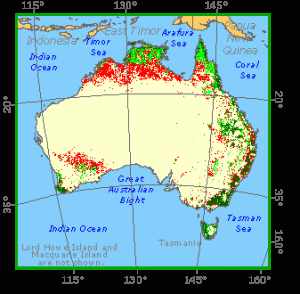
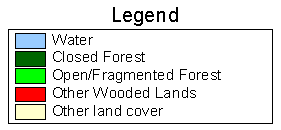
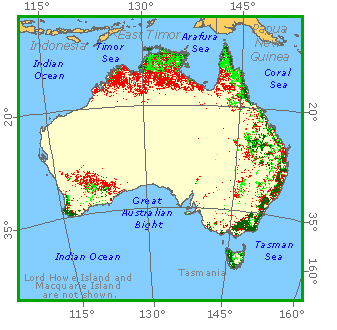
Australia has a large forest resource despite having a relatively low proportion of forest cover (about 21 percent of land area). At the same time the areas of other wooded lands are the largest among the temperate/boreal industrialized countries (more than 420 million ha, including open woodland and tall shrub lands). Forests are mainly located in a broad coastal band extending the length of the eastern seaboard. The vast majority of the Australian forest resource is natural forest, dominated by eucalyptus species, mixed with a variety of acacia species, cypress pine (Callitris spp.) and paper-bark (Melaleuca spp.). Australia also has significant areas of plantation forest comprised mainly of radiata pine and eucalyptus. The pine species besides Pinus radiata are P. elliottii, P. pinaster, and P. caribaea.
Forest Types
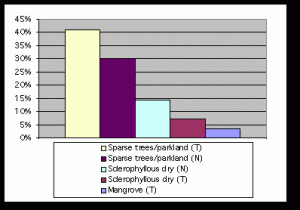
+2,330 ac Upper Montane Forest (T)
+14,177 ac Deciduous Broadleaf (N)
Geographic Description
Australia occupies the island continent of the same name located south-east of Asia. It is bounded on the north by the Timor Sea, the Arafura Sea, and the Torres Strait; on the east by the Coral Sea and the Tasman Sea; on the south by the Bass Strait and the Indian Ocean; and on the west by the Indian Ocean. It is about 4 000 km wide and about 3 700 km from north to south with a total area of 7 682 300 km2. Although Australia is the smallest continent, it still comprises five percent of the earth’s land area and Australia is the world’s sixth largest country.
Most of Australia is low and flat, with an average elevation of only about 300 m. The highest and most mountainous land lies along the east coast. Australia can be divided into three major land regions: the Eastern Highlands, the Central Lowlands and the Western Plateau.
The Eastern Highlands extend from the Cape York Peninsula in extreme north-eastern Australia to the southern coast of Tasmania. A low plain bordered by sandy beaches and rocky cliffs stretches along the Pacific coast. These highlands are also called the Great Dividing Range because rivers that flow down the eastern slopes empty into the ocean and rivers that run down the western slopes flow to the Central Lowlands. The most important rivers flowing toward the east coast are the Burdekin, Fitzroy and Hunter, while the Murray, Darling and Murrumbidgee are the more important ones flowing inland. The highlands consist mainly of high plateaus, broken in many places by gorges, hills, and low mountain ranges averaging approximately 1200 m in height. The highest point in the Highlands and in Australia is Mount Kosciusko at 2 228 m.
The Central Lowlands are generally flat. The climate is hot, rainfall is infrequent, much of the land is dry or desert, and many of the rivers flow only intermittently. The west-central part of the region is a barren, sandy desert. Lake Eyre, the lowest point in Australia, lies 16 m below sea level along the southern edge of this desert.
The Western Plateau covers the western two-thirds of Australia. Although higher than the Central Lowlands, most of the land is also flat. Deserts cover the central part of the Western Plateau, giving way to more moist conditions to the west, with higher rainfall to the north and south-west. A vast, dry, treeless plain, the Nullarbor (derived from the Latin for “no trees”), extends for over 600 km along the southern edge of the region. There are few major rivers. the most important being the Fitzroy, Ashburton, Gascoyne, Murchison, and Swan Rivers.
Ecological Zones
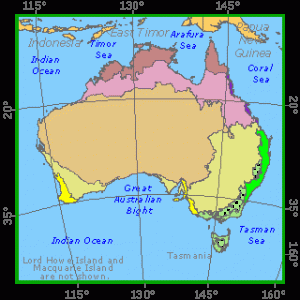
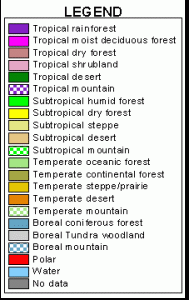
The climate of Australia varies from tropical with summer monsoons in the north to temperate in the south. The northern third of Australia lies in the tropics and is warm or hot all the time. The rest of the country lies south of the tropics and has warm summers and mild or cool winters.
Many points on the northern and north-eastern coast have an average annual rainfall of 1 500 to 2 500 mm. Inland are drier savanna grasslands, while in the deserts of central and western Australia the annual rainfall may be less than 250 mm. The south-east coast, on the other hand, receives rather uniform rainfall throughout the year. The warm, temperate western and southern coasts receive rain mainly in the winter months, usually from prevailing westerly winds. Tasmania, lying in the cool temperate zone, receives heavy rainfall from the prevailing westerly winds in summer and from cyclonic storms in winter. Snow is unknown over most of the country except in Tasmania and the mountains of southern New South Wales and northern Victoria, where snowfall is occasionally heavy. The southern regions often experience hot, dry summer winds that can desiccate crops and raise the danger of bush fires.
The temperate regions of southern Australia, although they have a mild climate, have four definite seasons with cool winters and warm summers. January and February are the warmest months, with average temperatures varying between 18° and 21° C. June and July are the coldest months, with an average July temperature of about 10° C, except in the mountains where temperatures average 2° C. There can be occasional frosts in the southern regions and sustained cold weather in the mountains and the interior of Tasmania. In central and northern Australia average summer temperatures range between 27° and 29° C.
Norfolk Island, located in the south-western Pacific Ocean about 1 500 km east of Australia, is a dependency of that country. Its area is about 34 km2.
The land is an undulated plateau about 90 to 120 m above sea level. There are two peaks in the north-west, Mt. Pitt (316 m) and Mt. Bates (318 m), which are extinct volcanoes. In the south, the land slopes gently to the sea, but around the remainder of the island basaltic cliffs drop directly into the ocean. Norfolk Island has fertile volcanic soil.
The climate is subtropical, with an average temperature of 17° C in the cool period of June to September and 22° C in the warmer period of December to March. Most of the rainfall occurs during the cool season, but annual and seasonal rainfall can be quite variable. The country is subject to occasional hurricanes.
Forest Industry
Management
A significant proportion of Australia´s forest land is reserved for conservation purposes in National Parks and reserves; the remainder is divided between private, State and Federal ownership. Conservation and maintenance of soil and other resources are fundamental aim of public land managers on nature reserves and State forests. The areas of lands with significant soil erosion in such areas is very small. Not all forests in Australia are considered protected areas as defined by IUCN (about 15 % are determined as such).
Forest Map