Forest Resource
Overview
Cameroon is well-forested with more than 40 percent forest cover and, additionally, more than 30 percent of other wooded land. The forests are mainly closed tropical broadleaved rainforests with three predominant types: lowland evergreen; lowland semi-deciduous; and montane. Important commercial species in Cameroon´s forests include Ayous (Triplochiton scleroxylon), Sapelli (Etandrophragma cylindricum) and Azobe (Lophira slata). The closed forests are concentrated in the south and along the coast. Areas of mangroves are found in the Gulf of Guinea and areas of Acacia woodland occur in the north. Cameroon has a modest area of plantation forest. Around 6 percent of Cameroon´s forests are formally protected in a network of protected areas. Further significant areas of forest, including the Lac Lobeke forest, are planned to be protected as part of a trans-national protected zone.
Forest Types
Geographic Description
The Republic of Cameroon, located in western Africa, is bounded on the north by Lake Chad; on the east by Chad and the Central African Republic; on the south by the Republic of the Congo, Gabon, and Equatorial Guinea; and on the west by the Bight of Biafra (an arm of the Atlantic Ocean) and Nigeria. It covers an area of 475 442 km2 lying between latitudes 2° and 13° N (about 1 200 km) and longitudes 8° 30´and 16° 10´ E, and for the most part between 200 and 800 m above sea-level. It can be divided into the following broad geographic regions on the basis of climatic and topographic criteria:
- The southern zone, roughly between 2°and 6° N and for the most part below an altitude of 800 m, with a four-season climate, rainfall over 1 500 mm and a maximum of two dry months. This is a region of closed evergreen or semi-deciduous rainforest, forming an unbroken blanket in the south and splitting into islands north of the fourth parallel; it corresponds to the “humid” and “low- and medium-altitude sub-humid” eco-floristic zones;
- The coastal zone, a 200-km-wide strip along the sea in which oceanic influences predominate. The single dry season is not very marked, and rainfall decreases from 4 000 mm on the sea (Douala) to 2 500 to 3 000 mm 50 km inland (Edea) and 2 000 mm along the border with the previous zone. It corresponds to the “low- and medium-altitude very humid” eco-floristic zone (42), with an evergreen forest whose vegetation differs from that of the evergreen forests further inland. The coastal and southern zones make up Letouzey’s “Congo-Guinean” floristic region (16);
- The northern zone, with a two-season climate, a dry season lasting six to eight months and a Sudano-Sahelian climate (in Aubréville’s scheme). It corresponds to the “very dry” eco-floristic zone (42) and is an area of Sudanian savannah with woody elements on the Adoumaoua plateau and Cameroonian basin of the Benoué River and Sudano-Sahelian thorn steppes, together making up the “Sudano-Zambezian” floristic region (16);
- Mount Cameroon (at 4 070 m the highest point in the country), the mountains and highlands in western Cameroon and on the border with Nigeria, together with the isolated mountain massifs in the north of the country, all over 800 m and ranging up to 2 740 m (Mount Bambouto). These areas differ climatically from the neighbouring lower areas and are covered by somewhat different vegetation, with high closed rainforest in the south and high savannah woodland in the north. They correspond to the “medium-altitude” and “montane” eco-floristic zones (42).
Cameroon has a tropical climate, humid in the south but dryer to the north. As indicated above, rainfall ranges from about 4 000 mm on the coast to about 400 mm in the north-east. The average temperature in the south is 25° C, while on the plateau it is 21° C and in the north it is 32° C.
Ecological Zones
Forest cover Vegetation
Closed Forests
Broadleaved
Low- and medium-altitude closed evergreen rainforests can be divided into two broad categories: the Biafran forest, forming an arc around the Bay of Biafra, and the Congolian forest further inland.
The Biafran forest can then be further subdivided. First there is the low-altitude coastal forest of Lophira alata and Sacaglottis gabonensis, as well as Cynometra hankei and Coula edulis, which is in fact a replacement forest, having recolonised it after earlier clearing (Letouzey, 1968). There is a long-standing trade in timber from this forest, especially in bongozzi or azobé (Lophira alata) and eteng or ilomba (Pycnanthus angolensis). The remainder of the Biafran forest is basically made up of Leguminosae combined with Irvingiaceae and Rosaceae. There are also some quite large pure stands of Caesalpiniaceae such as Brachystegia spp., Cynometra hankei, Didelotia brevipaniculata, Gilbertiodendron brachystegioides, Julbernadia spp., Monopetalanthus spp. and Tetraberlinia spp.
The medium-altitude closed Congolian evergreen rainforest stretches eastwards from the Biafran forest roughly to longitude 15° E. Its vegetation differs from that of the transitional forest (Centre Technilque Forestier Tropical, 1967) and also from that of the Biafran forest by the absence of numerous Caesalpiniaceae with the notable exception of Gilbertiodendron dewevrei which occurs in smallish stands, more or less confined to valleys. Another feature is the importance assumed by adjap or trade moabi (Baillonella toxisperma), a heavy hardwood member of the Sapotaceae family with a very fine grain, prized by farmers for the oil from its seeds.
The medium-altitude closed semi-deciduous forests are marked by an abundance of Sterculiaceae such as Cola spp., eyong (Eribroma oblonga), nkul or trade bété (Mansonia altissima), Nesogordonia spp., Pterygota spp., Sterculia spp., ayous, samba or trade obeche (Triplochiton scleroxylon), accompanied by many Ulmaceae, with Celtis being the most significant of these. Like the neighbouring semi-deciduous forests in the Central African Republic, they are particularly rich in commercial species, especially those used for veneer (ayous in particular), but they also contain a significant amount of Meliaceae red woods, especially asié or trade sapele mahogany (Entandrophragma cylindricum) and bibolo or trade dibetou (Lovoa trichilioides).
The mountain and high-mountain closed rainforests become increasingly homogeneous with altitude (with almost pure Cola spp. stands at 1 500 to 2 000 m on Mounts Koupé and Nlonako in the south, and Syzygium parviflorum and Lachnopylis mannii stands above 2 000 m in the Bamboutos mountains in the Bamiléké country). An interesting feature is the appearance of Podocarpus milanjianus, the only conifer in Cameroon, at about 1 800 m in the various mountain areas in the south. The fact that it is usually present only mixed with other species and that the forest islands where it does predominate are very small indicate that natural predominantly conifer stands account for a negligible area in terms of the country as a whole.
In the surrounding savannah, the composition of the gallery forests differs very little from that of the neighbouring semi-deciduous forest. South of latitude 6° 30¢ N, the area of gallery forests wider than one kilometre has been estimated at 145 000 ha (FAO, 1980), but the width and average height of these forests tend to decrease steadily further north and as the altitude increases. In Adamaoua the vegetation in the small hemmed-in forest valleys (Aubrevillea kerstingii, Eriocoelum kerstingii and Parinari kerstingii) and the pure stands of Syzygium guineense above the gallery forests are very typical features (Letouzey, 1968).
There are many types of closed edaphic forest, but the following should be particularly noted:
Mangroves: These lie along the border with Nigeria (the Akpa, Yafe, Ndian and Meme Rivers), all around the Cameroon estuary (the Bimbia, Mungo, Wouri and Dibamba Rivers), along the coast south of the mouth of the Sahaga and around the mouths of the Loukoundje and the Ntem (FAO, 1980). The outer or “normal” mangrove contains two species of Rhizophora (R. racemosa and R. mangle) with Avicennia nitida and Laguncularia racemosa in a few places. The inner mangrove is made up of stands of Pandanus spp., raffia and rattan palms.
Swamp and riparian raffia palms where species of the Raphia genus (R. hookerei, R. monbuttorum and R. vinifera) are found alongside Mitragyna ciliata, M. paludosa and Uapaca spp.
Many types of swamp or periodically flooded forest also contain some of the above species: two edaphic forests in the south-east of the country deserve special mention: the stands of Guibourtia demeusei in the Sangha flooded forest (which is also found in the south of the Central African Republic and the north of the Congo), forming a narrow fringe along the banks of the Sangha and the Ngoko, and the Sterculia subviolacea swamp forest of the Upper Nyong, where this species is exclusive to the dominant storey.
Forest Industry
Bamboo Palms
More or less isolated clumps of bamboo (Oxytenanthera abyssinica) should also be noted in the north of the Adamaoua plateau.
Borassus palms (Borassus aethiopum) form large stands in the Benoué basin (“Borassus Valley” west of Poli, around Rey Bouba and in the valleys of the Vina and the Mbéré).
Open forests
Broadleaved
Tree and woodland savannah and Sudanian dry open forest stretch to the north of Adamaoua approximately between latitudes 8° and 10° N. Their composition is fairly sharply divided (Letouzey, 1959): stands of Monotes kerstingii, and particularly of Isoberlinia dalzielii, I. doka and Anogeissus leiocarpus accompanied by many tree species common to Sudanian zones (Afzelia africana, Butyrospermum parkii, Daniellia oliveri, Parkia biglobosa, etc.) to the south of the Benoué River; and concentrations of baobab (Adansonia digitata), Anogeissus leiocarpus, Burkea africana and Prosopis africana, and such Sahelian elements as Acacia albida, A. caffra, A. sieberiana and Balanites aegyptiaca to the north of the Benoué. The Sudanian stands do not grow as tall at higher altitudes.
Part of the Daniellia oliveri and Lophira lanceolata savannah on the Adamaoua plateau could be classified as a tree (and not only shrub) formation, since Daniellia oliveri in particular is a tree that can grow quite large. Savannah woodland formed of Burkea africana with touching crowns is a special feature of the Adamaoua wooded savannah.
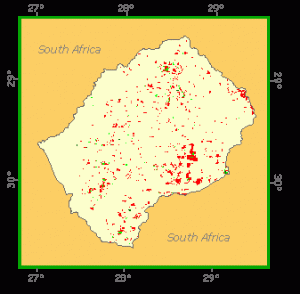
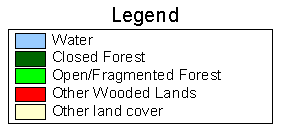
Forest Map
Other wooded land
Shrubs
Along with part of the Adamaoua wooded savannah, this category would cover the thorn steppes in the Sudano-Sahelian part north of latitude 10° N. These are made up of the following woody species: Acacia spp., Balanites aegyptica and Ziziphus spp., as well as non-thorny and more shrub-like species. Acacia seyal covers large areas wherever there is black clay soil (Letouzey, 1959). The many remaining Sudanian elements indicate that a man-made “Sahelization” is under way with grazing land and abandoned farmland being invaded by typically Sahelian woody species.
The thickets on the sandy coastal bars behind the mangroves can also be considered to be in the category of scrub vegetation, but cover only an insignificant area in terms of the whole country.
References
Centre Technique Forestier Tropical. 1967. Inventaire forestier préliminaire dans le Haut-Nyong et la Boumba-Ngoko. Nogent-sur-Marne. France.
Letouzey, R. 1959. Atlas du Cameroun – Carte phytogéographique. Paris.
Letouzey, R. 1968. Etude phytogéographique du Cameroun. Paris.
FAO. 1980. Cartographie du couvert végétal et étude de ses modifications. Système mondial de surveillance continue de l’envioronnement, Projet pilote sur la surveillance continue de la couverture forestière tropicale basé sur les travaux de R. Baltaxe, J. Guellec et L. Oko. Rapport technique No. 1 UN 32/6 (1102-75-005). Rome.