Forest Resource
Overview
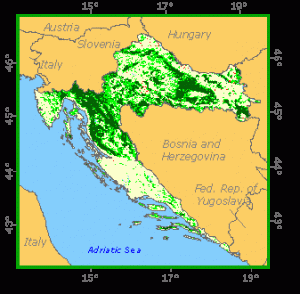
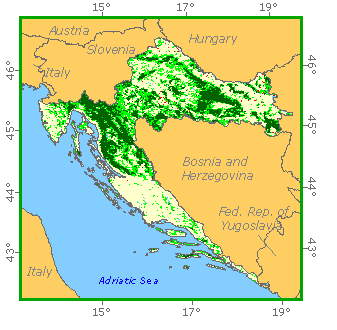
Croatia is located in southern Europe between the Adriatic Sea and Hungary, with Slovenia to the west and Bosnia and Herzegovina to the east. Forest and other wooded land covers more than a third of the area and falls into two climate-influenced categories: the more productive continental region forests to the north, with oak and beech high forests, coppice stands of oak, beech and other broadleaved species including hornbeam, chestnut, alder and robinia, and uneven-aged forests of spruce; to the south, the Mediterranean region forests, mainly rather unproductive ecosystems (maquis, barren karst areas, etc.) of oaks and pines, predominate. In the country as a whole, broadleaved species make up more than four fifths of the growing stock volume. Most of the forest area is classed as available for wood supply and as semi-natural, with relatively small areas of plantations; there is virtually no forest undisturbed by man. The area of protected forest has been increasing, for example by enlarging or creating National Parks. Nearly four fifths of the forest is State owned, the remainder is owned by a large number of individuals in small-sized parcels.
Forest Types
Geographic Description
The Republic of Croatia, located on the Balkan Peninsula, is bordered on the north by Slovenia and Hungary, on the east and south by Bosnia and Herzegovina, on the east by Yugoslavia, and by the Adriatic Sea on the west. The total area is 56 540 km2.
Croatia consists of two main regions, Dalmatia and the Pannonian Plains. Dalmatia, the coastal region between the Adriatic Sea and Bosnia-Herzegovina, has rocky cliffs and little fertile soil. The fertile Pannonian Plains lie in the north-eastern part of the country, bordering Hungary. They are drained by Croatia’s two main rivers, the Drava (Drau) and Sava rivers, which in turn flow into the Danube. Several parallel ranges of the Dinaric Alps extend through the centre of Croatia. The coast has many bays and islands.
Dalmatia has a Mediterranean climate with mild, rainy winters and warm, dry summers. In winter, the temperature rarely falls below freezing. However, a cold, gusty wind called a bora sometimes blows down from the mountains in autumn and winter. The Pannonian Plains have a more continental climate, with dry, hot summers and cold winters, often with a freezing wind called a kosava. The average temperature in Zagreb is 0° C in January and about 24° C in July, while in Dubrovnik the average is about 9° C in January and 25° C in July. Annual precipitation along the coast is about 760 mm
Ecological Zones
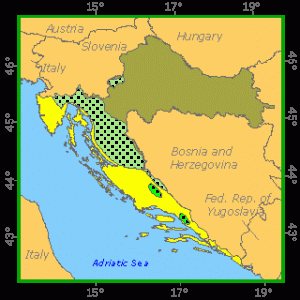
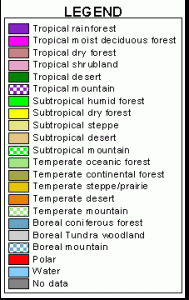
Forest Industry
Management
The new regulations which entered into force in 1996 have promoted the increase of the forest protected areas: in particular, the area of the National Park Plitvice Lakes is enlarged, and a new Nature park Zumberak is established. About 80 % of forests are owned by the state enterprise ACroatian forests and the remaining 20 % are owned by small forest owners, where mostly cordwood, fuel-wood, vine poles, etc are produced.