Forest Resource
Overview
India has a large and diverse forest resource. The country´s very large population means, however, that intense demands are placed on its forests. Its forest types vary from tropical rainforest in north-eastern India, to desert and thorn forests in Gujarat and Rajasthan; mangrove forests in West Bengal, Orissa and other coastal areas; and dry alpine forests in the western Himalaya. The most common forest types are tropical moist deciduous forest, tropical dry deciduous forests, and wet tropical evergreen forests. Nearly 22 percent of total land area is classified as forest land. India has established more than 12 million hectares of forest plantations, mainly for fuelwood purposes. Line planting along roads, canals and railways is also a very important wood source in India. The country has a large network of protected areas, including 80 national parks and around 450 wildlife sanctuaries.
Forest Types
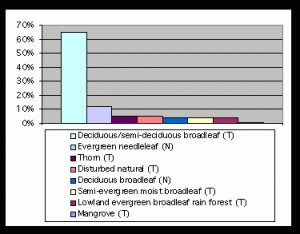
+247,247 ac Sclerophyllous Dry (T)
+16,549 ac Freshwater Swamp (N)
+221,806 ac Sclerophyllous Dry (N)
Geographic Description
The Republic of India, in southern Asia, is the seventh largest country in the world, covering an area of 3 287 590 km2. The mainland extends between latitudes 8° 04´ and 37° 06´ North and longitudes 68° 07´ and 97° 25´ East and measures 3 200 km from north to south between the extreme latitudes and about 2 950 km from east to west between the extreme longitudes.
India is bounded on the north by Afghanistan, China, Nepal, and Bhutan; on the east by Bangladesh, Myanmar, and the Bay of Bengal; on the south by the Palk Strait and the Gulf of Mannar -which separates it from Sri Lanka- and the Indian Ocean; and on the west by the Arabian Sea and Pakistan. It has a land frontier of about 15 200 km and a coastline of some 6 100 km.
The mainland is comprised of four well-defined regions:
- The Himalayas occupy the northern part of the country and consist of three almost parallel ranges interspersed with large plateaus and valleys. Some of the highest peaks in the world are found in these ranges. This mountain wall extends over a distance of 2 400 km with a varying depth of 240 to 320 km;
- The northern plains, about 2 400 km long and 240 to 320 km broad, formed by the basins of three main rivers – the Indus, Ganga and Brahamaputra – originating in the Himalayas. In this zone variation in relief does not exceed 300 m;
- Desert occupies the mid-western part of the country. There is no surface water and rainfall is very scanty. The region is almost sterile;
- The peninsula plateau is set off from the northern plains by a mass of mountain and hill ranges varying from 450 to 1 200 m in height. The peninsula is flanked on one side by the Eastern Ghats, with an average elevation is 600 m, and on the other side by the Western Ghats with elevations from 900 to 1 200 m rising in places to over 2 450 m. Between the Western Ghats and the Arabian Sea lies a narrow coastal strip. Between the Eastern Ghats and the Bay of Bengal the coastal strip is broader. The southern part of the plateau is formed by the Nilgiri Hills where the Eastern and Western Ghats meet.
The geological regions broadly follow the physical features and may be grouped into three well-defined zones:
- The Himalayan mountain belt and associated mountains are regions of mountain building activity.
- The northern plains are a great alluvial tract that separates the Himalayas from the peninsula in the south. The alluvium, which is about 6 000 m deep, conceals beneath it the southern fringes of the Himalayas and the northern fringes of the peninsula. This belongs to the latest chapter of earth´s history.
- The peninsula is a region of relative stability and rare seismic disturbances. Highly metamorphosed rocks of the earliest period occur over more than half of the area and the rest is covered by coal-bearing Gondwana formations, later sediments and lava flows belonging to the Deccan trap formation.
The climate of the country can be broadly classified as tropical monsoon type though it varies from torrid to arctic in different areas of the country. Four broad climatic regions are distinguished based on rainfall:
- Practically the whole of Assam and its neighbourhood, the Western Ghats and adjoining coastal strip and parts of the Himalayas are areas of very heavy rainfall with more than 2 000 mm annual precipitation.
- In contrast Rajasthan, Kutch and the high Ladakh plateau of Kashmir receive rainfall of less than 500 mm per year.
- Between these two extremes are regions of moderately high rainfall, from 1 000 to 2 000 mm. The former consists of a broad belt in the eastern part of the peninsula merging northward with the northern plains. The latter runs from the Punjab plains across the Vindhya Mountains into the western part of the Deccan, extending further east in Karnataka and Andhra Pradesh.
Forest Industry
Resources Forest cover Vegetation
Natural Woody Vegetation Description
Introduction
India comprises a variety of forests due to vast stretch of land representing different climatic regions and topography. The topical dry and moist deciduous, tropical rain and hill and montane are the main forest formations.
Closed Forests
Broadleaved
All predominantly broadleaved forests with a fairly dense canopy are described under this heading. Since they occur from tropical to temperate climates with large variation in species composition it is necessary to present them separately.
Tropical wet evergreen forests
These forests occur in the states of Maharashtra, Karnataka, Tamilnadu, Kerala, Andaman and the Nicobar Islands in the south and in the entire north-eastern region including the sub-mountain division of West Bengal. These forests are found in the plains, on low hills and on the gentle slopes of the foothills of the mountains at elevation ranging from almost sea level up to about 1 000-1 200 m. Generally, forests in the plains and on the lower slopes have been cleared in the past, such as along the Western Ghats where this type is absent from the coastal plain but appears at about 500 m and extends up to 1 500 m. The annual rainfall is 2 000 mm or more, rarely as little as 1 500 mm or more than 3 000 mm. The dry season does not extend beyond 2-4 months with less than 50 mm rainfall. These forests are composed of lofty, dense, evergreen trees, 45 m or even higher. Many tree species occur in mixture. Some species of the upper storey are trees with clear boles 30 m long and 5 m or more in girth. Long cylindrical boles, usually with thin smooth bark, are typical but plank buttresses are also frequently seen. The canopy is extremely dense and except for scattered giants that project well above the canopy there is no differentiation into definite canopy layers. The undergrowth is often a tangle of cane, creeping bamboo and erect palms. Bamboos may occur locally in the southern areas and in the north-eastern region they are usually present. Ground vegetation is absent in typical cases, elsewhere a carpet of Strobilanthes or Selaginella and ferns may occur.
Dipterocarps are very characteristic but not an essential constituent. The most widely distributed genera are Dipterocarpus and Hopea. Other typical components are Calophyllum, Mesua, Artocarpus, Syzygium and genera of Meliaceae, Anacardiaceae, Lauraceae and Myrtaceae. In the north-eastern region, apart from Dipterocarpus spp., Shorea assamica is present, forming conspicuously big trees. Bamboos are more commonly present in the north-eastern region. Dendrocalamus hamiltonii, Melocanna spp. and Bambusa tulda are common. Except in the Andamans, the more accessible forests have largely been cleared for permanent or temporary cultivation and some of the forests are now secondary. Moreover, proximity to settlements and past cutting has generally affected the forests to some degree. Fires do not spread in these forests.
Tropical semi-evergreen forests
Forests of this type include closed evergreen high forests with a varying proportion of deciduous trees, mainly as a broken top storey. Buttressed stems are frequent. The main canopy is dense and attains a height of 25-35 m. This type occurs throughout the more moist parts of the southern tropics although it does not occupy large areas. It exists in the Andamans and the Western Ghats just north of Bombay near Goa and south of Cochin. It has also developed in the moderately heavy to heavy rainfall areas of the north-eastern region and Bengal extending down the east coast of the peninsula to Puri in Orissa. The rainfall is between 2 000 mm to 2 500 mm, rarely less but frequently more. The type occurs on low hills and flat plateaus.
In the top canopy Hopea, Syzygium, Cinnamomum, Artocarpus and Magnolaceae spp. are evergreens whereas Terminalia species (T. myriocarpa, T. tomentosa, T. citrina), Tetrameles spp. and Stereospermum spp. are common deciduous species. Dipterocarps also occur frequently. Shorea robusta only retains its footing with burning and other desiccating factors. Among bamboos, Bambusa arundinacea, B. polymorpha, Dendrocalamus hamiltonii, and Melocanna bambusoides are common. The ground flora is very poor and is largely made up of Rubiaceae and Acanthaceae.
Tropical moist deciduous forests (without sal and teak)
These are closed forests of medium to tall height including a number of dominant species intimately mixed and a good many second-storey trees, though distinction among various storeys is not very marked. This type of forest occurs throughout the Andaman Islands, all along the Western Ghats and scattered freely throughout the low-lying hilly tracts and plains of Madhya Pradesh, Uttar Pradesh, Bihar, West Bengal and the north-eastern region. The type occurs in the Andamans on hill slopes up to 100 m. In the Andamans trees reach 40 m or more in height with large diameters and high buttresses. Along the Western Ghats the type usually occupies damp valleys, occasionally on high ground with shallow or porous soils and with rainfall too high for the development of sal and teak forests. Deciduous species are more abundant than evergreen ones. Sal (Shorea robusta) and teak (Tectona grandis) are generally absent although scattered trees may occasionally occur, except in the Andamans. This may be regarded as an indicator of secondary succession.
Typical species occurring in the Andamans are Pterocarpus dalbergioides, Terminalia bialata, T. mannii, T. procera, Canarium euphillum, Salmalia insignis, Chukrasia tabularis, Albizia lebbek, etc. in the top canopy. In the lower storey species such as Lannea coromandelica, Dillenia pentagyna, and Diospyros marmorata are common. Along the Western Ghats the common species are Tetrameles nudiflora, Stereospermum personatum, Syzygium cumini, Bombax cumini, Bombax ceiba, Dalbergia latifolia, Terminalia bellerica, Grewia, Madhuca, etc.
Tropical moist teak forests
These are generally closed high forests, 30-35 m or more in height, the dominant species mostly deciduous. Although an intimate mixture of species is the rule, relatively pure associations in the upper canopy are fairly frequent. Bamboo undergrowth is characteristic, though locally absent, in which case evergreen species are better developed. The main feature of this type of forest is a leafless period in the dry season. It occurs throughout India in locations with medium rainfall and along the eastern side of the Western Ghats in Madhya Pradesh, Gujarat, Maharashtra, Karnataka, Tamilnadu and Kerala. The mean temperature during the year varies from 24 to 27 ° C and the maximum temperature from 43° C in the central peninsula to 35° C on the coast. Rainfall varies, but it may be said that the climax corresponds to 1 500-2 000 mm of precipitation and a dry season of 4-5 months. The greater part of this forest type is on hilly ground but this is mainly due to the destruction of the forest on the flatter, cultivatable tracts. In some higher rainfall areas this type exists as a preclimax due to frequent fire. Teak is the most characteristic species and is of excellent development wherever the soil permits. In the top canopy it is generally associated with Terminalia, Pterocarpus, and Lagerstroemia species. Adina spp. is often present as well as Xylia, Schleichera and Careya species, mainly in the second storey. The typical bamboo is Bambusa arundinacea. Dendrocalamus strictus appears only in drier areas. As already noted, however, amboos are not invariably present. The type is very uniform throughout its range, and the local variants appear to differ mainly due to the different flora from which they are derived.
Tropical moist sal forest
The sal forests are characterised by the undisputed predominance of one species, sal (Shorea robusta). This is due to its resistance to fire, coppicing ability and adaptability to various conditions of soil and site. This species is favoured in forest management. Sal typically forms a high forest and constitutes 60-90 percent of the top canopy, which is 25-40 m high. The associated species are similar to that of moist teak forests. An important feature of sal is its semi-evergreen habit with a deciduous period of 5-15 days at the beginning of the hot period. The type occurs throughout northern India except in the dry north-west and much of the wet north-east. It is found extensively on the great plains of the north and over the peninsula plateaus and low hills to the south down to the northern border of Andhra Pradesh. The type is important in Uttar Pradesh, Bihar, Orissa Madhya Pradesh, Bengal and Assam and constitutes their most important forests. The mean annual temperature typically lies between 21 and 26° C. The January mean varies from 13 to 21° C. While the winter may be definitely cold, frost is normally absent or unimportant. The typical rainfall is around 1 300 mm to 1 500 mm.
Dry tropical teak forests
In this class are grouped mixed dry deciduous forests in which teak usually forms the major component. They are usually found growing on shallow porous or stiff clayey soils. When they are not considerably affected by human activities, as is often the case, their canopy is fairly complete and the trees are usually fairly large. The quality of the crop, however, is often poor and the trees small. A majority of the tree species coppice freely when cut. The type is widely present in south India, extending a few degrees north of the tropic. Rainfall varies from 900 to 1 300 mm. The annual mean maximum temperature is between 29 and 35° C and the annual mean maximum between 18 and 23° C. The highest summer temperature may be as high as 48° C. The greater part of these forests is on undulating hills of low to medium height. In central India, much of the area occupied is on the plateau at elevations between 450 to 600 m. Undergrowth is high and patchy. Characteristic species other than teak are Anogeissus latifolia, Diospyros tomentosa, Hardwickia binnata and other common deciduous trees.
Dry tropical sal forests
Sal of low quality and height predominates but is more mixed with other species than in the moist sal forest. The forest is rarely higher than 18 m and the canopy is irregular. Badly shaped boles and hollow stems are prevalent. The type occurs locally in Punjab, Himachal Pradesh and extensively in Uttar Pradesh, Bihar, West Bengal and Madhya Pradesh. The rainfall may be 900-1 000 mm and reach even 1 500 mm. There are large seasonal changes in temperature. The soil may be alluvial or sandy, overlying sandstone or conglomerate as in Siwaliks, or old red soil as on the hills south of river Ganga. It is found in areas of varying extent such as south-facing hillsides, flat hilltops, eroded ground and high well-drained gravel terraces. Good drainage and a long dry seasonare characteristic. Anogeissus latifolia and Buchanania lanzan are common associates. Bamboo may or may not occur. Sal remains leafless for several weeks.
Beach and dune forests
These forests can be found all along the coast (which lies completely within the tropical zone) wherever a fair width of sandy beach occurs and on sandy bars on the sea face of the river deltas. The temperature is moderated by proximity to the sea. Rainfall varies with the site from 760 mm to over 5 000 mm. The most characteristic species is Casuarina equisetifolia, a tall evergreen tree with light foliage replaced by Manikara littorali in the Andamans.
Mangrove and swamp forests
The finest tidal swamp forest is found on ground that is flooded at every high tide with only moderately brackish water. It has the form of an evergreen closed high forest 30 m or more in height of Heritiera or less commonly Bruguiera species. There may be an underwood of same species or of others such as Ceriops. This two-storeyed forest type is of common occurrence due to the prevalence of trees whose maximum height is only 5-10 m mixed with others capable of further development. On areas flooded only by spring tides there is more varied growth of Pandanus spp., canes, ferns, etc., and if the water is very brackish, many palms such as Phoenix paludosa. Rhisophoraceae replace Heritiera nearer the sea. The flora is a poor one and besides the genera of Rhisophoraceae, which are almost confined to this type, there are a few other genera, each usually with several species particularly adapted to the unusual conditions, such as Heritiera, Carapa, Sonneratia, Avicennia, Excoecaria, Cerbora, and Cynometra. Shrubs are few, Acanthus spp. being the most common. Palms are also limited to a few species, notably Phoenix paludosa and Nipa fruticans. The type occurs in the delta of the Ganga and Brahamaputra west of Raimangal branch. There are considerable areas in the estuaries of short rivers on the east coast and very little on the west coast. There are remnants in the estuaries of the Mahanadi, Krishna and Godavari rivers.
Shola forests
Shola forests are closed evergreen forests with mostly short-boled stems and branchy crowns occur on the higher hills of Tamilnadu and Kerala and on Nilgiri, Anamalai, Palni and Tirunelveli hills about 1 500 m and above. Their height is relatively low, rarely exceeding 6 m. The corresponding climate is perhaps the most equable experienced in India and is conditioned by the montane situation although well within the tropics. The rainfall varies from 1 500 mm up to 6 250 mm or even more. The type is prevalent on the rolling hills of higher plateaus and mostly occupies the sheltered folds in the hills. Due to annual fires and other influences, they are gradually shrinking. The flora is varied, including components of tropical and temperate origin. Ternstroemiaceae are well represented and Syzygium, Meliosma, Eurya, Simplocos, and Lauraceae species are common. Michelia, Ilex and Euonymus species are also represented. Rhododendron nilagiricum is as common as in the Himalayas.
Hill broadleaved forests
Throughout the temperate zone in the Himalayas (except in Kashmir) broadleaved species occur either in mixture with coniferous species (but seldom constituting a high proportion) or in form of broadleaved forests of Quercus spp. alone or mixed with other broadleaved species. There are different species of Quercus according to altitude and longitude. In the eastern parts of the Himalayas Quercus lamellosa and Q. lineata are found between 2 100 and 2 500 m and Q. pachyphlla occupies higher locations. In the western Himalayas the three typical oaks are Q. incana, Q. dilatata and Q. semecarpifoglia. They are also referred to as low-level, middle-level and high-level oaks, occurring from 1 800 m to 3 300 m. The oak forests are generally composed of a single species in the top canopy. They are usually of low height (10-20 m) with widely branching crowns and poor boles but may be much better developed on good sols and sheltered sites free from lopping. Other broadleaved species mixed with oaks in the eastern Himalayas are chestnut, Michelia spp. and Magnolia spp. The height of the trees also increases from west to east.
This type has been affected by lopping for fuel and fodder in the western Himalayas whereas in the eastern parts they have been subject to shifting cultivation and fires that has resulted in replacements by pure stands of bamboo.
Along the streams, shallow moist depressions and hollows between 1 800 and 2 750 m deciduous forests 20-30 m high are also found often in the form of strips. This particular type has been extensively cleared for cultivation and cattle rearing and has commonly been affected by proximity to settlements with the associated grazing, lopping and felling. The common species are Aesculus indica, Acer spp., Ulmus wallichiana, Betula spp., Juglans regia, Fraxinus micrantha, Cotylus colurna, and Cornus macrophilla.
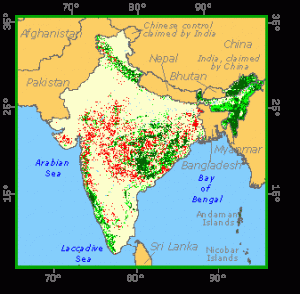
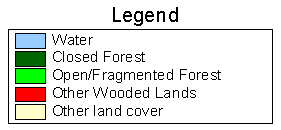
Forest Map
Coniferous
The coniferous forests in India are confined entirely to the Himalayan region and the parallel range of Siwalik and do not constitute more than 6% of the total forest area. The species within these forests are relatively few but form dense high forests.
Mixtures of different coniferous species, particularly Cedrus spp., Pinus wallichiana and Abies spp. are quite common. A small percentage of broadleaved species frequently occurs. Coniferous species are