Forest Resource
Overview
Laos PDR has comparatively rich forest cover relative to most other Asian countries. Deforestation and forest degradation are, however, significant problems for Laos. Mixed deciduous forest is easily the most predominant forest type. Smaller areas are covered by dry dipterocarp forest, dry evergreen forest and coniferous and mixed coniferous forests. The principal commercial species in Laotian forests are teak(Tectona grandis), rosewood (Dalbergia cochinchinensis and Terminalia spp.. Laos commenced a modest plantation programme in 1975. Around 20 National Biodiversity Conservation Areas have been legally established, covering about 10 percent of the country´s total area
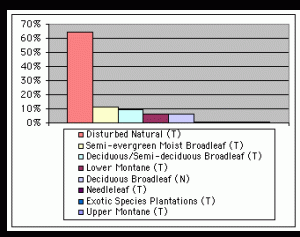
+140,543 ac Sclerophyllous Dry (N)
+24,947 ac Evergreen Needleleaf (N)
Geographic Description
Located in the centre of the Indochina peninsula, without direct access to the sea, the Lao People´s Democratic Republic covers a surface area of approximately 236 800 km2. It is bounded on the north by China and Vietnam, on the east by Vietnam, on the south by Cambodia, on the west by Thailand and on the north-west by Myanmar. Its long border with Thailand is largely formed by the course of Mekong River and the border with Viet Nam generally skirts the Annamite Range.
Excluding the alluvial plains of the valley of the Mekong and lower courses of its tributaries below 200 meters, the remainder of country (approximately 80 percent) is mountainous, and a little more half ranges between 1 000 and 2 000 m elevation.
Large, flat alluvial valleys extend along the rivers draining to the Mekong from the plain. Rugged plateaus lie between them with the larger mountains having elevations of 200 to 500 m. The Annamite Mountains spread to the south, paralleling the border of Vietnam and sometimes exceeding 2 500 m. They end in the southern extreme of the country in plateaus of 1 000 to 2 000 m elevation.
The whole country is drained to the east by Mekong (and its principal rivers such as the Nam Ngum), running toward Cambodia. The exception is the eastern area of northern Laos, the plateau of Nongkang in particular, that drains toward the gulf of Tonkin.
The topography creates quite distinct climates. The low areas are wet tropical while the higher areas above 1 000 meters have humid subtropical or humid montane climates. The area of the two climatic types is about equal in Laos. In the low areas, the average annual temperature ranges from 24° to 27° C. In the higher areas, the averages are appreciably less: 20° C and lower.
This distinction is not as clear with regard to precipitation. Often, there is plentiful rainfall at low altitude in proximity to the mountains (Boneng has 3 750 mm at 180 meters of altitude) and, conversely, there are mountainous areas with less precipitation (Sam Neua has 1 460 mm at 940 m of altitude). The dry season varies according to the area and its duration varies between 2 and 5 months (2 to 3 months in the area of Paksane, 4 to 5 months in the valley of the Mekong). The monsoon season generally lasts from May to September.
Forest Industry
Resources Forest cover Vegetation
Natural Woody Vegetation Description
Introduction
Rainfall is more than sufficient everywhere to maintain a moist closed forest. However, unfavourable edaphic conditions – such as rocky outcrops of various types (sandstone, limestone) or the presence of a hardened lateritic layer – prevent its development, thus giving rise to other woody formations. The following descriptions are drawn mainly from Vidal (1960), CIDA/USAID (1969), Nations Unies (1977) and FAO (1978).
Closed Forests
Broadleaved
Semi-deciduous moist closed forest
This type is found, for the most part, at altitudes of less than 1 000 m, especially in the western and southern parts of the country, which has a fairly wet, hot climate with a marked dry season. It is typically found on alluvial soils where the proportion of sand in the surface layer is high and the pH is between 5 and 6. There are usually four layers of vegetation. Very tall (35 to 45 m) Dipterocarpaceae (Dipterocarpus alatus, Anisoptera robusta) emerge at intervals above the main forest cover, which is composed of various species of Dipterocarpaceae (Hopea ferrea, Shorea spp., Vatica spp.), Leguminosae (Dalbergia, Dialium, and Ormosia spp.), Meliaceae (Aglaia and Walsura spp.), Sapindaceae (Schleichera spp.), Lagerstroemia spp., etc. Shrub layer is made up mostly of Annonaceae (Polyalthia and Uvaria spp.), Rubiaceae (Ixora and Rothmannia spp.), Euphorbiaceae (Alchornea, Mallotus, and Microdesmis spp.), palms (Calamus and Didymosperma spp.) and bamboos.
On red basaltic soils in the Pakse and Saravane regions, there is a forest similar to this semi-deciduous closed forest but without its key species, Dipterocarpus alatus, which is replaced by another common species of the Dipterocarpaceae family, Parashorea stellata.
On the western slopes of the Annamite Range below 1 000 m, closed forests of Dipterocarpus costatus and Hopea odorata with an undergrowth of palms (Rhapis spp.) belong to the same type of vegetation.
In the low-lying regions in the north of the country there are semi-deciduous moist closed forests on the slopes of limestone uplands or in alluvial areas. They are marked by the presence of Sapindaceae (Nephelium, Pometia, and Sapindus spp.), Annonaceae (Polyalthia spp.), and Meliaceae (Aphanamixis and Chukrasia spp.) with an undergrowth of palms (Arenga and Caryota spp.) and a grass cover. No Dipterocarpaceae are found here. The richness of the soils and their moisture-retaining capacity mean that areas occupied by this forest are under constant pressure from shifting cultivation or permanent rice cultivation.
Mixed deciduous forest
This type of forest is found on the margins of semi-deciduous forest, on the sandy hills bordering the Mekong between Vientiane and Paklay, and on the schisto-sandy alluvial soils of northern Laos. It is, on the whole, a semi-closed type of vegetation with three main layers: trees, shrubs and grasses. The most common species of tree are Pahudia cochinchinensis, Xylia kerrii, Bombax kerrii, Lagerstroemia balansae, Terminalia nigrovenulosa, and Pterocarpus macrocarpus, and Tectona grandis in the Paklay region. The presence of bamboos (Dendrocalamus and Cephalostachyum spp.) often makes the undergrowth luxuriant, but where these are absent, there is frequently a herbaceous layer of Imperata spp. Mixed deciduous forest is a formation of anthropogenic or edaphic origin. Fires very regularly affect these areas, and the constant erosion of the hills prevents the establishment of moist closed forest. On the best soils, there is frequent clearing for shifting cultivation.
In Laos, teak is found most abundantly in mixed deciduous forests on semi-compact, ochreous and usually gravelly soil formed from a schisto-sandy substratum. The trees are generally found in small clumps. Teak forests burn almost every year in the dry season in March to April. Teak has been intensively logged because of its high economic value.
Moist closed Fagaceae and Lauraceae forests
This type of forest is found at altitudes between 800 and 2 000 m. It is very different from the closed forest found at lower altitudes and is marked by the absence of emergent trees as well as the smaller average height of the trees in the dominant layer. The most common genera are Castanopsis, Lithocarpus, Pasania, Quercus, Cinnamomum, Litsea and Machilus. On clay-siliceous soil the general aspect is evergreen, despite a fairly high proportion of deciduous species in the tree layer (in the Xieng Khouang region). On red basaltic soil the rainforest aspect is more marked, emphasised by the tree ferns in the undergrowth and the many epiphytes (the Bolovens Plateau). In some places, there is a conifer, Podocarpus imbricatus, as well as the common broadleaved species. The presence of light-demanding species (Betula alnoides, Sapium discolor, Pithecolobium clypearia) indicates a certain state of degradation of the original forest, which suffers from clearance by fire throughout this region. Pure stands of Castanopsis spp. are found in some places on abandoned cropland.
Closed broadleaved forest with the presence of conifers
This type of forest is found in the Xieng Khouang region on spongy humus-rich soil above 2 000 m. A member of the Cupressaceae family, Fokienia hodginsii, is mixed with various broadleaved species such as Castanopsis, Manglietia and Elaeocarpus. The presence of rainforest vegetation (mosses, lichens, selaginellas) shows that there is practically no dry season.
Secondary formations
In the low-lying regions in the north of the country, small pure secondary stands of Macaranga denticulata, Broussonetia papyrifera or Melochia arborea are often found. These are probably merely transitional forms, as they seem to be fixed and never vary in aspect owing to their exploitation for firewood or charcoal. On the other hand, at altitudes of between 800 and 1 600 m in Sam Neua, Louang Prabang and Sayaboury Provinces, Styrax tonkinense (benzoin) forms pure secondary stands, on abandoned cropland. If there is no new clearing, these forests are gradually invaded by closed or open mountain forest species.
Coniferous
Conifers are found here and there in high regions, in small pure stands and closed formations on humus-rich soils, for example:
- Fokienia hodginsii, usually found mixed with broadleaved species (see the above description of closed broadleaved forest with the presence of conifers);
- Cunninghamia sinensis, a few old but small stands are found in the Sam Neua region; and
- Podocarpus imbricatus, which is also found mixed with broadleaved species on deep clay soils resulting from the decomposition of crystalline rocks.
Bamboo Palms
Stands of bamboo, some of them very extensive, are found between the lowlands of Vientiane and the Plain of Jars, in Saya Bouri Province, at Nam Lik and at Nam Ngum. These include bamboo forest made up of Cephalostachyum spp. clumps between 600 and 800 m and Arundinaria spp. forest, which grows in isolated stems at about 2 000 m. In the low-lying regions of the north, there are small pure stands of the Oxytenanthera genus. Bambusa tulda invades the gaps made by logging in closed forest. Dendrocalamus spp. is frequent in Vientiane Province.
Forest Map
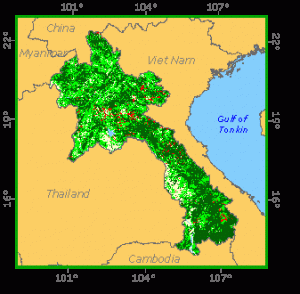
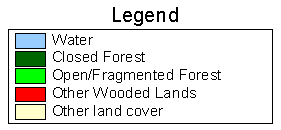
Open forests
Broadleaved
Open dipterocarp forest
This type of vegetation is frequent in the lowlands of the Mekong Valley and its tributaries upstream of Paklay, to the east of Savannakhet in particular, in regions with sandstone or laterite outcrops, and also sometimes on fairly deep soils. These formations may be edaphic in origin, formed under the influence of the soil or anthropogenic, resulting from the repeated burning of closed forests, although in most cases the two causes are combined. Generally speaking, open dipterocarp forest is made up of three main layers. In the stunted form (with an average height of under 15 m), the upper layer is typically Dipterocarpus tuberculatus and D. obtusifolius. The intermediate shrub layer is sometimes very dense due to the presence of small bamboos (Arundinaria spp.) which displace young members of the tree layer. Strychnos nux-blanda, Randia uliginosa and R. tomentosa are often found here. The lower layer is very rich in herbaceous and suffrutescent species, which form an continuous cover. Most of the woody species are deciduous. Fires are numerous at the height of the dry season each year. The structure of most of the trees (thick bark; buds that are scaly, sticky and hairy; glossy leaves) means that the fires do little damage to the woody cover, while most of the herbaceous layer escapes destruction due to its perennial underground parts. Since the vegetation remains open, there is much greater erosion than in closed forests. In some regions, there is a clear degradation of open forest into savanna as a result of fires and erosion. Teak is also found in open stands in the lowlands in the north of the country, but the trees are poor and stunted.
Open mountain forest
This type has the same origins as that in lower regions. The Castanopsis hystrix version seems to be a degraded form of the closed Fagaceae forest stabilised by repeated fires. Where the soil has a preponderant influence, the most common type of formation is open Quercus and Keteleeria forest, which can vary widely in aspect from fully-grown stands to stunted scrub. Quercus griffithii and Q. serrata are found in pure stands or mixed with Keteleeria roullettii, a conifer, and other broadleaved species (Engelhardtia and Schima spp.). The herbaceous cover is essentially made up of grasses. The shrubs in the undergrowth all have a twisted shape caused by fire. This formation can be seen as a pseudo-climax of edaphic – and to some extent anthropogenic – origin.
Savanna woodland
In the lowlands stretching to Ban Hin Khan, north of Thakhek, there is a savanna woodland made up mostly of Themeda spp., a tall species of the Graminaceae family growing in clumps, sometimes fairly spaced out, with some woody species such as Careya sphaerica or Lagerstroemia macrocarpa in certain places. Flooding in the rainy season and fires in the dry season work together to stabilise such formations.
In other cases, savanna woodland is the result of a degradation of open forest or mixed deciduous forest following logging and repeated fires. This leads, for example, to savanna made up of Thysanolaena maxima, a tall (2 to 3 m) species of the Graminaceae family, on the schisto-sandy clay crests bordering the Nam Pa Then Valley at Phon-Tiou north of Thakhek.
Coniferous
Although open stands of conifers are closely connected with mountain vegetation, some of them, such as Pinus merkusii, are also found in the lowlands and at altitudes up to 800 m, at which point it is replaced by P. khasya. Keteleeria roullettii is found both in pure stands and mixed with pines or Quercus spp. (see the above description of open mountain forest). Although these open formations are simply a transitory stage in the development of more closed formations, the recurrent devastation caused by humans and animals (burning and grazing) often keep them in this state. Repeated fires eventually lead to the still more degraded pseudo-steppe formation. This is very widespread in the Xieng Khouang region, and may be exclusively grassy as in the Plain of Jars, or scattered with small shrubby thickets or dotted with Pinus or Keteleeria trees.
Other wooded land
Shrubs
Climax or pseudo-climax scrub formations do not seem to exist, unless we count the mountain shrub savanna made up of a thick, continuous herbaceous layer broken by the emergence of ill-formed and widely spaced small trees or shrubs, such as Phyllantus spp., Schima spp., Helicia spp. and Callicarpa spp.
Clearing by fire, which completely destroys a section of forest in order to grow crops, is followed, when cultivation is abandoned, by the establishment of a secondary thicket. This is often herbaceous at the start and is made up of either a woody member of the Compositae family (Eupatorium odoratum) that quickly forms close thickets between 1 and 2 m high, wild bananas, or tall grasses. Creepers and fast-growing trees and shrubs gradually appear. In the lowlands, Trema spp., Mallotus spp., Ailanthus spp. and Anthocephalus spp. fairly soon dominate the underlying mass of Eupatorium, eventually choking it out when their cover is well developed. This leads to a type of forest made up of a small number of species. On the other hand, species of Croton, Alchornea, Macaranga, Celtis, Trema, Mussaenda and Rubus appear in mountain areas, producing mixed secondary thickets. One species will sometimes become dominant and form small pure or relatively unmixed stands.
References