Forest Resource
Overview
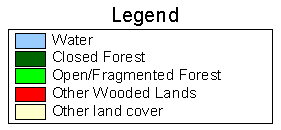
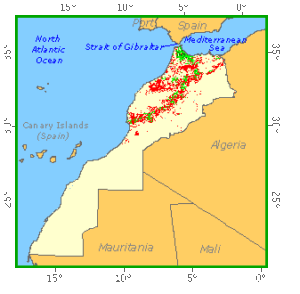
Morocco is lightly forested with around 9 percent forest cover and an additional 4 percent of other wooded land. The majority of the country´s closed forests occur in the Atlas mountains. These are montane and sub-montane mixed evergreen forests comprising mainly Pinus spp., Abies pinsapo and Juniperus spp., with areas of Quercus spp. and Cedrus atlantica.. Most of the country´s lowland forest has been cleared, with the most significant remnant being the cork oak (Quercus suber) Mamora forest. Much of the rest of the natural vegetation comprises palms and drought resistant scrub brush including species such as Argania spinosa and Acacia spp.. The south of the country extends into the Sahara desert. Morocco has established significant areas of plantation forest based on Eucalyptus and Pinus species. Morocco has a modest network of protected areas incorporating around 3 percent of the country´s forest area.
Forest Types
Geographic Description
The Kingdom of Morocco, located in north-western Africa, is bounded on the north by the Mediterranean Sea, on the east and south-east by Algeria, on the south by Western Sahara, and on the west by the Atlantic Ocean. The south-eastern boundary, in the Sahara, is not precisely defined. There are two Spanish exclaves, Ceuta and Melilla, on the Mediterranean coast. The area of Morocco is 446 550 km2.
A coastal plain borders the Mediterranean Sea and the Atlantic Ocean. The land gradually rises from the Atlantic coast and forms a plateau that extends to the mountains. Rich farmland in the Coastal Lowlands is irrigated by water from the region’s many shallow rivers.
The Atlas Mountain Chain extends across the middle of Morocco from south-west to north-east. The chain has three distinct ranges: The Anti Atlas in the south-west; the Grand Atlas, also called Haut Atlas, in the central area, and the Middle Atlas, or Moyen Atlas, in the north-east. The Rif, a group of mountains in the far north, are sometimes included in the Atlas chain. The highest mountain is Jebel Toubkal (4 165 m) in the Grand Atlas. The main rivers are the Moulouya and the Sebou.
The Sahara lies east and south of the Atlas Mountains. It is a barren region of sand dunes, rocks, stones, and scattered oases.
Along the Atlantic and Mediterranean coasts, Morocco has a subtropical climate moderated by coastal influence. Temperatures average 19° C in January in Rabat and 25° C in August. Toward the interior, winters are colder and summers warmer. At high altitudes temperatures of less than -18° C are not uncommon, and the mountain peaks are often covered with snow. Precipitation falls mainly during the winter months and is heaviest in the north-west and lighter to the east and south. The average annual precipitation is about 955 mm in Tangier, 430 mm in Casablanca, 280 mm in Essaouira and less than 102 mm in the Sahara.
Ecological Zones
Forest cover Vegetation
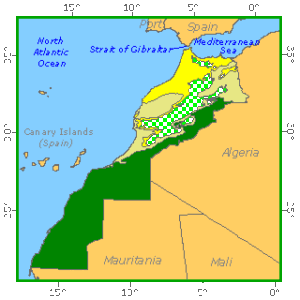
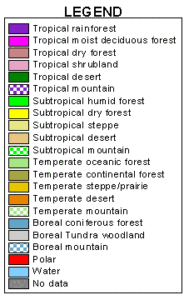
A Mediterranean country, the Kingdom of Morocco has wide variations in climate, relief and soil. It is divided in two by the Atlas mountain chains, thus experiencing ocean influences in the north and west, while the drying effects of the Sahara govern the south and east. The Mediterranean part of the country has a wide range of climates and subsoils, resulting in major variations in shallow soils, often marked by the presence of a calcareous crust and a very small proportion of organic matter. However, the commonest soils are chestnut-brown or red. The Atlas region contains a very wide range of landscapes, dominated by mountain chains separated by plateaux and basins. The Rif is a coastal chain along the Mediterranean coast, becoming plateaux and high plains in the east. South of the Rif lie low lands, then the Central Plateau (1 500-1 600 m). In the centre of the country are the mountainous zones of the Middle Atlas, High Atlas and Anti-Atlas. In contrast to this, the Saharan part of the country is almost flat over vast areas, with plateaux seldom over 500 m in altitude and depressions that give rise to desert. The desert regions south of the Anti-Atlas have soils that are for the most part fairly unevolved, shallow and pebble-covered, as well as fixed and unfixed dunes. More than three-quarters of Morocco is thus subject to very harsh climatic conditions: dry desert climates with low rainfall, violent and irregular rainfall, and wind erosion.
Morocco’s relief and climate have led to the development of a wide variety of forest formations, ranging from scattered Acacia stands in arid zones to conifer forests in humid mountain zones. This diversity in ecosystems means a corresponding floristic wealth, and over 4 200 species and subspecies have been recorded, about 800 of which are endemic.
The most common forest species are holm oak and Atlas cedar in mountain forests in humid and subhumid zones, whereas argan is the dominant species in the arid and semi-arid southwest Atlantic zones. Although other species (pine, thuja, juniper, cork oak and zeen oak, all of which are found in both pure and mixed stands) are found in the country, they do not cover areas as great as the above three. Other species (such as white poplar, tamarisk and pistachio in the Atlas, and thorny acacias along the edge of the Sahara) are found as isolated trees, typical features of the Moroccan landscape. Three broad forest groups can thus be distinguished:
the major formations in terms of area are found in subhumid and humid bioclimates (an annual rainfall of 600-1 800 mm), in other words chiefly in the mountains (the Atlas, Deddou and Rif ranges and the Central Plateau); the main species here is the holm oak (Quercus ilex), with scatterings of zeen oak (Q. faginea), Atlas cedar (Cedrus atlantica) and mountain juniper (Juniperus thurifera);
formations in semi-arid zones (an annual rainfall of 250-500 mm) cover smaller areas; found around the edges of the main mountain massifs, on the Atlantic plains and along the edge of the Mediterranean, they consist of argan (Argania spinosa), Phoenician juniper (Juniperus phoenicea), Aleppo pine (Pinus halepensis) and thuja (Tetraclinis articulata), depending on altitude;
formations in arid bioclimates (an annual rainfall of 100-250 mm) in the southern half of the country are mainly argan stands, alfa grass (Stipa tenacissima) and pre-Saharan shrub formations composed mainly of various acacia species and jujube (Ziziphus lotus) in combination with Pistacia atlantica, Withania frutescent and many herbaceous plants; Saharan formations are composed of scattered trees (mainly tamarisk and acacia).
Closed Forests Broadleaved
1. Oak forests
Predominantly holm oak (Quercus ilex) forests are by far the commonest formations in Morocco. Holm oak is the most versatile of all the oak species in terms of soil and climate, and is thus found in all the forested regions of the humid, subhumid and semi-arid zones between 400 and 2 000 m.
Holm oak will reach 15 m under optimum conditions either as high forest or when coppiced. It occurs both in pure stands and mixed with cork oak (Quercus suber), zeen oak (Q. faginea), maritime pine (Pinus pinaster) and Atlas cedar (Cedrus atlantica), the combination varying depending on climate. The flora associated with these forests is abundant and varied because the holm oak has such a wide and varied ecological area. Thus, in semi-arid zones it may be combined with thuja, Phoenician juniper and Aleppo pine; in subhumid zones it grows in low, closed formations, with no particular associations; and in humid zones the closed cover also contains such species as Montpellier maple (Acer monspessulanum) and yew (Taxus baccata) in the dominant storey, while the undergrowth contains many species (Crataegus monogyna, Cytisus battandieri, Rubus ulmifolius, etc.), as well as climbing plants and a well-developed herbaceous layer.
Predominantly cork oak (Quercus suber) forests straddle humid, subhumid and semi-arid bioclimates between 800 and 1 600-2 000 m. Although the cork oak does not tolerate calcareous, hydromorphic, clayey or overly compact soils, it covers large areas, especially in the Rif, the Middle Atlas and the Central Plateau.
This species is never taller than 15 m and usually occurs in almost pure stands, sometimes mixed with holm oak on the Central Plateau. However, there are many accompanying species, due to the wide ecological area of the species. The same combinations occur in semi-arid zones as in cork oak forests. In subhumid zones, it is found alongside zeen oak, while the shrub storey is made up of strawberry tree (Arbutus unedo) and tree heath (Erica arborea), and there is a bush storey of Cistus salvifolius, Cytisus monspeliensis, etc., and a very thin herbaceous layer. In humid zones, the rare cork oak stands have a closed cover, formed in association with Pyrenean oak (Quercus pyrenaica), holm oak and zeen oak, while the shrub storey is sparse and the herbaceous layer very thin.
Predominantly kermes oak (Quercus coccifera) forests are found only in the Rif. They are bushy and low (1-1.5 m in height). Kermes oak is indifferent as regards soil, but needs an annual rainfall of 450 to 1 000 mm.
Predominantly zeen oak (Quercus faginea) forests are usually pure and closed, and are found scattered in the Rif, the pre-Rif and the Middle Atlas, between sea-level and 1 800 m (subhumid and humid bioclimates). This species grows on all types of soil. Zeen oak stands are generally tall (up to 30 m), pure or dotted with holm or cork oak. The undergrowth is scanty and for the most part herbaceous.
Predominantly Pyrenean oak (Quercus pyrenaica) forests are similar to zeen oak forests and cover very small areas on the humid low- and medium-altitude mountains of the central and western Rif. The stands are either pure or mixed with zeen, holm or cork oak or pine.
Forests of secondary species are found in semi-arid climates on rich, heavy, clayey soils. Wild olive (Olea europea) is mixed with carob (Ceratonia siliqua), mastic (Pistacia lentiscus), phillyrea (Phillyrea angustifolia), dwarf palm, etc
Forest Industry
Coniferous
Atlas cedar (Cedrus atlantica) forests are found at high altitudes in humid and subhumid zones with cool winters. They are found on all types of soil in the Rif chain (above 1 300 m), the Middle Atlas plateau (between 1 500 and 2 300 m) and the High Atlas chain (between 1 500 and 2 700 m).
Atlas cedar can grow on various soils and is often mixed with other species as closed high forest. It can reach a height of 40 m in an optimum (i.e. humid) bioclimate. The floristic composition of Atlas cedar stands varies: at the lowest altitudes (1 600-1 700 m), it is associated with holm oak and, more rarely, Aleppo pine, zeen oak, prickly cedar, Phoenician juniper and mountain juniper. However, on richer soils and at higher altitudes (the Rif, Middle Atlas and eastern High Atlas) it is found in pure, very closed and generally old (200-300 year) stands.
Natural pine forests are not widespread, but are found in all the forested regions of Morocco.
Maritime pine (Pinus pinaster) is found as scattered stands between 1 200 and 2 000 m in humid and subhumid bioclimates (the Rif, High Atlas and Middle Atlas). It is often mixed with holm, cork and zeen oak, and, at higher altitudes, with Atlas cedar and Spanish fir. At lower altitudes it is found with holm oak.
Aleppo pine (Pinus halepensis) grows in the areas of the semi-arid zone with the highest annual rainfall (400-600 mm) and cool winters, at between 1 200 and 2 000 m. Although it covers only a relatively small area of the country, it is found especially on the northern slopes of the High Atlas as high forest of varying ages because of frequent fires. The floristic composition of these stands is often very mixed, although Aleppo pine is often associated with holm oak, thuja and Phoenician juniper. On steep slopes, these associations become open scrub of mastic, holm oak, prickly cedar (Juniperus oxycedrus), etc.
The usual undergrowth of pine forests is made up of mastic, rosemary, phillyrea, cistus, etc.
Predominantly Spanish fir (Abies pinsapo) forests are typical of the forested regions of the Rif and pre-Rif. Spanish fir is the sole fir species present in Morocco. It is very demanding in terms of water and is therefore found in the areas of the country with the highest rainfall. It occurs only at altitudes between 1 500 and 2 000 m. It can reach heights of 25 to 30 m and forms closed stands mixed with various other species (Cedrus atlantica, Quercus ilex, Acer campestre, Sorbus terminalis, etc.).
Forest Map
Open forests Broadleaved
Predominantly argan (Argania spinosa) forests are concentrated in the Atlantic southwest region at altitudes below 1 500 m, forming open forests in arid or semi-arid zones where annual rainfall is under 400 mm. The adaptability of the argan allows it to grow on all types of soil, so that it is found on the fragile soil of steep mountain slopes bordering the great plains of the south, and also around the edges of the large cultivated plains of the north.
This species never grows taller than 10 m, and it generally forms open stands when mature (termed “tree steppes” by some authors) or coppices after cutting. It is often associated with Ziziphus lotus, Acacia gummifera, Clematis cirrhosa, Pistacia lentiscus, etc., and its undergrowth is scanty.
Coniferous
Predominantly Phoenician juniper (Juniperus phoenicea) forests are found in the semi-arid zones of the ranges bordering the High Atlas and eastern Middle Atlas up to 2 000 m, and also on coastal dunes (Essaouira). This species is drought-resistant and grows on all types of soil.
These stands are usually low, broken forests, and Phoenician juniper is often associated with other species, such as Aleppo pine and holm oak, depending on geographical location; on the coast it is associated with Phillyrea angustifolia, Pistacia lentiscus, etc., as well as other non-woody plants; in the High Atlas and Middle Atlas there is no regular association; and on the slopes of the High Atlas and Anti-Atlas it grows in very dry, degraded places, along with such species as Fraxinus antholoides, Rhamnus oleides and Stipa tenacissima. The undergrowth tends to be very scanty, if not totally absent.
Other juniper species (mountain juniper and prickly cedar) are found only as scattered specimens without becoming proper communities in which they would be the predominant element.
Mountain juniper is a Moroccan high mountain tree species found in cool, semi-arid zones at altitudes of 1 800 to 3 150 m, marking the upper limit of forests, above Atlas cedar and holm oak. It suffers from severe degradation and is found in small, very open stands in the High Atlas. At higher altitudes it is accompanied by Alyssum spinosum, Bupleurum spinosum, etc., and at lower altitudes by Fraxinus xanthoxyloides, Ephedra major, etc.
Prickly cedar is a common shrub in Morocco, usually found in association with holm oak and Phoenician juniper.
Predominantly thuja (Tetraclinis articulata) forests are found in semi-arid regions subject to maritime influences below 1 400 m. Thuja thus occupies large areas of the Atlantic southwest, although it is also widespread on the Central Plateau and its edges, where it grows on the warmer slopes. It is indifferent to the nature of the soil.
Thuja stands take the form of very irregular coppices because of indiscriminate cutting and fires. Old mature stands are rare. The species forms a light cover and can grow to a height of 15 m. It almost never forms pure stands. The wide variety of ecological conditions leads to considerable floristic diversity in this type of forest, and thuja is thus found in association with a wide range of species, especially sun-loving ones such as Cistus villosus, Clematis cirrhosa and Quercus coccifera.
Other wooded land Shrubs
Shrubland (or matorral) is found on siliceous soils, combining such species as mountain juniper, red juniper, thuja, argan and secondary species. It reflects various stages of forest degradation, ranging in appearance from forest to simple ground cover. Thus, on siliceous soil the first stage in the degradation of an oak forest is shrubland of tree heath and strawberry tree, then cistus (Cistus spp.) and finally a ground cover of rock rose.
Garrigue, on calcareous soils, is made up of weak, low woody formations on bare or grass-covered ground. Its botanical composition varies, depending on local natural conditions and human pressure. The degraded form of oak forests on calcareous soil is thus garrigue of kermes oak or rosemary (Rosmarinus officinalis), changing to a ground cover of Brachypods as degradation becomes more advanced.
Maquis, on siliceous soil, is thicker and taller than garrigue, and contains a wide variety of shrub species.
Steppe formations of alfa (Stipa tenacissima), a perennial grass, or sagebrush (Artemisia herba alba) are in some cases a degraded form of pine forests which have lost their wooded character.
Thickets of holm oak in association with Juniperus oxycedrus, Rubus, etc., are the outcome of the degradation of Atlas cedar forests. At a more advanced stage of degradation, holm oak trees are scattered among a ground cover of fescue. Juniperus oxycedrus or Crataegus is also found. In high mountains, degraded Atlas cedar forests are replaced by thorn bushes.
Degradation of zeen and Pyrenean oak forests leads initially to open woodland with an abundant undergrowth, then to a bushy formation of secondary species, including some oaks, and lastly to a ground cover of Pteridae, Ampelodesmae and Asphodelae.
References Direction des Eaux et Forêts et de la conservation des sols (?). Xe Congrès forestier mondial. Rapport d´activité forestière.
Ministère de l´agriculture et de la mise en valeur agricole/SNC-Lavalin International Inc. (1996). Rapport final. Inventaire des ressources forestières du Maroc. 18 p. + annexes.
Seigue A. (1985). La forêt circumméditerranénne et ses problèmes. Techniques agricoles et méditerranéennes. G. P. Maisonneuve & Larose Ed. et A.C.C.T., Paris, France. 502 p.
GEM (1987). La grande encyclopédie du Maroc. Volumes I et II. Rabat, Maroc. 237 p. (volume I) et 239 p. (volume II).