Forest Resource
Overview
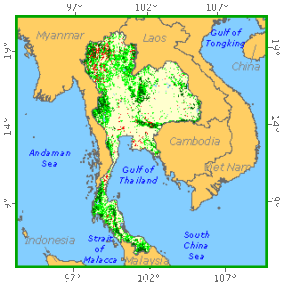
Thailand is moderately forested, although its forest cover has roughly halved since 1960. Thailand presently has slightly less than 30 percent forest cover. Most of the forests are restricted to relatively inaccessible mountainous areas. The main forest types are evergreen montane rain forest; mixed deciduous monsoon forest; and open dry dipterocarp and savannah forests. Dipterocarpus spp., Shorea spp., and Hopea spp. are among the most prevalent species. Teak (Tectona grandis) has generally been the most important timber species. Since 1989, Thailand has had a ban on all logging in natural forests, and has implemented a series of supporting measures to protect the remaining forests and to promote private sector involvement in forest management and plantations. Thailand presently has more than a half-million hectares of plantation forests. A network of parks and reserves encompasses more than 10 percent of the total land area.
Forest Types
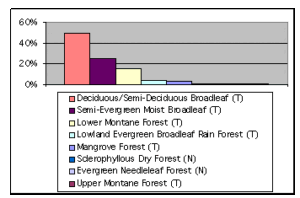 +118,807 ac Freshwater Swamp (T)
Geographic Description
The Kingdom of Thailand, located in south-east Asia, covers an area of 513 120 km2 between latitudes 5° 45´ and 20° 30´ N and longitudes 97° 30´ and 105° 45´ E. It is bounded by Myanmar on the north and west, by Laos on the north-east, by Cambodia and the Gulf of Thailand (Siam) on the south-east, by Malaysia on the south and by the Andaman Sea and Myanmar on the south-west.
The main geographic regions are:
- The Northern region consisting of a series of parallel and longitudinal fold mountains extending through peninsular Thailand into Malaysia. The average height of the peaks is 1 600 m with some above 2 000 m. Between these ridges lie relatively flat basins in which flow the four major tributaries of the Chao Phraya, Thailand´s main river-the Mae Ping, Mae Wang, Mae Yom and Mae Man. The alluvial soils of these basins are fertile. The region has a mild dry climate;
- The North-eastern region with the Khorat plateau is separated from the Central plateau by the Don Phraya mountains. The elevation of the plateau varies between 130 and 200 m. The mountains in the west are between 800 and 1 300 m and the southern edge of the plateau averages about 400 m with peaks up to 700 m.
The plateau gently slopes eastwards towards the Mekong River but fairly abruptly northward towards the Mae Nam Mun. Most of the plateau is sandstone, which is the parent material of the sandy soils. Some alluvial areas are scattered along the courses of the two major rivers, the Mae Nam Mun and Mae Nam Chi and their tributaries, and they constitute the major agricultural areas;
- The Central plain region is the largest and can be subdivided into three physiographic subregions:
– The south-eastern subregion is much dissected by southerly flowing rivers and flanked in the east by hills. The alluvial streams are utilised for rice cultivation, the higher and well-drained grounds for plantations and orchards;
– The northern rolling plains subregion where the northern rivers flow together into the Chao Phraya. This area is, in general, fertile;
– The Chao Phraya delta subregion is generally flat and usually flooded in the wet season. It is the largest and most fertile lowland area of the country, almost completely under cultivation except for the mangroves, and is composed of silt brought down by the rivers. Bangkok is situated in this delta;
- The Southern region is peninsular Thailand and is composed of mountains, in the west, up to 1 000 – 1 500 m, and flat land. Streams flow eastward toward the Gulf of Thailand and have often built up deltas suitable for wet rice cultivation.
Thailand has a monsoonal climate with a wet season (90 percent of the annual rainfall) from April to September during the south-western monsoon and a dry season from October to May with dry continental northerly winds.
During the dry season, Thailand is also influenced by the southern Asiatic cyclonic storm belt that brings irregular amounts of additional rain. Annual rainfall is highest in the southern and western parts of the peninsular region and in the south-eastern region (from 2 000 to more 3 000 mm). It is lowest (less than 1 000 mm) on the central plain that, in fact, lies in the rain shadow of the western mountains.
The north-eastern region has an average rainfall from just more than 1 000 mm in the west to more than 2 000 mm in the north-east. Temperature variations are small in the southern and south-eastern regions, around an average of 28° C. Temperatures in Bangkok vary between 16° C in December and 35° C in April. Winter temperature in the north can fall to approximately 10° C or lower.
Forest Industry
Resources Forest cover Vegetation
Natural Woody Vegetation Description
Introduction
Thailand has a variety of vegetation types ranging from tropical evergreen rainforest to dry deciduous forest and savanna forest that reflect a wide range of ecological and climatic conditions (Banijbatana, 1962 and 1968; de Backer. and Lopenshaw, 1972; Gartner and Beuschel, 1963; Neal,1967; Royal Forest Department,1962; Smitinand, and Pheng Khlai, 1971; Smitinand et al, 1980; and Whitmore 1975).
Closed Forests
Broadleaved
Evergreen and semi-evergreen forests
Tropical evergreen and semi-evergreen forests occur from sea level up to 1 000 m elevation where annual rainfall is at least 2 000 mm and fairly evenly distributed throughout the year. Drier types of evergreen forest are found in areas with a seasonally dry climate. Three subtypes can be distinguished in Thailand:
- Tropical lowland evergreen rainforests are found only in the far south of the peninsula where the seasonal variation in rainfall is smallest. They have three major tree layers and a sparse ground vegetation. The main tree stratum is very diverse and about 24 to 36 m high, with higher emergents and smaller shade-tolerant trees below. Dipterocarps dominate in the emergent stratum, especially the red meranti group (saya) of which Shorea curtisii is common but also Shorea leprosula, and Shorea parvifolia and the famous hardwood takhian chan (Balanocarpus heimii) and tin pet daeng (Dyera costulata). Bamboos are rare except the climbing species, but palms such as Eugeissona tristis and shade and moisture loving species of Areca, Iguanura, Nenga and Pinanga are common;
- Semi-evergreen rainforests are found in the remaining parts of the peninsula below 1 000 m and north up to about 11° N and in the extreme south-eastern part of Thailand. Huge emergent trees are rare and the whole canopy tends to be lower. Red merantis are absent but white merantis are abundant, especially Shorea hypochra and, on limestone, Shorea roxburghii. The legumes Intsia palembanica and Sindora spp. and the dipterocarps Anisoptera oblonga, Dipterocarpus kerii and Shorea guiso are also very characteristic. Other predominant species are yang (Dipterocarpus spp.), takhian (Hopea odorata) and other Hopea spp., khai khieo (Parashorea stellata), Artocarpus spp., mang tan (Schima wallichii), wa (Eugenia spp.), Syzygium spp. and Diospyros spp. In south-eastern Thailand, common species are yang, takhian, krabak (Anisoptera costata), ka pong (Tetrameles nudiflora), ta suea (Amoora spp.) sa thip (Phoebe spp.), Diospyros spp. and many others. In certain localities Dalbergia spp. occur. In the provinces of Chantaburi and Trat, khanun nok (Palaquium obovatum), rong (Garcinia hanburyi) and samrong (Sterculia lychnophora) occur with valuable gutta or fruits;
- The dominant form of evergreen forest in Thailand is the dry evergreen forest. It is found along the western parts of the Tenasserim Range from latitudes 11° to 16° N, along the western Phetchabun and Dong Phraya Ranges and on the southern edges (Dongrak Range) and in the north-east (Nong Khai) of the Khorat Plateau, in the south-east and in various places in northern Thailand but mainly east of Phrae and near the Laotian border. Dry evergreen forests typically occur with bamboo and scattered patches of deciduous forest and fire climax Imperata cylindrica grasslands, with shrubs of Eupatorium spp. Undergrowth is dense. In north-eastern Thailand, a few deciduous species occur that shed their leaves in the dry season. Areas formerly cropped are overgrown with thick bamboo and thorny shrubs. Typical tree species are Dipterocarpus spp., Hopea spp., Shorea spp., Intsia spp., Anisoptera spp., Dalbergia cochinchinensis, Cinnamomum spp. and Lagerstroemia spp. There is a dense lower storey composed of a variety of plants including ferns, climbers, palms and, in the open parts, clumps of bamboo. In northern Thailand this forest type mostly occurs in moist deeply cut gorges and is often replaced by mixed deciduous forests on the upper slopes. It also covers large areas in northern Chiang Mai Province. Typical trees species there are yang na (Dipterocarpus alatus), yang pai (Dipterocarpus costatus) and takhian. Other common species are krabak (Anisoptera spp.), yom hom (Toona ciliata), mahat (Artocarpus lakoocha), kra thon (Sandoricum koetjape) and, near streams, chomphu (Eugenia spp.) and dam dong (Diospyros spp.). The undergrowth consists of various palms such as rattans (Calamus spp.), Arenga saccharifera and bamboos such as mai bong yai (Dendrocalamus brandisii), mai hia (Cephalostachyum virgatum) and maj raj khruea (Dinochloa maclellandii). The forests of central Thailand have a more or less similar composition except that the main bamboo species is mai phai pa (Bambusa arundinacea). Yang na also tends to form more pure stands. In south-eastern and southern Thailand the dry evergreen forests generally resemble the semi-evergreen forests of these regions except for their generally poorer composition and smaller diameters. Yang na and other Dipterocarpus spp. form an important part of the forest.
Hill evergreen forests occur above 700 m in areas where rainfall exceeds 1 400 mm and is fairly evenly distributed throughout the year. They mainly occur in northern Thailand and on the western edge of the Khorat Plateau. Emergents are absent, so there are only two tree layers. The size of the trees decreases with altitude while epiphytes become more abundant. Dominant trees are oaks, (Quercus and Lithocarpus spp.) and chestnuts (Castanopsis spp.) while species of Dipterocarpus and Hopea are less common. Common species are thalo (Schima wallichii), kha hot (Engelhardtia spicata), kam yan (Styrax benzoides), champa (Michelia champaca) and others. Species of the Rosaceae, Ericaceae, Magnoliaceae and Lauraceae are well represented.
Fresh water swamp forests occur in central and southern Thailand, mostly in the peninsular region. They are two-storeyed. In central Thailand, the most common species are krabao (Hydnocarpus anthelminticus), chum saeng (Xanthophyllum glaucum), inthanin (Lagerstroemia speciosa), thon (Albizia procera), thong kwao (Butea monosperma) and many Nauclea and Barringtonia spp. In southern Thailand, common species are kan krao (Fagraea fragrans) and Cratoxylum arborescens in the upper storey. Within the second storey Elaeocarpus spp., thia (Alstonia spathulata), wa (Eugenia spp.), chicknam (Barringtonia acutangula), sok (Saraca sp.) and many rattan species are common. On waterlogged clayey soils near the coasts in eastern and southern Thailand, samet (Melaleuca leucadendron) forms almost pure stands along with some Carallia and Dillenia species. These forests are of great local importance for wood but are being drained and cleared, mainly for wet rice cultivation.
Mangrove forests occur on the muddy tidal flats at the river mouths and along the coast of southern and eastern Thailand. They cover large areas along the western peninsula coast and also along the eastern peninsula coast, in the Chao Phraya delta and along the south-eastern coast. They are two-storeyed, with an upper layer up to 20 m high. The most important mangrove tree growing in the upper storey is Rhizophora apiculata and, to a lesser extent, Rhizophora mucronata (both are locally named kongkang), ngon kai (Heritiera littoralis) and Xylocarpus moluccensis. Common species of the lower layer are thua khao (Bruguiera cylindrica), thua dam (Bruguiera parviflora), prasak nu (Bruguiera sexangula) and prong (Ceriops decandra and Ceriops tagal). Prasak (Bruguiera gymnorrhiza) is a common emergent of up to 40 m in height and 2 m in girth. Other species are ta bun khao (Carapa obovata), ta bun dam (Carapa moluccensis), samae (Avicennia officinalis and Avicennia marina), lam phu (Sonneratia caseolaris), lam phaen (Sonneratia griffithii), fat (Lumnitzera spp.), tatum (Excoecaria agallocha), tin pet (Cerbera spp.), ngon gai and lumpho thale (Intsia retusa). Inland, where mud has accumulated, dryer soils are overgrown with ferns and herbs and can give way to evergreen forest. On the edge of creeks the chak palm (Nypa fruticans) is common. A major part of the mangroves are under management for charcoal production. Species most used are Rhizophora apiculata, Rhizophora mucronata, Avicennia marina and Xylocarpus spp.
Beach forests develop on sandy beaches along the coast. The main species of this narrow forest belt are son thale (Casuarina equisetifolia), krathing (Calophyllum inophyllum), yi thale (Pongamia pinnata), hu kwang (Terminalia catappa) and pho thale (Hibiscus tiliaceus).
Deciduous forests
Mixed deciduous forests occur from the plains up to 1 000 m elevation where annual rainfall is between 1 250 and 2 000 mm with well pronounced dry and wet seasons. Fire plays an important role in these forests and often fire resistant tree species such as teak (Tectona grandis) dominate. During the dry season large areas of these forests are burnt. Because of the light canopy, undergrowth is dense, with many characteristic bamboo species. Three subtypes are distinguished which often occur in a complex mosaic pattern:
- Lower mixed deciduous forest on sandy loams and lateritic soils to 300 m elevation. The forest has three storeys. Teak is absent from the upper storey. This subtype occurs in the northeastern part of northern Thailand and south of the Phetchabun Range;
- Dry upper mixed deciduous forest on sandy loams or gravel soils above 300 m elevation. It extends over a large area along the Tenasserim mountains from 12° 30? N up to Mae Hong Song in the extreme north-west and through northern Thailand to the Laotian border. It has mainly deciduous trees and its ground layer is often destroyed by fire. Repeated depletion of these forests turns them into bamboo scrubland;
- Moist upper mixed deciduous forest on loamy calcareous or granitic soils, also above 300 m elevation, occurring in the northern tip of the country and on the eastern and northern edges of the Khorat Plateau. Evergreen trees are prominent. The undergrowth is well developed. Palms only occur locally. This type gradually merges into evergreen forests.
Teak, is the dominant tree in the mixed deciduous forests of northern Thailand, except in the lower type and occurs south as far as the Kanburi province. These forests are open, with teak trees isolated or in small groups. Sometimes, in suitable locations on alluvial soils, teak forms pure stands. Other common trees in these forests are pradu (Pterocarpus macrocarpus), daeng (Xylia kerrii), tabaek (Lagerstroemia calyculata), salao (