Forest Resource
Overview
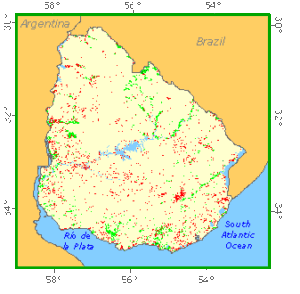
Uruguay is lightly forested with around 6 percent forest cover. The country is comprised principally of a large undulating plain rising to a low mountain range, the serrianas, in the eastern third of the country. The natural vegetation is primarily prairie grass though nearly 90 percent of the land is in some agricultural use. The country´s natural forests are predominantly low temperate scrubland forests, typified by the Bosque de Parque and the Bosque Serrano. Prosopis spp. are common in more open woodland. Palm-hardwood associations occur in the south-east and north central regions. Commercial species include urunday (Astronium fraxinifolium) and lapacho (Tabebuia serratifolia). Smaller areas of riverine and swamp forest and mixed coniferous forests also occur. Around 40 percent of Uruguay´s forest area is plantation forest. Eucalyptus (82%) and Pinus (17%) are the principal plantation genera. Uruguay has a small area of protected forest areas.
Forest Types
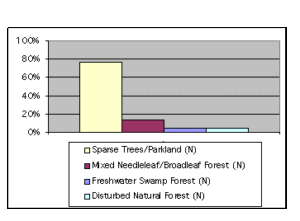 +4,940 ac Semi-Evergreen Moist Broadleaf (T)
Geographic Description
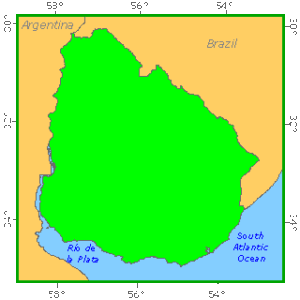
The Eastern Republic of Uruguay, located in east central South America, is bounded on the north by Brazil, on the east by Brazil and the Atlantic Ocean, on the south by the Atlantic Ocean and the Río de la Plata, and on the west by Argentina. The Uruguay River forms the entire western boundary. The country’s area is 177 410 km2.
Grassy, rolling coastal plains extend in a narrow arc along the Uruguay River, the Rio de la Plata, and the Atlantic Ocean. They cover about a fifth of the country. The rest of the country is mostly low plains and hills. In the north and north-west is a low plateau, the Cuchilla de Haedo, while in the east are highlands called the Cuchilla Grande (Big Knife) because knifelike formations of rock jut through the soil on many of the ridges. They contain the highest point in Uruguay, Mirador Nacional, also called Cerro de las Animas, at 501 m.
Uruguay has a mild, humid temperate climate. The average temperature for the warmest month, January, is 23° C, and for the coldest month, July, 11° C. Rainfall is well distributed and averages about 890 mm a year.
Ecological Zones
Forest Industry