
Forest Resource
Overview
The islands of Vanuatu generally consist of a narrow coastal plain rising through broken foothills to a steep mountainous interior. Forest lands cover almost 80 percent of the total land area, and consist of dense tropical rainforests and exotic plantation forests. Much of the natural forest is on steep inaccessible sites and the limited accessible sites contain few species of commercial use. In the island interiors much of the natural forest has primarily a protective role. Some of these forests have been degraded by conversion to grazing and in places by burning. In some areas erosion and soil degradation are significant problems. Vanuatu has operated two plantation development programmes over the past 25 years and has established small areas of Cordia alliodora and Pinus caribaea plantations.
Geographic Description
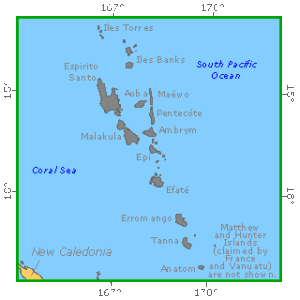
The Republic of Vanuatu is located in the south western Pacific Ocean about 5 600 km south west of Hawaii and about 2 400 km north east of Australia. The country consists of 83 islands and islets with a total land area of about 12,190 km2, extending about 800 km from north to south and about 200 km from east to west. The country’s largest islands are, in order of size, Espiritu Santo, Malakula, Efate, Erromango, and Tanna.
Most of Vanuatu’s islands are of volcanic origin and several are still active, including Mount Yasur on the island of Tanna. The highest peak, Mount Tabwemasana on Espiritu Santo, rises to an elevation of 1 879 m. Most of the islands have narrow coastal plains fringed by coral reefs.
Vanuatu has a tropical, humid oceanic climate, somewhat moderated by trade winds between May and October. Temperatures in the northern islands average about 27° C year around with an annual rainfall of about 3 000 mm. Temperatures in the southern islands range from about 19 to 31° C with a yearly rainfall of about 2 300 mm. There are occasional cyclones.
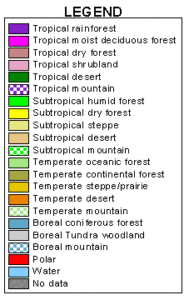
Ecological Zones
Forest Industry
Resources Forest cover Vegetation
Natural Woody Vegetation Description
Introduction
An eastern Melanesian archipelago of more than 80 islands as large as 3 900 km2 (Espiritu Santo) and as high as 1 879 m (also Espiritu Santo), the woody vegetation of Vanuatu includes lowland rain forest, montane cloud forest, seasonal rainshadow forest, mangrove forest, littoral forest and secondary forest. After Espiritu Santo, the largest islands are Malakula (2 000 km2), Erromango (1 000 km2), Efate (900 km2) and Ambrym (665 km2). Anatom (150 km2) is the southernmost island in the group. The following description of vegetation types is derived from Corner et al. (1975) and Mueller-Dombois and Fosberg (1998).
Closed Forests
Broadleaved
Littoral Forest
Forests of Casuarina equisetifolia and Pandanus spp. are common, as are assemblages with Barringtonia asiatica, Hernandia spp., Terminalia catappa, and Thespesia populnea. Locally common are Acacia simplex and Vitex negundo. Seaward is a shrub zone of Scaevola taccada and Tournefortia argentea. This coastal formation is less common now because of conversion to human habitation and coconut plantations.
Lowland Rain Forest
This type of forest is the natural plant cover up to 500 to 600 m elevation on the windward (south-eastern) sides of the islands above the coastal zone. A number of subtypes can be recognized; the first four are found in the older northern islands, while the fifth is restricted to the southern islands.
- Medium-Stature Forests Heavily Covered With Lianas: Characteristic trees in this subtype include Castanospermum australe, Dendrocnide spp., Ficus spp., Kleinhovia hospita, and the deciduous Antiaris toxicaria, Garuga floribunda and Pterocarpus indicus. It is similar to the Semideciduous Transition Forest (described under Seasonal Forest) except for the prevalence of lianas such as Calamus, Flagellaria, Ipomoea, Merremia and Mikania, which suggest past disturbance. On poorly drained soils, Myristica fatua and Dendrocnide spp. can dominate and, on sites disturbed by man, thickets of Hibiscus tiliaceus are encountered.
- High-Stature Forest on Old Volcanic Ash: This subtype is characterized by large-crowned trees over 30 m in height growing on hills from 300 to 600 m elevation on soils enriched by recent volcanic ash. Best seen in the interior and western mountains of Malakula and Espiritu Santo, it is structurally similar to the widespread lowland rain forests in the Solomons but with fewer species. This subtype includes no unique species to distinguish it, and contains many of the species listed under the other subtypes.
- Complex Forest Scrub Densely Covered With Lianas: The most widely distributed lowland forest type on the larger northern islands, this heterogeneous assemblage appears to be in various secondary successional stages toward pre-existing rain forest cover following hurricane disturbances. It often exists as forest islands rather than as continuous stretches of vegetation. The main canopy trees are Gyrocarpus americanus, Intsia bijuga and Kleinhovia hospita, with a subcanopy of Diospyros acris, Garcinia pancheri, Myristica fatua, Syzygium spp., Terminalia spp., Polyscias spp., and palms of the genus Vietchia. Merremia spp. and Mucuna spp. are the dominant lianas.
- Alluvial Forest: Found along lowland river courses in Espiritu Santo and Efate, this wet, periodically inundated subtype includes thickets of Hibiscus tiliaceus in addition to tree species typically found in lowland forests in Vanuatu.
- Mixed-Species Forest: A subtype from the southern islands of Vanuatu, this heterogeneous lowland- to mid-elevation rain forest occupies fertile soils and has thus been more modified by human activity. It is not as species-rich as the Agathis/Calophyllum Forest described below. One form features Antiaris toxicaria, Ficus spp., and Kleinhovia hospita on calcareous plateaux. Another, found on sedimentary clay soils in valleys, is dominated by species of Aleurites, Bischofia javanica, Dracontomelon, Pometia, Pterocarpus and Terminalia. On fertile soils fortified by recent volcanic ash, Acacia, Metrosideros, Schefflera, Semecarpus, Serianthes, and Syzygium species dominate. On calcareous outcrops, species of Cryptocarya., Ficus and Neonauclea are common.
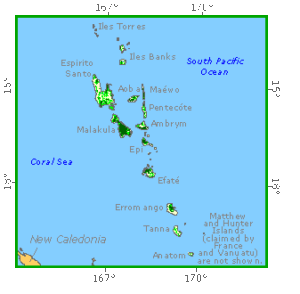
Forest Map
Montane Microphyllous/Cloud Forest
On the high islands of Vanuatu, montane rain forest begins at about 500 m elevation and grades rapidly into stunted, mossy cloud forest at the summits. On the high island of Espiritu Santo (1 879 m elevation), microphyllous forest extends up to 1 000 m, characterized by matrices of trees of the genera Ascarina, Geissois, Metrosideros, Quintinia, Syzygium and Weinmannia, along with scattered individuals of the gymnosperm genera Agathis and Podocarpus. In the cloud forest, the gymnosperms are absent, and Freycinetia spp. are locally common.
Seasonal Forest and Scrub
These formations are caused by a distinct rainshadow effect on the north-west side of most islands. Three variants are recognized.
- Semi-deciduous Transition Forest: Transitional between dry and rain forest, this assemblage is dominated by Castanospermum australe and Kleinhovia hospita, along with Gyrocarpus americanus, Intsia bijuga, and Pterocarpus indicus. This forest type is common in north-west and central Malakula and throughout north-east-central Espiritu Santo, often on calcareous substrates covered with volcanic ash and enriched with organic matter. The shrub layer is well developed and includes Clerodendrum buchananii, Micromelum spp., Murraya spp., Pseuderanthemum spp. and Psychotria spp.
- Acacia spirorbis Forest: Locally called gaiac forest, this widely distributed, somewhat open forest is dominated by spreading, 8 to 15 m tall trees of Acacia spirorbis. The understory includes the shrubs of Croton, Symplocos and Xylosma species, and Santalum spp. are occasional in this forest type, on Erromango and Anatom. Psidium guajava is an introduced invader, and thickets of Leucaena leucocephala can be found in larger canopy openings.
- Leucaena Thickets: In the driest habitats on the west and north-west sides of the islands, Acacia spirorbis is displaced by mono-dominant thickets of Leucaena leucocephala, often occupying a zone inland of the strand zone. On disturbed sites where fire has been absent for some time, the assemblages may include the trees Acacia spirorbis, Leucaena leucocephala and Psidium guajava, and the introduced shrubs Acacia farnesiana and Lantana camara.
Mangrove Forest
This formation is only found on some of the islands in localized areas in sheltered coasts. Tree genera include Avicennia, Ceriops, Rhizophora, Sonneratia and Xylocarpus.
Secondary Forest
Secondary forests develop in response to disturbances such as shifting cultivation or hurricane damage. This common forest type has already been touched on in descriptions of the lowland rain forest and seasonal forest, which are dominated by secondary forest species such as Antiaris toxicaria, Castanospermum australe and Kleinhovia hospita. Primary local uses of these forests are as tree gardens and bush fallow
Mixed
Agathis/Calophyllum Forest
This subtype of Lowland Rain Forest is restricted to the southern islands of Erromango and Anatom and features a canopy of kauri (Agathis obtusa), along with Calophyllum neo-ebudicum, Dacrycarpus imbricatus, Elaeocarpus spp., Hernandia cordigera, Metrosideros spp., Palaquium spp., Serianthes spp. and Syzygium spp. The canopy is 20 to 30 m high, with Agathis obtusa emergents up to 35 m tall. Calophyllum neo-ebudicum is the most common canopy associate in Erromango, while Hernandia cordigera fills the role on Anatom. This forest ranges from 100 to 500 m elevation on older, more acidic volcanic soils with 2 000 mm or more annual rainfall, and adjoins montane rain forest at its upper range; it does not inhabit raised coral limestone terraces. A wide range of genera are present in the subcanopy, and there is a rich ground layer of ferns, as well as many epiphytic ferns and orchids.
Bamboo Palms
Palms of the genus Clinostigma dominate the summit of the island of Ambrym and are a component of the summit vegetation of both Erromango and Anatom.
Open forests
Broadleaved
Floodplain Forests
This subtype is a form of Alluvial Forest with trees that are scattered or occurring as groves in a matrix of Imperata cylindrica or Miscanthus floridulus grassland.
Other wooded land
Shrubs
Montane Scrub
Some of the montane summits are dominated by a treeless scrub that includes shrubs of the genera Eurya, Gaultheria, Pipturus and Vaccinium, the large-leaved herb Gunnera spp., tree ferns Cyathea spp. and Dicksonia spp. and a variety of other ferns.
References
Corner, E. J. H., F. R. S. Lee and K. E. Lee (co-ord.) (1975). A discussion on the results of the 1971 Royal Society – Percy Sladen Expedition to the New Hebrides. Philos. Trans. Royal Soc. (London), B, 272: 267-486.
Mueller-Dombois, D. and F. R. Fosberg (1998). Vegetation of the tropical Pacific islands. Springer-Verlag, New York. 733 pp