
Forest Resource
Overview
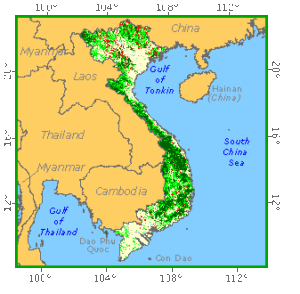
Vietnam is a moderately forested country with more than 25 percent forest cover. Vietnam has almost 20 million hectares classified as forest land. Slightly less than half of this, however, is forested area. The remainder is denuded hillsides and barren lands. Viet Nam´s forests comprise temperate and sub-tropical pine dominant forests (Pinus merkusii, P. kesiya); mixed conifer-broadleaved forests (Podocarpus spp.); dry dipterocarp types (Lagerstroemia spp., Pterocarpus spp.) in upland zones; moist lowland dipterocarp forests (Dipterocarpus spp., Anisoptera spp.); and mangroves. The most densely forested areas are the Western High Plateau, the north central region, and the coastal south central region. Viet Nam has more than a million hectares of mainly immature plantations. Viet Nam has more than 10,000 km2 of land in more than 50 protected areas
Forest Types
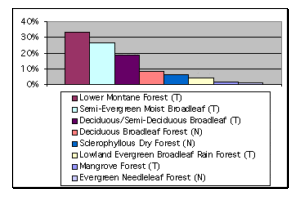 +23,218 ac Freshwater Swamp Forest (T)
Geographic Description
The Socialist Republic of Vietnam, located on the eastern coast of the Indochinese Peninsula, covers a surface area of 331 690 km2 from latitude 9° to 23° N and longitude 102° to 110° E. It is bordered on the north by China, on the west by Laos and Cambodia and on the south and east by the South China Sea.
The country can be represented in a schematic way in the form of two plains, the delta of the Songkoi (Red) River in north and the delta of Mekong River in the south, connected by mountainous ridges between and the coastal plains of Annam:
- The Songkoi, as does the Mekong, has its source in south-west China. The whole of its area and that of its rivers of less importance covers an area of 1 500 000 hectares. The area of the delta is prone to frequent flooding.
- The Mekong delta covers 3 700 000 hectares and is formed by five branches of the Mekong and three secondary rivers, the Long Vam Co, the Song Sai Gon, and the Song Dong Nai. This plain is very fertile and mostly cultivated. The sediment deposited by the Mekong is so significant that the size of the delta increases by up to 80 meters per year. The low-lying areas on the coast and inland are covered with mangroves.
- The Annam Mountains constitute the southern spur of the mountains of central China and Tibet. The northern part in Viet Nam is narrow and very rugged. That part in the south constitutes the central plateau with mountains reaching 2 500 m.
The northern mountains border China and at their highest exceed 3 000 m (Fan Si Pan, 3 143 m). Mountainous spurs that are topped by rocky outcrops break the narrow coastal plain between the two deltas. It has an average width of 16 km but widens, toward the south, to the vast plain of the Mekong.
Most of Viet Nam enjoys a tropical monsoonal climate. At Hue, which is practically in the middle of the country, the monthly average temperature varies between 20° C in January and 30° C in August, with an annual rainfall of 2 600 mm of which 1 650 mm occurs during the wet season of September through November.
The climate is generally hot and humid. In central and southern Vietnam, seasonal variations are slight. The average daily temperatures in the Mekong Delta range from 17° to 34° C in January and from 22° to 33° C in July. Along the central coast, temperatures range from 18° to 28° C in January and from 24° to 37° C in July.
The Songkoi delta is subject to cold north winds during the monsoon and has a cold season from December to March with temperatures of about 17° C in January and February. The average annual rainfall is about 1 680 mm in the Red River Delta, 1 650 mm along the central coast, and 1 980 mm in the Mekong Delta. Much of the rainfall occurs during the summer monsoon season. The central coast is subject to periodic typhoons.
Forest Industry
mia genus and represent a transition between closed evergreen forests and open forests. Lagerstroemia angustifolia – but also L. macrocarpa, L. floribunda, L. duperreana and L. thorelii – predominate, with Xylia dolabriformis, Sindora cochinchinensis and Vitex pubescens. Bamboos, particularly Oxytenanthera spp., often predominate in the undergrowth. This type of forest is very sensitive to clearing, as can be seen from the open-forest species. A pure combination of Terminalia tomentosa and Xylia dolabriformis is often found in valley bottoms.
- Moist deciduous forests and semi-deciduous lowland forests are found in combination in northern Viet Nam. Dipterocarpaceae, Leguminosae, Meliaceae and Sapindaceae predominate in the tree layer of the semi-deciduous forests. Two types of moist deciduous forest can be distinguished – one in higher areas, in which bamboos predominate, the other in lower areas. The families best represented are Leguminosae, Verbenaceae and Combretaceae. After clearing, shrub vegetation develops, with either Eupatorium spp. or Saccharum arundinaceum. Repeated fires lead to the development of open forest.Coniferous
Conifers are a major component of mountain forests. Various species are found in many forests but do not make up pure stands, apart from Dacrydium pierrei and Fokienia hodginsii. Two species of conifer, Pinus krempfii and Glyptostrobus spp., are endemic to Viet Nam, the latter being a small tree found in marshy areas.
The most widespread species of pine are Pinus merkusii and P. khasya, which make up large stands in the north near the frontier with Laos and in the southern provinces of Tuyen Duc and Lam Dong. Another stand is reported in the northern part of Kontum Province. A single block of about 100 000 ha, made up for the most part of Pinus khasya, covers the Langbian Mountains between 1 100 and 1 700 m. P. griffithii is reported in the mountains of the Hué region. In open forests, P. merkusii is often mixed with Dipterocarpus obtusifolius
Forest Map
Bamboo Palms
Bamboos are the natural undergrowth in deciduous forests. They invade abandoned cropland on rich basaltic soils and schistose slopes. In closed forest areas, the most common species are Bambusa arundinacea and Oxytenanthera spp., while only the latter is found in “semi-closed” forests. In mixed dry open forests, Arundinaria falcata is found in pure stands between 1 and 2 m tall, which are burnt off during the dry season. Other bamboo species found in Viet Nam are Sinocalamus latiflorus, Dendrocalamus hamiltonii, Phyllostachys spp., Schizostachyum funghomi and Arundinaria amabilis.
Open forest
Broadleaved
Typical open dipterocarp forests are confined to a sub-moist warm climate with a dry season of 5 to 6 months and annual rainfall between 1 000 and 1 500 mm. These climatic conditions are particularly favourable to the outbreak of fires and rapid soil degradation. Certain forests of this type seem to have become stabilised on skeletal soils of schistose origin (with Pentacme siamensis and Terminalia tomentosa). In Viet Nam, open forests are generally found above 500 m, although they also exist in the south-eastern lowlands. Rollet (1953) distinguishes the following types:
- Pure or almost pure stands of Pentacme siamensis on rocky or skeletal soils are very open and wholly deciduous, with a thorny ground vegetation;
- Pure or almost pure open stands of Dipterocarpus obtusifolius are probably the remains of old closed forests on sandy soils. Irvingia and Parinari are sometimes present. The shrub layer is sparse, but grass cover is unbroken. Shorea obtusa, S. talura and Pentacme siamensis gradually make their appearance;
- The most degraded type of open forest, on white sandy soils, is made up of stands of Dipterocarpus intricatus accompanied by shrubs such as Randia tomentosa and Buchanania reticulata that dominate a herbaceous layer. If there are no fires, these combinations develop into richer stands. Acacia intsii, Memecylon edule, Ochrocarpus spp., Eugenia brachiata, Capparis beneolens, Melanorrhea laccifera and Irvingia oliveri are also found in this type of vegetation. Open stands of Dipterocarpus intricatus or D. obtusifolius are also sometimes found;
- Dry mixed formations are the most common type, and are generally found on slightly loamy soils with a thick laterite layer, so that it is hard for water to penetrate in the rainy season. The species in the dominant storey are Dipterocarpus tuberculatus, Shorea obtusa and Terminalia tomentosa, as well as Cratoxylon formosum, Terminalia mucronata, T. chebula, Careya sphaerica, Adina sessilifolia, Vitex pubescens, Shorea talura, Diospyros spp., Canarium subalatum and Phyllanthus emblica. If there are no fires, a dry closed forest develops, particularly in inhabited regions, with Shorea obtusa, S. talura, Dipterocarpus intricatus and Cratoxylon spp. as frequent species. In over-logged forests or drier areas, many thorny shrubs such as Ziziphus cambodianus, Gardenia spp., Randia tomentosa, Acacia intsii, Combretum quadrangulare, Feroniella spp. and Terminalia mucronata appear.
Other wooded land
Shrubs
Savanna. After the clearance of forests growing on red basaltic soils, an open scrub vegetation develops, composed mainly of Careya sphaerica accompanied by Phyllanthus emblica, Albizia procera, Grewia elatostemoides, Bauhinia spp., Pinus spp., Canarium spp., Dillenia spp., Wrightia annamensis, Symplocos racemosa and Hymenodictyon excelsum. On very degraded soils the predominant species are Rhus spp., Careya sphaerica, Aporosa spp. and Wendlandia glabrata.
On sandy and shallow soils, particularly sandstone hill-tops, secondary vegetation is scrub, with such species as Rhodamnia trinerva, Vaccinium, <foica” size=”-1″>*Semi-closed” forests are dominated by various species of the LagerstroeNT FACE=”Arial, Helvetica” SIZE=-1>Cinnamomum, Eugenia spp. and Melastoma spp. On dry and sandy degraded soils, scrub vegetation becomes thorny, with such species as Acacia intsii, Gardenia spp., Capparis beneolens and Ziziphus cambodianus. It often takes many years for forest to recolonise abandoned cropland.</foica”>
Steppes occur in southern Viet Nam, particularly in the Pleiku and Dalat regions and around the 17th Parallel on red basaltic soils between the altitudes of 500 and 1 000 m. The shrubs grow to heights of 4 to 5 m, and are mainly Grewia paniculata, Aporosa spp., Eugenia spp., Careya sphaerica, Phyllanthus emblica, Engelhardtia spp., Wendlandia spp.and Melastoma spp.
References
Champsoloix (1955). La forêts des pays montagnards du sud Viet Nam et ses produits. Bois et Forêts des Tropiques No. 40, Nogent-sur-Marne, France.
Rollet, B. (1952). Les forêts claires du Sud-Indochinois, Cambodge, Sud-Laos, Sud Viet Nam. Centre de Recherches Scientifiques et Techniques du Cambodge, du Laos et du Viet Nam. Direction des recherches forestières.
Rollet, B. (1953). Note sur les forêts claires du sud de l´Indochine. Boise et Forêts des Tropiques No. 31, Nogent-sur-Marne, France.
Rollet, B. (?). Note sue la végétation du Viet Nam au sud du 17 ème parallèlle Nord. Mimeo.
Rothé, P. L. (1947). Forêt d´Indochine. Bois et Forêts des Tropiques Nos. 1-3, Nogent-sur-Marne, France
Thai Van Trung (1970). La végétation forestière do Viet Nam (en Vietnamien). Hanoi.